


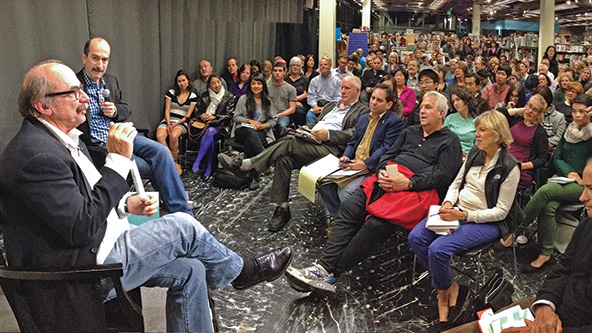
 IIDEO partners and
brothers David and Tom
Kelley (left) lead a book
event at Kepler’s Books. (Photo courtesy of Kepler’s Books)
IIDEO partners and
brothers David and Tom
Kelley (left) lead a book
event at Kepler’s Books. (Photo courtesy of Kepler’s Books)
The past couple of decades have been a roller coaster for the book industry, beginning with the rise of superstores like Borders and Waldenbooks that swept the retail landscape in the late 1980s and early ’90s. For many readers, independent bookstores were welcome holdouts, notably for their personalized services and local events. By the mid-1990s, however, another formidable competitor emerged: online booksellers. Amazon now sells approximately 50 percent of all print books in the United States, and e-books comprise 11 percent of all books sold.
Despite this tumult, indie bookstores have proven to be resilient, while most superstore behemoths have since shuttered. Incredibly, a critical mass of indie bookstore owners found the challenges of thinning margins and online purchasing not insurmountable, and their efforts, scattered as they were, kept the sector alive. In fact, indies have increased in number—from approximately 1,650 in 2009 to 2,500 in 2022, according to Publishers Weekly.
A diverse swath of people in the industry, from booksellers to writers to publishers, are invested in the continued growth of indies as cultural community centers. A small group of advocates acted on their commitment to the indies and convened a two-day digital conference in October 2021 called Reimagining Bookstores. This event, with the expertise of Future Search Network cofounder Sandra Janoff, helped to coalesce the movement’s vision and stakeholders. The organizers anticipated 200 participants—however, more than 600 registered and 350 attended.
“Reimagining Bookstores is a movement for strengthening communities, deepening literacy, and paying living wages,” says Praveen Madan, conference co-convener and CEO of Kepler’s Books in Menlo Park, California.
The conference brought together attendees in an open-space digital format where participants suggested several topics and met in breakout groups for discussion. Some groups have even continued to meet regularly via Zoom. “Meeting with bookstore owners from the conference each month to discuss marketing best practices has been a big benefit,” says Brad Jones, co-owner of BookSmart. “Gaining knowledge from owners of bookstore co-ops, a structure that we’re considering, has helped us think about our future.”
Like most social movements, Reimagining Bookstores has a fluid organizational structure. “For now, we’re keeping Reimagining Bookstores decentralized, with nodes of activity,” co-convener, writer, and editor Paul Wright explains. “We’re still absorbing what it means to be a movement, in terms of structure and as a dynamic system with many moving parts.”
Funding for projects is flowing from diverse sources. The philanthropic arm of the Emerson Collective is currently working with a portfolio of 12 indie bookstores—the first step of its three-part bookstore agenda—which will expand to 24 in 2023. Selected bookstores represent three types of stores: those in book-desert locations, underrepresented booksellers, and innovative models. These indies will receive a multiyear grant and capacity-building services, plus access to online group mentoring sessions. And bookstore advocate and impact investor John Valpey is providing financial and operational advice pro bono and offers reduced- and no-interest loans with flexible terms to seven indie bookstores located in the New England region.
Bookstore advocates like Valpey are offering their time and expertise for new initiatives. For example, the Community Conversation project promotes civic discourse and strengthens community through a dialogue among participants. Co-convener and author Peggy Holman led an event on how to bridge the partisan divide with journalist Mónica Guzmán and 150 people.
New initiatives are in development for 2023, including Beyond Books, a community storytelling project that aims to effect positive social change. Beyond Books was inspired by three individuals—a publisher, an author/publisher, and a bookstore owner—who met at the conference. And, still in the design phase, a group of 10 to 15 indie bookstores will launch a series of events, displays, and other experiences around socially relevant themes tailored to their respective communities. In addition, two workshops are planned for this year on how to pay living wages to indie-bookstore employees.
“We are supporting bookstores with new ways to engage their communities, access funding, and adopt new business models,” Madan says. He emphasized, however, that independent bookstores “need [to have] a broader vision and not just be a channel for publishers.”
New initiatives will continue to emerge organically, as well as from a future centralized hub through which individual bookstores will manage their own participation. And, given the success of the conference, a second one is planned for 2023.
“Movements start when a disturbance is named in a way that touches a chord,” Holman observes, because when “people are drawn together by meaning, intention, purpose … along the way, they find kindred spirits.”
Read more stories by Kathy O. Brozek.