


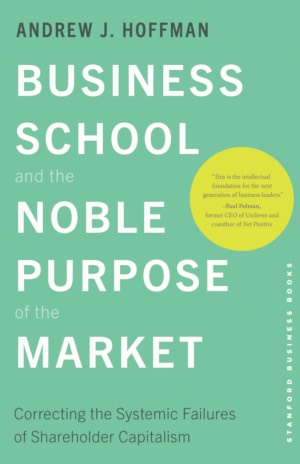
Business School and the Noble Purpose of the Market: Correcting the Systemic Failures of Shareholder Capitalism
Andrew J. Hoffman
360, Stanford University Press, 2025
Business schools, the academic bastions of capitalism, are crucial platforms for addressing today’s most important issues, from environmental sustainability to inequality. Yet for the past four decades, as I have witnessed as a business school professor, their curricula have been dominated by neoclassical economics and its fixation on efficiency, profit maximization, and shareholder value. The lure of short-termism and the simplicity of quarterly earnings growth and stock price as the prime objectives of business have drowned out other critical and more nuanced views that should be taught in the classroom: the legal perspective, which clarifies that shareholders are not principals and that business leaders are not legally required to maximize profit; the organizational perspective, which holds that companies are human-centered organizations where shared purpose, culture, and values matter; and the environmental perspective, which emphasizes that economies are dependent on and subsidiary to the environment, not the other way around. The predominant curriculum also views government as an intrusion into the free market, downplaying the government’s essential role as rule setter and regulator.
In Business School and the Noble Purpose of the Market: Correcting the Systemic Failures of Shareholder Capitalism, University of Michigan’s Ross School of Business professor and prolific author Andrew J. Hoffman argues that business school curricula “are not preparing future leaders with the skills, knowledge, and wisdom they will need to deal with planetary challenges such as climate change and social challenges at home such as widening income inequality.” Yet, unlike the current US government trend of dismantling systems for their so-called inefficiencies or shortcomings, Hoffman remains committed to his profession and to capitalism more broadly, believing that “the market is a place where we can—indeed we must—address the grand challenges of our day,” and thus calls for a “rejuvenat[ion] of business school curriculum.”
Hoffman’s call aligns with increasing efforts to make business schools more responsive to societal and sustainability concerns. The United Nations’ Principles for Responsible Management Education (PRME), for example, now includes more than 800 business schools around the world that are transforming management education to develop responsible decision makers who will advance sustainable development. The Association to Advance Collegiate Schools of Business (AACSB), the global standard-setting body for business schools, recently added Standard 9 to its business school accreditation requirements, focused on “Engagement and Societal Impact.” However, most such efforts have resulted in what University of Vermont Grossman School of Business Dean Sanjay Sharma and I have called “saddlebag” sustainability—centers, institutes, workshops, and elective courses dedicated to these issues that “hang off the side,” with little change to the underlying core curriculum of business education.
Hoffman’s book rightly recognizes the systemic nature of the challenge—of transforming the core curriculum to prepare students for careers with purpose—and the urgent need for pedagogical innovation to teach the “why” of business as well as the “how.” In Hoffman’s estimation, today’s MBA degree has become a “product that has been packaged for students” and has fixated on “fifty-year-old notions of shareholder primacy and a variant of ‘greed is good’ mentality.” Many business schools do indeed offer courses on ways to exploit climate change as a business opportunity, through, for example, clean-tech innovation. Yet, Hoffman contends, they largely ignore the reality that “we are talking about an existential threat to life on Earth or the moral reality that it is the people of the rich countries that are primarily responsible for climate change and the people of the poor countries who will feel its effects first and hardest.” He concludes that “making the business case [alone] … is not just absurd, it’s sociopathic.”
“Business school as usual” won’t cut it: Today’s students don’t want to work for companies lacking an authentic social purpose.
Hoffman’s prescriptions for changing business school education begin with questioning the existing wisdom and dominant narratives that have shaped curricula for the past 40 years. He points to the inadequacy and unintended consequences associated with established business precepts such as discount rate, growth and consumption, profit maximization, and zero-sum competition. He stresses the idea that business education must include new considerations—such as how to internalize externalities, value the natural environment, and address inequality—if capitalism is ever to become truly sustainable in the long term. Today’s business students are “demanding an education that equips them to solve society’s challenges through commerce,” rather than simply make more money. Accordingly, Hoffman believes business education must center values and personal purpose in the curriculum: Faculty must stop the obsession with exclusively transmitting technical expertise—filling business students’ minds with more quantitative tools, methods, and metrics—and pay more attention to the ends that business seeks. Faculty should attune their pedagogy so as to function more as “guides rather than simply experts” to help their students cultivate their own best selves. For Hoffman, this guidance involves teaching to the entire person, developing the virtues of wisdom, character, and purpose—going “back to the future” to when business schools were first created with a strong focus on ethics and serving “the common good.”
Hoffman stresses the idea that management must once again become a vocation, like medicine or law, driven by a set of ethical commitments to benefit society. The current student obsession with “résumé virtues” to land the highest-paying job must give way to more of a focus on “eulogy virtues” aimed at making lasting positive contributions to the world. He offers his important new course “Management as a Calling” as a practical example of how faculty and business schools can constructively begin to engage students in the broader considerations discussed above. He entreats business students to stop becoming “cormorants”—a bird that is so good at catching fish that a fisherman can tie a rope to its foot and take each fish the bird catches for himself. Business schools must emphasize more critical thinking, not blind conformity to the strictures of neoclassical economics; the goal should be to help students realize their own agency to be masters of their own (and the world’s) fate, not perpetuators of the status quo.
Despite his passionate entreaties for transformative change to business education, Hoffman stops short of offering a comprehensive set of practical strategies for achieving such systemic innovation. His prescriptions for students, faculty, and administrators, while important, are merely a start to producing a new mission of business schools to aspire to the “noble purpose of the market.” To achieve reform, business education must engage the larger ecosystem of actors—business leaders, corporate recruiters, accreditation bodies, school rankers, student associations—to shift away from short-termism and shareholder primacy toward long-term and sustainable value creation. More and more, these constituency groups are recognizing that “business school as usual” will not cut it: Today’s students don’t want to work for companies lacking an authentic societal purpose, and companies need more employees with critical thinking skills and a deeper understanding of the role that business can play in society. As Hoffman notes, “When political processes are ‘thin,’ the opportunity to distort capitalism is strong and business leaders have responsibility to correct the system. They should sacrifice easy profits from exploiting market flaws and support healthy institutions that are beneficial in the long run because they reinforce capitalism’s legitimacy and the existence of a market society.”
As a professor who has spent the past 30-plus years trying to realize such a transformation, I believe our current times could not be “thinner,” thus heightening the urgency for business and business leaders to step up. Perhaps they could start by advocating and financially supporting the development of entirely new MBA programs built upon this new vision. Examples of such programs exist, such as the University of Vermont Grossman School of Business’ Sustainable Innovation MBA Program (where I served as cofounder and director). At Vermont, we created a new business model for MBA education by reinventing not only the curriculum but also the marketing and recruitment process, as well as the career-development approach (focused on corporate transformation, purpose-driven companies, and impact investing—not Wall Street and mainstream consulting). In my view, the current MBA model shaped by shareholder primacy is outdated—most prospective Gen Z business students aren’t even sure capitalism can be salvaged. The time is thus ripe for disruption and innovation.
Today’s shareholder-first business education is bolstered by a larger ecosystem, including an academic reward system based on scholarly publishing (rather than teaching innovation), corporate recruiting and career development focused on Wall Street and consulting (rather than sustainable innovation by companies), and business school rankings focused on starting salaries for graduates (rather than how well programs prepare students for the future). The current business school business model makes it difficult for a single professor, dean, or school to realize the necessary change alone.
So, while Business School and the Noble Purpose of the Market
provides the blueprint for the business school of the future we desperately need, the real challenge will be to figure out how to secure the developers, contractors, carpenters, electricians, and plumbers to build it.