


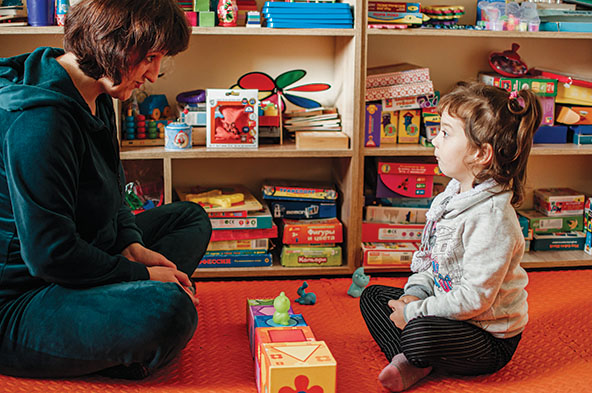
 The UBS Optimus Foundation’s proceeds support programs like ERUDIT, which helps children in Rivne Oblast, Ukraine. (Photo courtesy of ERUDIT)
Just days after Russia invaded Ukraine in February 2022, the UBS Optimus Foundation launched the Ukraine Relief Fund for UBS employees and banking clients to donate to in support of young people suffering from the war.
The question, however, was how to identify organizations on the ground that would use the fund’s money most effectively. The foundation turned to OutcomesX, a marketplace then being developed by Jason Saul and Phyllis Costanza, its founders, to convert social impact into “verified impact units” (VIUs) that could be measured, priced, and sold to donors.
When OutcomesX launched in April 2023, it was with a deal to transfer $2 million in proceeds from VIUs the foundation had purchased to local nonprofits providing education and mental-health services to children in Ukraine.
The new marketplace relies on data from the Impact Genome Registry (IGR), an independent body that defines a unit of measurable progress on a social problem or objective, such as one of the United Nations’ 17 Sustainable Development Goals.
Nonprofits report progress—for example, enabling 1,000 families to become food secure—to the IGR, which evaluates their data using peer-reviewed, evidence-based standards to verify and determine units of social impact. The IGR currently has 2.2 million social programs registered and more than 3,900 verified.
After a donor specifies a cause and region, the OutcomesX team will find verified results on the IGR that match that request. OutcomesX can also create a portfolio of VIUs from different nonprofits, if the donor prefers to fund a cause rather than a single nonprofit. The donor then will pay for the units, in addition to a fee to OutcomesX ranging from 5 to 15 percent.
The approach turns traditional funding on its head. Rather than funding nonprofit programs whose results have yet to be proven, donors can pay for results that have already been achieved and verified. Nonprofits receive the full amount paid for the units—without having to produce expensive, time-consuming impact reports.
Because donors pay only for verified results, the risk of funding organizations that are not effective is reduced. “It’s a more precise and efficient mechanism for procuring outcomes,” says Saul, who developed the IGR and is also executive director of the University of Chicago’s Center for Impact Sciences.
Given the type of grants the Ukraine Relief Fund wanted to make, OutcomesX was an appealing solution. “It can be challenging to identify grassroots organizations with a strong track record,” says Marissa Leffler, the UBS Optimus Foundation’s executive director of humanitarian assistance and global health. “Purchasing outcomes gives us enhanced confidence that our funding is delivering the intended impact.”
In addition to confirming that donors’ money has made a measurable contribution to solving a social problem, the OutcomesX team wants to help with the challenges that smaller nonprofits face in raising money. Without marketing budgets, web administrators, and development teams, many struggle to compete for funding. “The average cost of raising capital for a nonprofit is $20 for every dollar raised,” Saul says. “So the deck is stacked against small nonprofits.”
One potential challenge for donors who use OutcomesX is that they might feel disconnected from causes when their giving takes the form of buying VIUs. OutcomesX hopes partnerships could help fill this feel-good gap. For companies using the marketplace for employee donations, for example, a partnership with Benevity, a Canada-based donation-management platform used by more than 900 corporations, offers OutcomesX donors connections to Benevity’s volunteering and other engagement opportunities.
Partnering with Benevity will also help OutcomesX with its next goal: attracting more donors to the marketplace. “The infrastructure is ready to scale, and we’ll scale as fast as the market is willing to move,” Saul says.
Costanza believes the nonprofits that are most effectively solving social problems should be the ones receiving the most funding, regardless of size or brand name. “We’re really hoping this will create more equality and level the playing field,” she says.
Read more stories by Sarah Murray.