


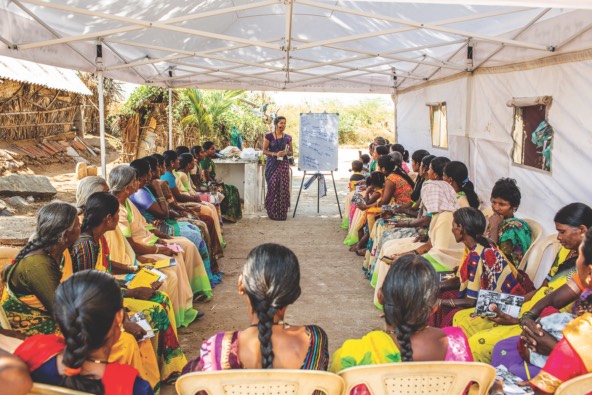
 A Buzz Women India trainer conducts a session on financial resilience for women in a village in Karnataka. (Photo courtesy of Buzz Women India)
Late in 2023, the grassroots nonprofit Buzz Women did something unusual: It asked the community it serves for funds.
“We told these women that we needed their help to bring other women and their families out of poverty,” says Uthara Narayanan, cofounder of Buzz Women. The mission of the nonprofit, established in 2012 in Bengaluru, India, is to provide financial, management, and entrepreneurial training to underserved women and give them the lifelong tools they need to achieve financial stability.
Narayanan asked for a donation of Rs 1 per day ($0.012), or Rs 365 ($4.27), to offer the very same financial literary training that the comunity received to other women. This seemingly modest amount is still a stretch for people whose monthly family income for a family of five, according to internal estimates, is Rs 15,000 ($175).
Soon after Narayanan made her ask, Devamma, who completed Buzz Women’s training in 2012, took a bus from her hometown of Tumkur to Buzz Women’s headquarters in Bengaluru and proudly placed a cash box with Rs 365 on the table in front of stunned team members. Thanks to the training, Devamma was able to get out of years of debt, start a business, and save money for her family. Now, she wanted to pay it forward.
Since its inception, Buzz Women India—the first of six Buzz Women organizations (Gambia, Georgia, Ukraine, Tanzania, and Kenya) now in existence—has trained more than 700,000 women like Devamma in 12 districts in the state of Karnataka, India. Over the course of two days, the trainers offer financial sessions on issues including how to save money, grow their business, and pay and refinance loans. Learning continues after the trainings, thanks to a strong network of women volunteers called gelathis (“friends” in Kannada), who act as mentors to new trainees. Gelathis lead groups that provide peer-learning and financial guidance, also offering mutual aid in times of financial hardship.
Today, a network of 13,000 gelathis offer mentorship in villages across Karnataka. Narayanan solicited these very gelathis in 2023 for funds to create a giving circle, called the Shakti Fund. (The word shakti means “power.” It’s also the name of a headstrong, mainstream Hindu goddess worshipped in most parts of India.) When Narayanan first floated the idea of the Shakti Fund in 2019, she faced resistance and skepticism from her team of 200 employees, her board, and even some gelathis. How could you ask money from economically vulnerable women whom the organization was supposed to serve?
“The opportunity to pay it forward is very empowering for women who have always been on the receiving end,” Narayanan says. “The ability to contribute to help others will give them the confidence to become leaders in their own communities and solve their own problems.”
Narayanan insisted that they should pilot the idea, and when Devamma unexpectedly appeared at the office and gave the annual amount, the team agreed to try it out. However, the nonprofit lacked the infrastructure to launch the pilot. Many women whom the nonprofit trains didn’t have a bank account or phone. They spent and saved in cash, but collecting cash from these women entailed risk—team members could be robbed.
However, during the COVID-19 pandemic, the Indian government encouraged everyone to move away from the cash economy toward a digital one. Families then opened bank accounts and got debit cards, making a digital payment system feasible. So the team safely implemented the Shakti Fund pilot.
In 2024, the Shakti Fund raised 18 lakhs ($20,700) in India—about 1.5 percent of the organization’s total revenue in the country. Additional funding, amounting to an annual revenue of $1.5 million, comes through private donors and grants from financial foundations and corporations such as Aditya Birla Capital Foundation, Rainmatter Foundation, and Citi Foundation.
Later this year, Buzz Women India plans to expand the Shakti Fund to all the 700,000 women they have trained. Narayanan hopes to achieve financial sustainability for her organization with the help of these women in the next five years.
“Real growth happens when people start leading their own communities,” she says, adding that the next step for the nonprofit is to train the gelathis to conduct financial management training for new villages, without any intervention by the organization.
Read more stories by Shweta Taneja.