


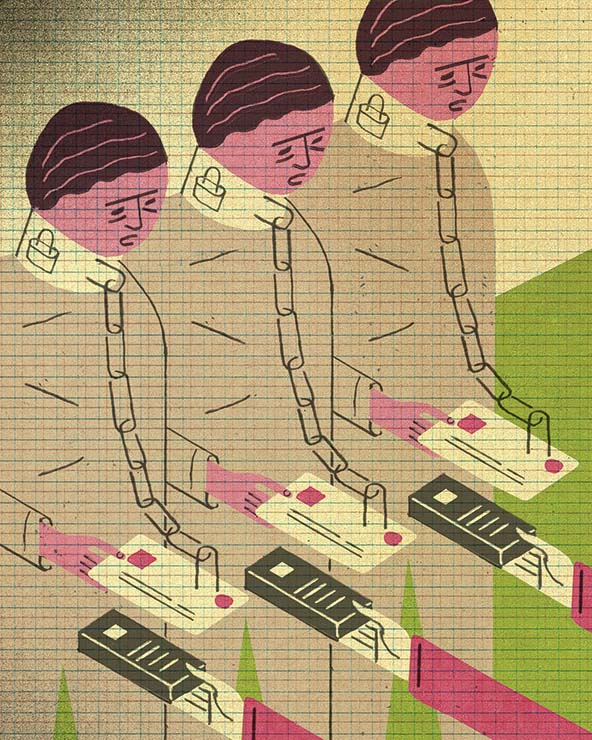
 (Illustration by David Plunkert)
With massive support from governments and the tech industry, digital payments are becoming the norm globally. This shift got an inadvertent push during the COVID-19 pandemic, when people around the world switched to online and contactless payments. Calls for a 100 percent cashless economy are getting louder, and countries such as Norway, Sweden, and the Netherlands are well on their way.
Despite being the cofounder and CEO of a social impact fintech setting up digital payments infrastructure, I believe that going cashless comes with its own dangers—and not only for those on the fringes of digital society.
To be sure, digital payments offer many advantages to consumers and businesses. For consumers, they eliminate the need to carry physical cash or cards. Transactions are generally quick and secure, thanks to enhanced security such as encryption, biometrics, and two-factor authentication. And they often come with rewards offered by banks, credit cards, and payment partners.
For businesses, this convenience and speed translate into increased sales and cash flow. With digital payments, users interact with their banks via their phones at least once a week for payment-related matters. This connection makes payment apps a great platform to cross-sell other products and services. Digital payments also leave trails of valuable information that can be used to generate consumer insights and further business.
But on the flip side, cash provides a crucial layer of redundancy, offering an alternative means of transaction and reducing the dependence on a single pathway, such as the internet or digital platforms. Cash is “free” in that it can be exchanged many times without the need for complex digital infrastructures. Redundancy helps ensure that the system can adapt and recover from disruptions. It also mitigates the risk of catastrophic failures that result from a single point of failure. Embracing cash alongside digital methods will ensure a more resilient financial infrastructure.
Given these and other benefits, I do not believe that moving toward a fully cashless economy is the right move, at least for the foreseeable future.
Two Stories
To better understand the financial marginalization that a cashless economy can unleash on individuals from different backgrounds, consider the following two stories. (Names and identifying details have been changed to protect their privacy.)
Bandana Kumari (33), Gurugram, India | Each day, Bandana Kumari walks two miles from her single-room dwelling in a congested slum to the high-rise condominium in Gurugram where she works as a maid. A third-grade dropout, Kumari has never handled a smartphone, let alone a digital wallet. She never even worked outside her home until her husband, a factory worker, lost his job during the COVID-19 pandemic.
A year in, further tragedy struck the family when he succumbed to cirrhosis of the liver. Their entire savings was depleted in the desperate attempt to save his life. Now a widow with three children ages 16, 14, and 12, Kumari is burdened with the debts incurred for her late husband’s treatment. Without medical coverage, her family and those like hers must borrow to meet hospitalization requirements.
To add to her woes, Kumari lost 3,000 rupees ($36)—the equivalent of 10 days’ wages for her. She did not get pickpocketed or scammed. She lost it to her husband’s digital wallet. When her husband’s smartphone malfunctioned, the repair charges of $50 were beyond her means. After his death, she could not afford to keep recharging the SIM, which led to its deactivation.
The loss is significant for a family struggling to make ends meet. Illiterate and relying on her family for financial matters, Kumari was familiar with cash only to the extent of recognizing denominations by their color. She had never used a phone for anything beyond making calls to her family. In her world, where three meals a day are difficult to obtain, owning a phone and affording its recharge are luxuries—let alone navigating the complexities of using it for digital payments.
When economies push for 100 percent digital transactions, they take away people’s right and freedom to control and use their money independently.
Emil Nystrom (41), Stockholm, Sweden | Emil Nystrom is an entrepreneur from Sweden fully used to a digital world. He was invited to speak at a prestigious design conference in Singapore in July 2023. Though he was recovering from a knee injury and had been advised to take it slow, he jumped at the opportunity. He had barely a couple of days to plan his trip and had no time to get currency converted. Used to a cash-free lifestyle in Sweden and knowing that he was traveling from one developed economy to another, Nystrom did not worry too much about it.
On reaching Singapore, he encountered the exclusion of a cashless world for the first time when he tried to buy an EZ-Link card to use the MRT, Singapore’s
mass rapid transit system. His international Visa card was declined by the system. Since it was close to midnight, he had to take a taxi to his hotel, the Novotel on Stevens Road, which cost him 40 Singapore dollars ($30).
To compound his dismay, he discovered that there was no ATM at the MRT station near the hotel nor at the 7-Eleven down the road. The nearest ATM was on Orchard Road, 21 minutes away by foot. He might have enjoyed such a walk, if not for his knee. He hurriedly exchanged a few euros he had for Singapore dollars at the hotel, incurring significant currency conversion charges. What’s more, the terminals available for topping up his EZ card using cash as a mode were far and few. He had to walk quite a bit within the station to access a mode of recharge that allowed cash.
Digital Is Not Inclusive
Kumari and Nystrom represent diverse demographics with distinct needs, experiences, and levels of familiarity with financial systems. However, their cases highlight the challenges of a fully cashless society. As governments converge toward a digital future, they must approach the task with empathy, recognizing the continued existence of the poor, the unbanked, the elderly, and the illiterate, and the potential for emergencies.
For people like Nystrom, the costs extend beyond monetary considerations to include accessibility and convenience. For those like Kumari, it is about literacy and cost. Cash for her is free. Digital is not. Every single transaction requires connectivity and access to data. It also demands a certain level of literacy, tech-savviness, and financial awareness that not everyone possesses or can access.
More generally, digital increases dependency on institutions, such as banks, fintechs, and cell-phone service providers. When economies push for 100 percent digital transactions, they take away people’s right and freedom to control and use their money independently. In November 2023, The New York Times reported an increase in banks closing down customer accounts without warning, leaving hundreds of individual customers and small businesses in the lurch.
While the banks cite suspicion of fraudulent activity flagged by algorithms, those affected are often left bewildered. “There is no humanization to any of this, and it’s all just numbers on a screen,” a programmer who used to code such algorithms told The Times. “It’s not ‘No, that is a single mom running a babysitting business.’ It’s ‘Hey, you’ve checked these boxes for a red flag—you’re out.’”
Moreover, digital networks often end up being inaccessible during times of crisis. During the war in Ukraine, many countries have imposed sanctions on Russia, and Visa, Mastercard, and other payment companies suspended operations in the country. As a result, Russian citizens could no longer make global digital payments, and it led to a panic-stricken rush for the ATMs to withdraw cash.
In another potent example, Nigeria in early 2023 attempted to fight inflation and counterfeiting by replacing old currency in a bid to promote digital payments. But the country’s banks simply did not have the infrastructure necessary to support the demand for new currency and chaos reigned, with enormous lines at the banks and ordinary people unable to buy food or get to work.
Climate disruptions provide further examples. For instance, during the 2019 floods in Kerala, India, electricity was out for days, and ATMs were inaccessible to most. With mobile phones not functioning, people used their cash reserves for essential supplies. The same problem repeated when Cyclone Michaung hit Chennai, India, in December last year and disrupted digital payments, leaving people unable to purchase essential items like milk and groceries.
Given these limitations, we should strive for a less-cash economy, not a cashless economy. Central banks play a crucial role in determining the direction that individual economies take, and they must strike the right balance. The shift to digitization must go hand in hand with literacy, both basic and financial. The gap between physical and digital natives needs to be bridged through human-centric, empathetic financial systems.
In India today, cash worth $397 billion is in circulation. Some of the most economically advanced nations, including the United States, Singapore, Japan, and Germany, are still cash-based in many aspects. Yes, cash transactions are dropping globally, and digital payments are on the rise—and that is the right direction to take. Just as airplanes replaced slower and more cumbersome travel options, and Zoom replaced face-to-face meetings requiring travel, digital transactions have become a modern and efficient alternative, offering convenience, security, and speed.
However, true progress lies not in rendering traditional and perceived backward methods obsolete; it lies in acknowledging the need for a coexistence between the various modes. Factors such as a growing shift globally toward authoritarian governance, climatic disruptions, rising inequality, and the increasing demand for privacy and cybersecurity also warrant significant consideration while moving to a digital world.
In the end, cash must not be eradicated completely. It gives people liquidity, control, resilience, privacy, and protection from authoritarian regimes. These benefits are too vital to ignore. Governments and central banks need to advocate for less cash, rather than aim for a fully cashless society. Otherwise, they threaten to put vulnerable people in desperate circumstances.
Read more stories by Seema Prem.