


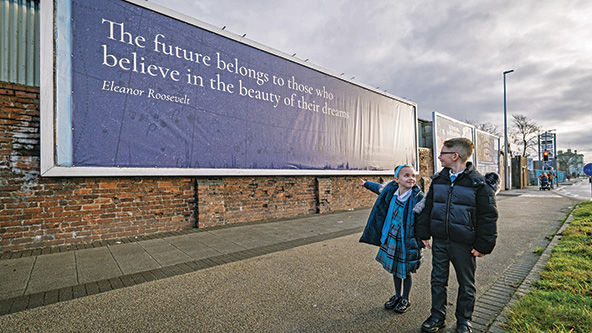
 New Constellations’ process to help Barrovians envision a new future for the borough included a huge billboard intended to inspire residents to dream. (Photo courtesy of Steven Barber/New Constellations)
The Victorian tenements of Barrow-in-Furness, a peninsula town that overhangs the Irish Sea on Great Britain’s northwest coast, are still occupied, though the brickwork is crumbling. In the shipyard, descendants of the workers who built Barrow are today constructing nuclear submarines for the aerospace company BAE Systems, the town’s largest employer. But the collapse of the iron and steel works several decades ago left a legacy of deprivation and divisions that finds its rawest expression in an 11-year gap in life expectancy between the town’s richest and poorest neighborhoods.
Seeking inspiration for renewal, Barrovians turned to New Constellations, a UK nonprofit founded by Gemma Mortensen and Iris Andrews in 2020 to help communities like Barrow imagine more prosperous and sustainable futures. Mortensen had previously run social change organizations and took on consultancy work to generate seed capital to fund the launch. Andrews, a communications specialist, took the lead on developing the techniques that New Constellations would use in client work.
Their connection to Barrow originated in 2019, during New Constellation’s ideation stage, when they organized a retreat for social innovators to gather feedback. One of the participants was social entrepreneur and author Hilary Cottam, who in 2020 took a part-time role as an advisor to the Barrow Borough Council. On New Constellations’ behalf, Cottam approached Love Barrow Together, a coalition of local government and third sector organizations, including Barrow Borough Council and local charities, and asked if it would back a bid for UK National Lottery funding to enable New Constellations to take a group of Barrovians on a journey to imagine a new future.
The successful bid, resulting in a £50,000 ($71,000 USD) grant from the lottery, enabled New Constellations to test its methods with the community, officially launching the “Barrow’s New Constellation” experiment. The involvement of the Love Barrow Together coalition meant the team would be working with community leaders from local charities and public services, as well as with the council. These connections were important because, as an organization without local roots, New Constellations needed to win residents’ trust.
New Constellations designed an open nominations process and tapped local knowledge to ensure that minority communities were represented among the 16 recruited residents. The result was a deliberately diverse group, christened the “crew,” which met over Zoom—because of COVID-19 restrictions—for six days in December 2020 to discuss Barrow’s problems and potential solutions.
Mortensen describes New Constellations’ methods—blending meditative practices, guided visualization, and assigned excursions into nature—as the opposite of workshops in which participants brainstorm ideas. In one exercise, for example, the crew was asked to imagine embarking on a voyage and deciding what to take from Barrow and what to leave behind. “If all you ask is what’s bad in this place, what you get back is ‘the bins not being emptied.’ But if you ask, ‘Where is the light in this place, where is the dark?’ you get back how people really feel,” Mortensen says. That matters, she adds, because “to imagine how things might be better,” it is necessary to start from “a place of honesty and authenticity.”
The crew developed a dozen guiding principles, which were endorsed by the council’s leadership. These include pledges to help Barrovians connect with and care for each other, and to back local businesses. Another ambition is to promote Barrow’s unspoiled coastline and offshore islands to green-minded tourists.
New Constellations’ next step is to repeat the Barrow experiment in another town to establish whether the results would differ with the involvement of different partners.
Looking further ahead, Mortensen hopes to develop “a business line of income” to enable New Constellations to become self-financing. That could involve working with, for instance, an oil company that wants to rebrand itself by replacing old destructive practices with green alternatives.
Mortensen hopes that New Constellations will encourage more communities to imagine new and better futures. “At first there won’t seem to be many of them,” she says, “but slowly 10 turns into 100, then 1,000, and 100,000, and that’s how a new system is born.”
Read more stories by Alicia Clegg.