


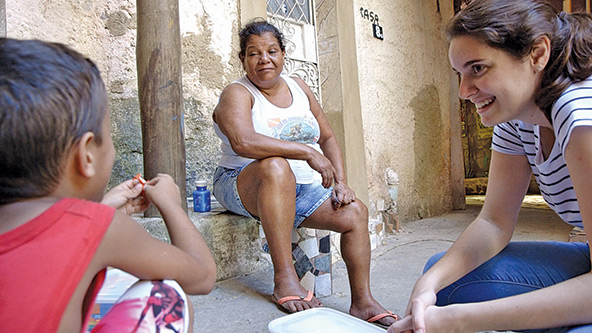
 Day-care providers play with a child in Rio de Janeiro during a training session offered by Mopi’s pilot program. (Photo courtesy of Mopi)
Cleide da Silva receives the first knock at her door at dawn. It’s the beginning of a long day at her home-based day care in a working-class community in Brazil’s largest metropolis, São Paulo. She cares for seven children, ages six months to nine years old, until 8 p.m.
“They call me Auntie Cleide” she says. “I offer much more than a regular day care.” On top of changing diapers and cooking meals she helps children with their homework, takes them to the pediatrician if needed, and even attends parents’ evening at school.
Day care is a community business system that receives no government support, and the women like Silva who provide this important service are largely invisible as laborers. Three young Brazilian social entrepreneurs, Elisa Mansur, Maria Martinez, and Angela Hernandez, are trying to address this problem through their startup, Mopi.
The social venture aims to professionalize and build a network of home-based day cares in Brazil, a growing informal market filling an important gap in early childhood care and education in Brazil. Only 26 percent of poor children under 4 years old are enrolled in licensed day care, compared with 55 percent of wealthy children—mainly due to both the shortage of public day-care centers, where waiting lists are long, and the expense of home-based day-care high. Silva, for example, offers a reasonable monthly fee of $47 for full-time childcare, which can be a stretch for parents who earn a minimum wage of $237 a month.
Children are entitled to universal education from ages 4 to 17 in Brazil, but there is no state provision for toddler day care. “Educational inequality in Brazil starts early and it is reproduced in the school years, because these poor kids will be sent to public schools in vulnerable areas and will not have the same opportunities as wealthy kids,” says Clãudia Costin, director of the Getulio Vargas Foundation’s Center for Excellence and Innovation in Education Policies. She adds that given the high cost of building nurseries, so-called “community mothers” like Cleide da Silva are providing an “incredible” service as social workers.
The Mopi model was inspired by two similar projects based in Colombia and Portugal. Mopi won the World Bank Youth Summit social project competition in 2018, the year of its launch. “Mopi brings innovation to the childcare business as part of the sharing economy, like Uber and Airbnb,” Martinez says. “Home-based day cares overcome the main obstacle in this market: the high costs of building new centers that many local governments with tight budgets cannot afford.”
Mopi’s program pilot was run in a favela (shantytown) of Rio de Janeiro in 2018. After the pilot, the founders hired a law consultancy that specialized in women’s rights to develop a legal framework for the business so they could start selecting caregivers, thanks to grants from the Massachusetts Institute of Technology’s (MIT’s) Legatum Center for Development & Entrepreneurship, MIT’s Sandbox Innovation Fund, MIT’s Education Ignite Fund, and Harvard University.
The selection involves an extensive vetting process: After passing an online application and a multiple-choice test about early childhood development and childcare, the shortlisted candidates are put through a two-stage interview, a background check, and an assessment of their homes.
Of the 76 candidates who applied for the first cohort, eight were offered courses by Mopi on a standardized model for teaching activities, safety, health, hygiene, management, and leadership in São Paulo. “We want to identify regional champions that could have a voice and leadership in their own communities and replicate this model nationwide,” Mansur says.
The cohort’s program, which began in December 2019, is set to end in time for the participants to launch their own centers at the start of the new academic year, in February 2020. After the program, Mopi supports both the caregivers and the families and works to reinforce bonds between parents and caregivers by establishing clarity and transparency about the service provided. Each caregiver is rated based on family feedback. In return for offering protection and reliability to families and caregivers, Mopi charges families a fee of 5 percent of the childcare costs.
By June 2021, Mopi wants to expand from eight to 25 home-based day-care centers. But standardizing an invisible job market is just part of the project. The founders intend to use Mopi to make the case for a national public policy supporting child day-care labor.
“When this happens,” Mansur says, “we will have met our goal.”
Read more stories by Yula Rocha.