


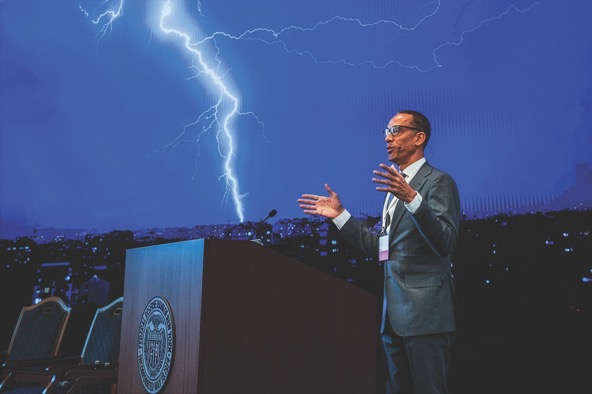
 Otho Kerr of the Federal Reserve Bank of New York gives opening remarks at a Making Missing Markets event in November 2025. (Photo courtesy of the Federal Reserve Bank of New York)
If money is like water—it must move in the right direction to be useful—the Federal Reserve Bank of New York sees one place where this is not happening: the flow of funding for community development. With a mandate that includes promoting a healthy economy, the New York Fed decided to take action. In 2024, led by its community- development team, it launched Making Missing Markets, an initiative designed to drive more capital into low- to moderate-income communities.
It’s not that capital for these communities is lacking, says David Erickson, the New York Fed’s head of outreach and education. He points out that funding is often available to tackle problems such as climate vulnerability, poor access to health care and education, or lack of economic opportunity. But while these problems and their solutions are often overlapping or interconnected, the funding and interventions tend to be siloed and narrowly targeted.
“A missing market is an instance where there is sufficient money to pay for complex interventions that we know work,” he explains. “But no one entity owns the problem, and therefore we have a coordination problem.”
The New York Fed is not alone in thinking this. “I see missing markets as a broad term, and using impact capital is one of the tools in the toolbox,” says Jennifer Pryce, president and CEO of nonprofit investing firm Calvert Impact. “But we need a big term to get everyone in the room, get them collaborating, and gain mutual understanding of what the problems are and in what sequence we’re going to solve them.”
Like Calvert Impact, the Making Missing Markets team wants to help unlock more private capital for community development, reducing dependence on government and philanthropic funding. However, the New York Fed has neither funds of its own nor the funds of external investors to deploy. Instead, it seeks to address the “coordination problem” through its convening power.
By bringing together what it calls the “buyers of better outcomes” (funders) with the “producers” of those outcomes (problem solvers and innovators), Making Missing Markets aims to connect existing impact ecosystems or to create new ones so that funding is directed more holistically toward community needs, rather than to individual organizations working in silos or to one-off interventions.
Making Missing Markets has several ways of doing this. Design Teams (essentially, working groups) focus on everything from artificial intelligence to the arts, youth development, climate resilience, and rural innovation. Meeting on a monthly basis, teams talk through ideas and reflect on the funding challenges and opportunities they see.
One Design Team is, for example, engaging with a range of capital providers to explore the possibility of creating a new asset class focused on investment in community broadband. “We want the Design Teams to consider financing structures that will attract private capital,” says Otho Kerr, the New York Fed’s director of strategic partnerships and community impact investing.
Here, too, the objective is to encourage teams to seek areas where their work overlaps with that of others, rather than leaving them to work in isolation. For example, strategies being developed by a climate- resilience team could be used by a team working on challenges related to poverty.
Meanwhile, Making Missing Markets Communities are place-based groups of individuals or organizations, such as community foundations and health-care institutions, that help to implement a range of strategies and interventions, potentially including those developed by Design Teams.
To foster improved coordination, Making Missing Markets is also hosting convenings and encouraging others to do so. In addition to its annual event in New York (held in November in person and online and hosted by the New York Fed), informal invite-only gatherings take place around the country. These are mostly hosted by local entities, although the New York Fed and the Cleveland Fed co-hosted an event in Ohio last year. “We start with our own network, which we’ve developed over many years,” says Erickson. “Then we tap into other networks, whether in health, education, or philanthropy.”
The initiative is still developing metrics to assess the impact of all these activities. “I want to be able to say that X number of dollars were invested and Y number of lives were transformed,” Erickson says. “We can’t say that yet.”
The New York Fed currently lacks the resources to develop and run evaluation systems for impact measurement. One solution could be for a large foundation to manage this, Kerr says. “That’s not something we have right now, but that’s certainly on our radar screen.”
Meanwhile, as the initiative expands, led by other regional US federal reserve banks, Making Missing Markets is turning into something of a movement. While it is early days, Erickson sees potential for impact at scale across the United States.
“What’s great is that in almost every major city there’s a federal reserve bank or a branch,” he says. “From Chicago, Atlanta, and Salt Lake City to Helena, Montana, you can go to any of these places and step into a federal reserve network of people who care about an economy that works for everyone.”
Read more stories by Sarah Murray.