


 (Illustration by iStock/Orbon Alija)
Roughly a decade ago, a coalition of industry leaders, businesses, nonprofits, and community organizations in an American city tried to pass a ballot measure for a tax increase. The tax aimed to raise funds for infrastructure projects that would ease traffic congestion. When the initiative flopped at the ballot box, the coalition rallied behind a newly elected mayor to devise a second effort. Together, they engaged with the community, figured out the reasons for their failure, and adapted their strategy. Two years later, a new ballot measure to raise taxes and improve infrastructure passed with bipartisan and cross-sectoral support.
Another collaboration that started around the same time was less successful. Launched by a retired teacher who joined forces with the public school system and a regional firm, it aimed to improve the STEM knowledge and skills of underserved students. The collaboration notched some initial wins, but when differences emerged among the partners about the schools that would be served and the long-term vision, the partnership succumbed to infighting and inaction. Funding dried up, and the nonprofit hosting the collaboration decided to stop doing so.
From creating economic and educational opportunity to ensuring public safety, the hardest problems that communities face require the knowledge, skills, and resources of multiple sectors, including government, business, and nonprofits. But as these two examples show, cross-sector collaborations (CSCs) vary dramatically in their success—and research to date provides only limited insight into what distinguishes effective from ineffective CSCs.
A study recently published in the Journal of Public Administration Research and Theory and supported by the Bloomberg Harvard City Leadership Initiative suggests that how a collaboration reacts to setbacks plays a key role. CSCs that use failure as an opportunity to learn and adapt, like the first collaboration we described, are likely to survive and thrive, while those that do not, like the second, are more likely to flounder or fail.
A Key to Successful Cross-Sector Collaboration
Our study asked the following: What helps and what hinders the design and management of CSCs? To explore the question, we examined nine CSCs across three cities and three policy areas (education, public safety, and economic development). Most prior investigations have analyzed a single CSC in depth or compared multiple CSCs in a single policy area—making it difficult to generalize insights or compare across policy domains. In contrast, our distinctive approach allowed us to build hypotheses that span specific cities and policy areas. For each collaboration, we looked at archival documents and conducted interviews and group exercises with members of all contributing organizations. Although our study offers strong hypotheses about the roots of CSC success, further research is needed to test the theory we propose.
We found that all CSCs required initial trust among members to get off the ground, and all encountered setbacks early on. But what happened in the wake of the setback was key. Some CSCs responded by engaging in a trust-building process of mutual learning. They participated in joint problem-solving—that is, they saw the problems as shared, came together, and went through various iterations to co-produce solutions (Kerrissey, Mayo, and Edmondson, 2021). As the figure below shows, this mutual learning reinforced their trust in one another, despite the setback, and enabled them to get back on track toward success. In contrast, other CSCs—even ones that enjoyed quick wins at the beginning—responded to setbacks by blaming each other, fighting among themselves, and disengaging. These CSCs spiraled downward toward failure: members’ trust in one another eroded, and little public value was delivered.
Mutual Learning and Mutual Blaming Loops
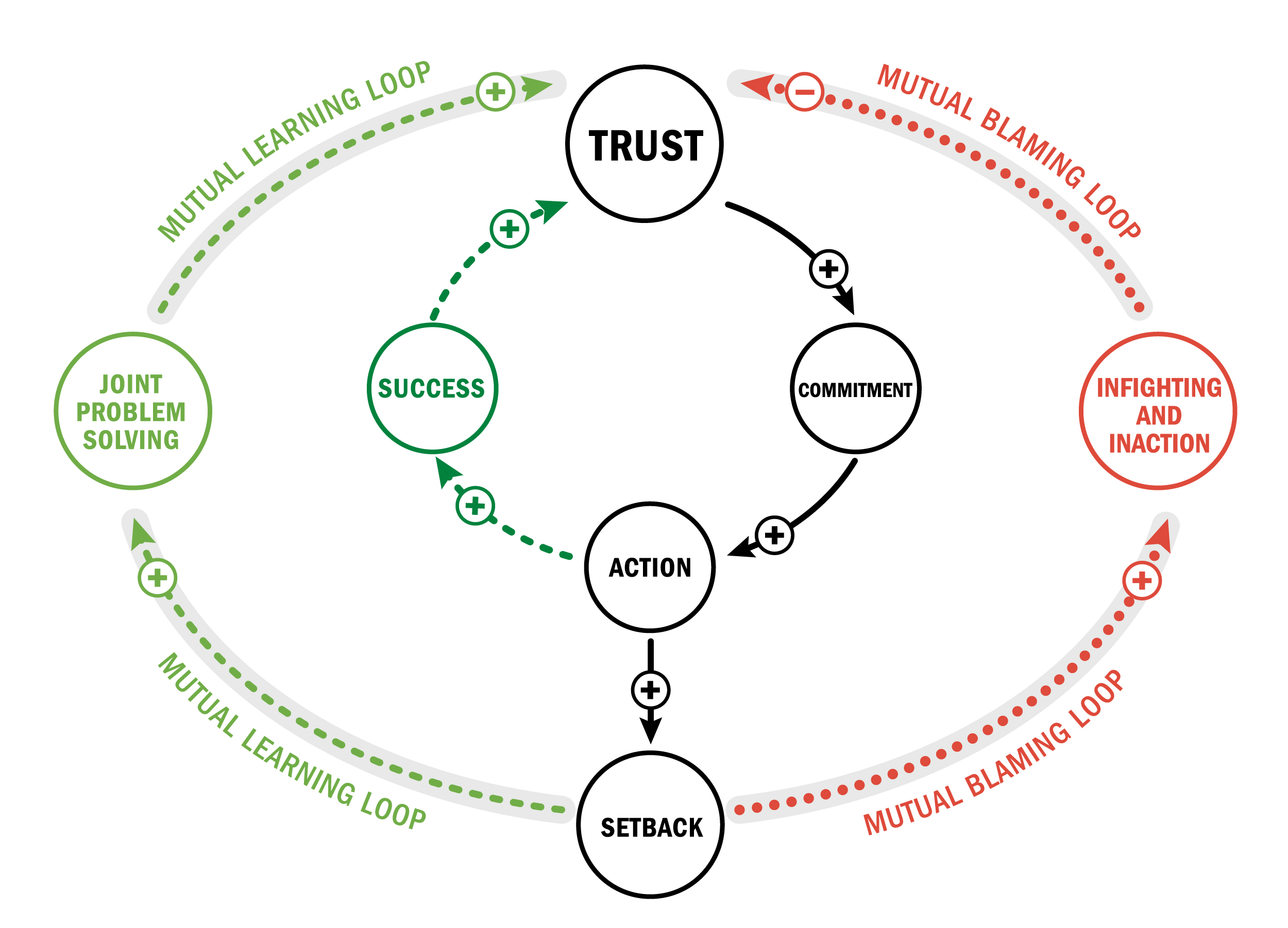
Source: Pulido Gomez, S., De Jong, J., and Rivkin, J. “Cross-Sector Collaboration in Cities: Learning Journey or Blame Game?” Journal of Public Administration Research and Theory, 2025.
Five Actions for Collaborative Success
Our study identified five actions that, according to members of the collaborations we studied, launched a CSC towards a path of mutual learning:
Building on prior relationships: When organizations and individuals have worked together effectively in the past, it is easier to build the trust required to start a new collaboration and to respond to setbacks by learning together. If people know each other and understand where others come from, both new adventures and undesired outcomes can be less daunting.
Relying on a trusted individual: A well-known individual or small group of individuals with strong and longstanding relationships and reputations across sectors can make partners confident that collaboration is possible, even when things don’t go as hoped. Collaboration takes effort, and people want to see a return on investment. Skilled and experienced navigators increase trust in the likelihood of that happening.
Engaging the community: Generating input and feedback from residents and businesses in all stages of the process can result in better plans with broader support for implementation. Collaborations can leverage existing community spaces or design new, purpose-built platforms for engagement.
Using data and evidence: To better understand problems and guide discussions, collaborations often collect and analyze data and review them together. This helps partners align perspectives, develop well-informed plans, monitor progress, manage collaborative performance, evaluate results, and—crucially—avoid a blame game when setbacks occur.
Deliberately investing in joint problem-solving: Creating dedicated time and space for troubleshooting helps collaborators come together and discuss how things are going and what changes are needed. Setting expectations for open and constructive communication is important: it reminds people that joint problem-solving is an integral part of being on a learning journey together.
The first collaboration we described above engaged in all five: It drew on coalitions of industry leaders, business, nonprofits, and community organizations that had come together several years before the initial loss at the ballot box. After that loss, they went through a process of joint problem-solving to learn from their election failure, engaging the community with over 20 meetings across the city. When they learned that many people’s anti-tax sentiment stemmed from a general distrust of government spending, they suggested a tax earmarked for a locked-down list of specific infrastructure projects, and they used a data-driven approach to evaluate each proposed project. Finally, they rallied behind a trusted individual—the mayor, who had held other elected positions and knew the players and community well, and whose leadership was crucial in garnering broad electoral support.
In contrast, the education collaboration described above took only two of the five actions that support mutual learning. While they relied on a trusted individual and engaged the community, they did not invest deeply in the other actions. This made mutual blaming more likely than mutual learning when the partnership hit the setback we described earlier.
Takeaways for City Leaders
For communities facing complex social problems, cross-sector collaboration is both necessary and challenging. How city leaders prepare for and react to the inevitable setbacks may be a key to effective partnerships. Previous research by the authors as well as recent research from the University of Minnesota published in SSIR emphasizes the importance of investing in the foundation for collaboration at an early stage. Our new study offers insights and tips that may help city leaders boost their odds of collaborative success once the collaboration is underway but not yet delivering desired results, namely:
Spend time upfront with partners discussing how you will react to setbacks. Think about the difficulties your collaboration is likely to encounter in such moments—e.g., varying definitions of success, disagreements on how to make decisions, resource shortfalls—and devise a plan for overcoming them in a way that encourages learning and reinforces trust among members. Spending some time at the outset figuring out the group’s goals, values, processes, and limitations can help you devise an actionable strategy to keep learning in tough moments.
Incorporate the five actions pinpointed earlier. As you design and manage your CSC, think about how you can build on existing relationships, rally behind a trusted leader, engage with the community, use data and evidence to make decisions, and create spaces and methods to solve problems together. Committing to these actions might not be a recipe for immediate success, but doing so increases the likelihood of making meaningful progress on the learning journey.
Don’t fall into the trap of seeking the perfect governance model. Among the nine collaborations we studied, no single CSC governance model (shared, lead organization, or separate network administrative organization) made a collaboration more or less likely to succeed. The three least successful collaborations used three different governance models, and the three most successful ones also employed three different models at different times. What made the difference, rather, was a CSC’s willingness to adapt its governance model as the needs of the collaboration changed. In fact, several of the more successful CSCs we studied switched their governance models, while none of the less successful ones did.
Since 2017, the Bloomberg Harvard City Leadership Initiative has worked with city leaders from more than 300 cities across the world. They all rely on cross-sector collaboration to make progress on their most pressing issues, and they all face similar challenges. This reality has prompted the research we have published about barriers to collaboration (“Building Cities Collaborative Muscle”) and finding entry points in an early stage (“Cross-boundary Collaboration in Cities: Where to Start”). This final study on the role of structure, key actions, and collaboration as a learning journey complements that work. While collaboration across organizational and sectoral boundaries may never be easy, you can raise the odds of success by acknowledging common challenges and taking advantage of research and lessons learned.
Read the full study, “Cross-Sector Collaboration in Cities: Learning Journey or Blame Game?” in the Journal of Public Administration Research and Theory.
Read more stories by Santiago Pulido-Gomez, Jorrit de Jong, Jan Rivkin & Yamile Nesrala.