


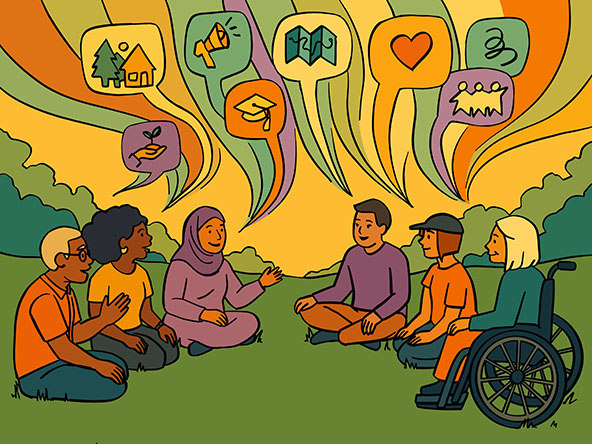
 (Illustration by Jasmin Pamukcu)
Imagine trying to navigate an unfamiliar city with a broken compass. The needle appears steady and reliable, instilling confidence in each turn you take. But unbeknownst to you, every step leads you further off course. You keep walking, trusting the instrument in your hand. But your confidence is misplaced: The compass is broken—faulty and unreliable, and you’re steadily moving in the wrong direction. This broken compass is much like the civic data we use in the United States today.
Civic data attempts to capture and describe the realities of public life and community well-being. Data sources like census surveys and administrative records—such as tax filings, traffic data, school standardized testing results, and labor statistics—are used to determine which neighborhoods will be funded and which will be starved of resources, which communities will have roads and public transportation built and which will remain isolated, which schools will receive investment and which will be left to fail, and which neighborhoods will have jobs and economic opportunity while others face disinvestment and decline. Civic data influences where we live, how we live, and quite literally, how long we live.

But data is never neutral or objective. Data systems are designed by people working within institutions, and when those institutions are built on structural racism, patriarchy, and other systems of oppression, the data they produce will reflect and reinforce those same inequities. To this day, we’ve been relying on civic data that appears scientific and trustworthy, but in truth, it has been rooted in multiple systems of oppression, including structural racism, colonialism, and white supremacy. This means that the traditional forms of civic data we’ve relied on to shape nearly every aspect of our existence have been undermining our community health goals broadly but have been explicitly weaponized against communities of color.
When Data Tells Lies
Consider the Home Owners’ Loan Corporation (HOLC), a federal agency created during the Great Depression to stabilize the housing market. To assess the perceived “risk” of lending in neighborhoods across the nation, HOLC began developing detailed maps of US cities in the 1930s, ultimately color-coding neighborhoods in hundreds of cities based on their perceived investment worthiness—and using the race of residents as a proxy for lending risk. HOLC applied one of four color-coded grades: “A” or “Best” (green), “B” or “Still Desirable” (blue), “C” or “Definitely Declining” (yellow), and “D” or “Hazardous” (red). Driven by white supremacy, racism, nativism, classism, and anti-Semitism, HOLC deemed all-white neighborhoods most “desirable” while marking neighborhoods with Black, immigrant, and other marginalized residents as “declining” or “hazardous,” systematically denying them access to loans and investment. This policy and practice became known as redlining.
Redlining maps were themselves data systems that visually documented a racist federal policy with shocking specificity. What makes redlining maps such horrifying and powerful evidence is their shamelessness: Racist policy rendered in color, applied systematically to hundreds of cities, creating the legalized residential segregation whose effects we still live with today.
The state and local officials, bankers, realtors, and appraisers who collaborated to create these maps relied on seemingly objective criteria: They counted demographics, arbitrarily assigned value to properties based on the assumed race of the people who lived there, and measured proximity to “undesirable” populations. Although the data appeared factual and “objective,” it was fabricated and false. Embedded within every data point were racist assumptions about which families did and did not deserve access to homeownership, quality schools, and neighborhood investment.
Nearly a century later, we’re still living with the devastating health, wealth, educational, and environmental inequities that were driven by redlining. Children in formerly redlined neighborhoods are more likely to attend under-resourced schools, live in food deserts, and develop asthma from poor air quality. Now, algorithmic appraisal systems are automating and accelerating these discriminatory practices. Research reveals that appraisers routinely use racist assumptions, treating neighborhood racial composition as a proxy for property value and assuming white neighborhoods are inherently more desirable, to generate the sales data that algorithms now learn from. How can home valuation data have any credibility when it’s generated through a process where racism determines value, undervaluing homes in Black neighborhoods by over 20 percent?
Redlining reveals a disturbing truth: Civic data has long been weaponized to directly back “data-driven” policies that were designed to intentionally harm communities of color by preventing Black families from accessing homeownership and its wealth-building benefits. Redlining maps weren’t merely “objective” assessments of risk when it came to lending and community investment: They were tools of systemic oppression and exclusion.
Today’s Data Disasters
Patterns of data manipulation and harm persist across every sector that touches community life, even if the harm isn’t intentional.
Take pretextual traffic stops. They aren’t about safety but about finding something, anything to justify a police search. They disproportionately target Black and Latino drivers while producing little evidence of criminal activity. The same discriminatory pattern plays out for pedestrians: In Jacksonville, Florida, Black people were three times more likely than white people to be stopped and cited for jaywalking and other pedestrian violations, despite representing only 29 percent of the population. These efforts and the faulty “data” they generate create a vicious cycle where communities of color are subjugated by enforcement efforts simply because the “data” shows they have higher crime rates. Meanwhile, real safety needs—near-miss collisions with pedestrians, children unable to safely walk or bike to school, and seniors afraid to cross intersections—remain invisible in the statistics that drive policy and funding decisions.
A similar trend repeats in education, where high-stakes standardized testing—rooted in eugenicist and explicitly racist efforts to rank and dehumanize students based on their “race” —continues to masquerade as a measure of merit. These tests serve as false proxies for school quality, while ignoring what actually drives student success: well-resourced schools, rich educational opportunities within and outside the classroom, tutoring support, and economic and housing stability. At the same time, standardized testing fails to account for the systemic barriers that prevent students from thriving, including racism, poverty, language barriers, and trauma. Standardized testing was never designed to measure the full spectrum of student brilliance in qualities like bilingualism, artistic talent, resilience, and creativity. Schools serving predominantly Black and Latinx students are disproportionately labeled as failing, triggering sanctions and funding cuts instead of the resources and support students actually need.
Data erasure and its consequences are equally disturbing. Missing and murdered Indigenous women and girls are invisible in national databases because law enforcement agencies use inconsistent reporting practices, misclassify victims, and fail to investigate cases thoroughly. Black women and girls face similar data erasure. When Black women and girls go missing, their cases often receive less media attention, fewer investigative resources, and inadequate documentation in national databases. When law enforcement misclassifies legitimately kidnapped individuals as runaways rather than missing persons, they undermine the accuracy of their own administrative data, leading to delayed or entirely absent responses. Advocates cannot identify or expose patterns needed to drive policy solutions, and policy makers lack accurate information and critical context to allocate funding for prevention and investigation. The absence of data becomes a form of violence itself, manifesting as institutional gaslighting—when authorities downplay valid danger, dismiss family and community concerns, and withhold critical investigative resources that could save lives.
Data manipulation also threatens our democratic institutions. Census data is used to determine congressional representation and district boundaries, directly affecting voting strength and legislative influence. When presidential administrations and the Supreme Court enable policies that drive immigrant communities underground, such as allowing ICE agents to use race as grounds for immigration stops, people become afraid to participate in the census. The result is predictable: Undercounted communities lose political representation and billions in federal funding. In Texas, legislators have redrawn district lines years ahead of schedule, concentrating Black and Latinx voters into fewer districts, even as Latinx people approach becoming half the state’s population. Control of civic data translates directly to control of political power, and until we democratize civic data and ensure it is inclusively created and governed, marginalized communities will continue to have their voices diminished.
Transforming Our Civic Data by Centering Equity, Justice, and Sovereignty
Data embodies the stories of people and communities. When we center this fundamental truth, the path forward becomes clear: We can and must transform our civic data systems. And transformation is already underway, led by communities themselves.
To build truly inclusive, useful, and transformative civic data systems with the potential to guide us toward more just decision-making, we must understand and apply three interconnected concepts: data equity, data justice, and data sovereignty
Equity means recognizing that people face different barriers and circumstances and, as a result, they need different supports to achieve fair outcomes. It requires understanding that structural injustices have created different starting points for people and communities. As a result, equity calls for making sure people have what they need to flourish and thrive by meeting three requirements: 1) valuing all people and populations equally, 2) recognizing and rectifying historical and contemporary injustices, and 3) providing resources according to need.
Data equity applies the three requirements of equity to civic data systems to make them more fair and inclusive. That means government agencies and other powerful institutions that collect, house, and use data must utilize policies, practices, and processes that do not perpetuate exclusion and harm. They must honor and center communities most impacted by structural racism and other systems of oppression, including their diverse ways of knowing and lived experiences. Additionally, these institutions must responsibly use data to inform decisions and policies that explicitly address structural inequities and improve systems and processes.
Data equity could involve a city planning department collaborating with a community-based organization to facilitate a series of open forums on policies to govern new development in the city—and using the information collected from residents to guide decision-making in ways that are transparent, purposeful, and meaningful. For example, in spring 2021, Oregon’s health authority partnered with Pacific Islander leaders to redesign its COVID-19 data collection to better capture the distinct experiences of Pacific Islander people and communities. The existing system wasn’t intentionally leaving people out, but it wasn’t designed to accurately represent discrete populations.
Data equity can make data systems more thoughtful and inclusive, but it stops short of changing or transforming them entirely.
Justice means completely transforming systems by dismantling structures built on exclusion and oppression and building new ones grounded in dignity, human-centeredness, and self-determination. Data justice applies this transformative approach to data systems. It embraces equity’s three requirements but also pushes us to completely reimagine how data can be collected, governed, and used to benefit people, particularly those who have been marginalized and oppressed.
Portland’s Coalition of Communities of Color and its partners are doing exactly this kind of transformative work by building an entirely new community-led data ecosystem. Government climate data systems may simply track temperature and air quality but ignore real impacts on frontline communities endangered by climate disasters. However, their community-centered data ecosystem is designed to build up communities’ resilience in the face of climate-related disasters. It is connecting diverse data sources, community relationships, and local governance structures to create more complete and representative data that’s focused on community members’ experiences—including which neighborhoods flood during storms, which families lack access to cooling during heat waves, and which cultural practices strengthen community resilience against climate injustice.
Data sovereignty is about self-determination: Communities have the right to govern the collection, ownership, protection, and application of data about their own lives. It also means people get to decide what information about them is gathered, how it’s used, and who benefits from it. Indigenous communities have led the fight for data sovereignty, developing frameworks like the CARE Principles for Indigenous Data Governance (Collective Benefit, Authority to Control, Responsibility, and Ethics). These principles affirm that Indigenous peoples have the right to control data about their communities, lands, and cultures, ensuring that information systems serve their well-being and sovereignty. (See also Using the CARE Principles to Preserve Indigenous Data Sovereignty for applied examples.)
The Tucson Indian Center and its partners are demonstrating what data sovereignty looks like in action. Through its Promoting Indigenous Models of Assessment (PIMA) initiative, the Tucson Indian Center, supported by government agencies and other local partners, is building a local data ecosystem rooted in self-governance and traditional knowledge systems. Their data system is centering urban American Indian people in Tucson and throughout Pima County, Arizona, using community-specific data that reflects their priorities to shape workforce, health, and community development decisions.
Together, these principles are blueprints for thriving communities. When equity, justice, and sovereignty guide how data is collected and used, civic data can become a force for shared well-being—one that strengthens democracy, deepens trust, and results in communities defining their own futures.
Transforming Data for an Equitable and Just Future
Data equity, data justice, and data sovereignty point us toward a fundamentally different approach to civic data. Instead of powerful institutions studying communities and extracting information, communities themselves decide what questions to ask, what information to gather, how to interpret findings, and how data is used. This includes community data—what the Coalition of Communities of Color defines as the qualitative, quantitative, cultural, and place-based knowledge that communities generate and use on their own terms. Examples include stories, maps, oral histories, participatory research, and documentation of lived experiences that traditional data systems often exclude or ignore completely.
So, what happens when communities control their own data? What happens when community members’ realities and lived experiences are at the heart of policymaking and used to drive decision-making?
History provides powerful examples, including Hazel M. Johnson, known as the mother of environmental justice. In Chicago’s Altgeld Gardens on the Far South Side during the 1970s and 1980s, she documented patterns of illness in her community and mapped pollution sources that official agencies ignored, connecting dots between industrial facilities and health outcomes that academic researchers had missed. Her systematic documentation of environmental racism helped drive landmark legislation and influence Environmental Protection Agency policy, inspiring similar community-led data efforts across the country.
This legacy of community-generated data driving systemic change continues today. In Baltimore City, Baltimore’s Promise and its partners have built a youth-focused data hub that centers young people’s perspectives in efforts to drive educational attainment and economic mobility. Instead of relying on government-centered, institutional data about youth, the Youth Data Hub centers the experiences of young people themselves and provides insights to convey what success looks like in their own lives.
Other communities are using data justice to transform broken systems that have long harmed them. Through their multi-organizational collaborative, the Black Equity Coalition, in partnership with the City of Pittsburgh, is building a local data ecosystem to track housing quality and environmental conditions in Black neighborhoods—information often absent from traditional government datasets. In lieu of trying to fix systems that have long failed Black residents, they are creating new data infrastructure to guide investments in safe housing, healthier environments, and community wealth.
By making civic data community-led and relational (built through sustained community connections), contextual (providing deep understanding of local conditions), systems- and structures-focused (organized for sustained impact), and solutions-oriented (designed to drive specific changes that communities want), we can plant seeds for transformative and generational change.
Making Civic Data Transformation a Reality
Picture neighborhoods where residents’ knowledge about safety shapes how transportation systems are designed and operated. Envision successful schools that are held accountable not to test scores but to measures of learning and joy that students and families define. Visualize housing investments that are guided by communities’ own assessments of neighborhood strengths rather than algorithms trained on discrimination.
This future isn’t hypothetical. Communities are building this future right now. They’re mapping their own neighborhoods, documenting their own health outcomes, and developing their own indicators of well-being. The question isn’t whether this knowledge exists. It’s whether institutions with power will listen, learn, act with humility and respect, and provide the resources communities have long been denied.
Here’s what we can do:
If we work in government or philanthropy, we can:
- Partner with communities to co-design data systems that reflect the reality of their own lives, including how data is collected, governed, analyzed, and used.
- Provide sustained resources to communities to support community-led data initiatives.
- Act to implement solutions based on community needs, priorities, and desires in ways that advance collaborative governance and reflect a deference to community leadership.
If we’re researchers or data analysts, we can:
- Design community-led research approaches where communities set research questions and govern data use.
- Learn about data justice frameworks and Indigenous data sovereignty principles.
- Challenge assumptions that only quantifiable metrics count as legitimate knowledge.
As residents and members of communities, we can:
- Proclaim that our lived experiences and local knowledge are valid, trusted, and credible data.
- Organize with others to collect information about issues that affect our communities.
- Demand a seat at the table when institutions attempt to make decisions about our lives and our communities.
And no matter who we are or what we do professionally, we can all reject the myth that data is neutral or objective. We must question whose knowledge is centered and whose is excluded in every statistic, map, or report we encounter.
Data transformation is possible. The broken compass of our current civic data systems can be reimagined, recreated, and made anew. Communities are already building new navigation tools, grounded in community knowledge and guided by community values. These community-led systems can point us in the right direction, redefine where we’re headed, and help us work together to get there. Our job is to follow their lead, provide the investments they need, and let community wisdom guide our collective future.
Read more stories by Jamila M. Porter, Zamir Bradford & Lynne Le.