


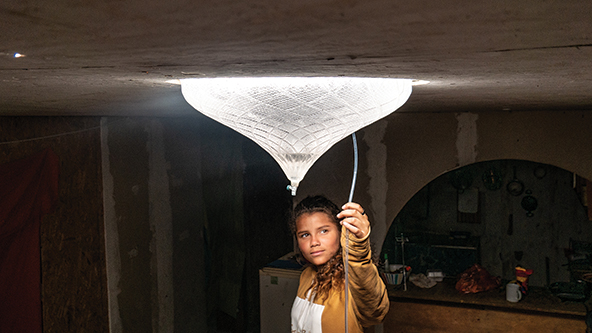
 The Solar Desalination Skylight uses solar energy to turn seawater into fresh water and uses the leftover brine to power batteries. (Photo courtesy of Henry Glogau)
Nearly 1.5 billion people live in parts of the world with high water scarcity. And if climate change worsens, that number will grow to nearly 6 billion people by 2050.
The idea of water scarcity may seem implausible on a planet filled with water: More than 320 million trillion gallons fill the world’s oceans and seas, covering two-thirds of the Earth’s surface. But its salinity makes most of it undrinkable. In fact, only 3 percent of the planet’s water—found in glaciers, lakes, rivers, swamps, or underground—is fresh water for human consumption.
In 2019, Henry Glogau decided to help solve the water scarcity problem. For his master’s thesis at the Royal Danish Academy in Copenhagen, the 25-year-old New Zealand architect took a new look at desalinating water. “I thought about how desalination, which has been around for hundreds and hundreds of years, could be applied within a new context,” Glogau says. “It was about trying to instigate a dialogue with the community about how you can access resources through very simple and low-tech solutions.”
Glogau traveled to Chile’s Atacama Desert—one of the driest places on earth. When he arrived in Nueva Esperanza (“New Hope”), an informal settlement on the outskirts of Antofagasta, the capital of Chile’s second region, he learned that it was not connected to the nation’s water and electricity grid. Chile is the only country in the world with a fully privatized water system. The consequence for many Chileans is lack of water access—especially in the country’s 802 informal settlements (favelas) that house more than 110,000 people.
To meet the community of Nueva Esperanza and better understand their needs, Glogau sought the help of Fernanda Monserrat Santos Acuña, a volunteer at Techo, a nonprofit that fights poverty by helping people construct transitional housing. Glogau learned that some water was delivered to the community in trucks, but they came infrequently. He also visited their homes and discovered that many were missing a functioning or secure lighting system.
The community did, however, have plenty of sunshine and salt water from the Pacific Ocean. To address the potable water and lighting issues, Glogau created the Solar Desalination Skylight, a conical lamp that transforms salt water into fresh water. The lamp is placed through the ceiling, with its back exposed to the sky and its belly filled with salt water. Heat and sunlight start the evaporation process, and the resulting water accumulates at the bottom of the lamp, from which it is extracted. The prototype—the resources for which Glogau funded from his own savings—produces about half a liter of water daily, and the remaining salt brine powers the light’s battery.
“I bring salt water from the ocean, we desalinate it, and then we use it in the kitchen,” says Alfredo Panameño, a resident of Nueva Esperanza who allowed Glogau to install the prototype in his kitchen.
Acuña also helped Glogau hold community workshops to re-create the Skylight’s design with material that was readily available. Today, according to Acuña, there are 10 active prototypes in the community that produce water, but, she explains, “we need a bigger prototype because the needs are bigger. We need something for communal shared use.”
Glogau acknowledges that his prototype doesn’t solve water scarcity, but it is the first step toward finding a better solution. After being named a 2021 Lexus Design Award Finalist, he received a four-month mentorship program, which he used to improve his design. Following the community’s advice, he worked on an iteration—a larger model installed not inside people’s homes but instead in strategic locations within the community that could serve multiple households simultaneously. Looking like a sizable reverse umbrella either held aloft by rods or hung with ropes between homes, Glogau’s Portable Solar Distiller won the 2021 Lexus Design Award out of a pool of 2,070 projects and received a prize of $25,000 to develop the prototype.
Glogau is committed to increasing the accessibility of his idea because, he says, “resource scarcity is going to become more and more of an issue, not just in developing countries, but also developed countries.”
Glogau plans to create a guidebook so that anyone can reproduce his designs. The architect is making his work open source, hoping that more designers and engineers will use the same approach.
“We need to break down the barriers for people to empower themselves and take ownership over their access to resources,” Glogau says.
Read more stories by Agostino Petroni.