


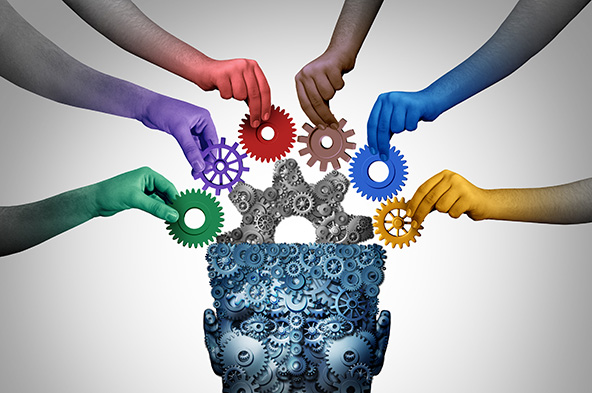
 (Illustration by iStock/wildpixel)
Many organizations claim to value people who “think differently.” Innovation, independent thinking, and challenging assumptions are celebrated in mission statements and leadership rhetoric. Yet the systems these organizations rely on to hire, evaluate, and promote employees often systematically filter out the very people most likely to think differently. Nowhere is this contradiction clearer than in how workplaces treat autistic individuals.
We write as a father-and-son research team that has firsthand experience confronting this persistent contradiction in modern workplaces. One of us a behavioral scientist, the other a neuroscientist; one neurotypical, the other autistic. Our collaboration has changed how we think about organizations, competence, and human potential.
Hiring processes tend to reward social fluency over competence. Performance evaluations often privilege style over substance. Workplace norms frequently equate professionalism with eye contact, conversational ease, rapid interpersonal responsiveness, and conformity to unwritten social expectations. Inclusion efforts, even well-intentioned ones, for neurodivergent employees often focus on helping them appear more like typical employees rather than on redesigning environments so that they and their divergent cognitive styles can genuinely thrive.
These practices reflect a deeper problem in how organizations understand neurodiversity. Autism is still commonly framed primarily in terms of deficit, accommodation, or social impairment. Yet a growing body of research in psychology, organizational behavior, and neuroscience suggests a more complicated and potentially more hopeful story. Some of the same cognitive and neurological differences associated with autism may also confer important organizational advantages, including greater resistance to cognitive bias, reduced susceptibility to conformity pressures, and a tendency to prioritize evidence over social consensus.
These are not marginal capabilities. They are increasingly central to organizational survival. Modern organizations operate in environments saturated with complexity, uncertainty, and information overload. Under these conditions, human judgment becomes especially vulnerable to distortion. Decades of research in behavioral economics and psychology have shown that people routinely rely on cognitive shortcuts that lead to systematic errors in thinking. Confirmation bias, motivated reasoning, overconfidence, groupthink, and moral rationalization all shape organizational decision-making in ways leaders often underestimate.
These distortions are not merely abstract psychological phenomena—they have real-world consequences. They undermine hiring decisions, generate ethical failures, and encourage excessive financial risk-taking, strategic blind spots, and cultures of silence. Entire industries have experienced catastrophic failures because people ignored contradictory evidence, deferred to social consensus, or failed to challenge flawed assumptions. To mitigate this risk, organizations invest enormous resources trying to improve critical thinking, reduce bias, strengthen ethics, and encourage candor.
Many autistic employees possess aptitudes that support these goals. Our own research, along with work by others, suggests that autistic individuals may be less susceptible to several forms of cognitive and social bias. In experimental studies, autistic participants have shown lower susceptibility to the bystander effect, meaning they may be more likely to intervene or speak up when something appears wrong. Other research suggests reduced moral disengagement, indicating a lower tendency to rationalize unethical behavior. Autistic individuals may also be less vulnerable to the inflated self-confidence associated with the Dunning–Kruger effect—the tendency of people with limited knowledge of a domain to overestimate their competence.
These findings should not be interpreted romantically or simplistically. Autism is not a superpower, nor do all autistic individuals share identical traits or experiences. Neurodiversity is diversity. But the broader pattern matters because it challenges long-standing assumptions about what constitutes valuable workplace cognition.
Failures of Organizational Design
Autistic individuals often appear to rely more heavily on principles and external evidence than on social inference when making judgments. In group settings, they may be less influenced by peer inaction, status hierarchies, or pressures for consensus. As a result, they may identify problems, inconsistencies, or ethical concerns that others overlook or avoid discussing.
Neuroscience research may help explain why some of these patterns emerge. Studies examining large-scale brain networks suggest atypical relationships among systems involved in social reasoning, external attention, and cognitive control. In neurotypical individuals, these systems often work together in ways that allow social information to fluidly shape attention and judgment. In autism, these relationships may be organized differently, producing greater emphasis on externally grounded information when social cues conflict with observable evidence.
These tendencies, when translated into organizational life, can produce a distinctive cognitive profile: greater focus on accuracy over impression management, reduced concern with how things appear socially, and stronger attention to how things actually are. Yet most organizations are not designed to recognize and incorporate these tendencies as strengths.
The barriers autistic employees face are often framed as individual limitations, but many are more accurately understood as failures of organizational design. Traditional hiring systems remain heavily dependent on unstructured interviews that reward charisma, improvisational social interaction, and familiarity with implicit norms. These characteristics have surprisingly weak relationships with actual job performance in many roles, yet they strongly shape employment outcomes.
Similarly, organizational cultures frequently reward interpersonal smoothness over principled dissent. Employees who question assumptions, point out inconsistencies, or communicate too directly may be perceived as difficult, inflexible, or insufficiently collaborative, even when their observations are accurate and valuable. In these environments, autistic employees often learn to mask their natural communication styles to appear more socially acceptable. Such masking can help individuals navigate workplace expectations, but at the psychological and cognitive toll of lost energy that could otherwise be directed toward performance, creativity, or problem-solving.
The result is not only inequitable for neurodivergent employees but strategically shortsighted for employers. When organizations systematically privilege conformity, impression management, and social sameness, they narrow the range of perspectives available during decision-making. They increase vulnerability to groupthink and reduce the likelihood that flawed assumptions will be challenged early. Diversity initiatives often focus heavily on demographic representation while overlooking cognitive diversity, even though organizations depend fundamentally on how people perceive problems, process information, and make judgments.
Designing for Neurodiversity
Designing for neurodiversity, therefore, requires more than accommodation. It requires rethinking how organizations define professionalism, competence, communication, and collaboration.
This begins with hiring. Organizations should rely less on socially performative interviews and more on work-sample tests, structured assessments, and evaluations tied directly to job-relevant competencies. Many autistic candidates perform exceptionally well when given opportunities to demonstrate actual skills rather than navigate ambiguous interpersonal rituals.
It also requires making organizational expectations more explicit. Many workplace norms operate through implication and social inference, creating hidden rules that advantage employees already fluent in dominant communication styles. Clarifying expectations around communication, feedback, meetings, and performance standards improves functioning for everyone, not just neurodivergent employees.
Leaders must also distinguish between professionalism and stylistic conformity. Differences in eye contact, conversational pacing, tone, or social interaction should not automatically be interpreted as disengagement, disrespect, or incompetence. Organizations committed to inclusion must create environments where employees can contribute effectively without constantly suppressing their natural cognitive styles.
Most importantly, organizations need cultures that genuinely reward evidence-based thinking. Teams function better when disagreement is not penalized, contradictory information is surfaced early, and employees are encouraged to challenge assumptions constructively. Neurodiverse employees often thrive in precisely these environments, but so do organizations more broadly.
The implications extend beyond autism. Designing organizations that accommodate different cognitive styles ultimately strengthens decision-making quality for entire teams. Systems that reduce ambiguity, clarify expectations, minimize bias, and reward principled dissent improve organizational functioning across the board.
Organizations today are facing increasingly complex social, technological, and ethical challenges. They cannot afford to rely on narrow models of competence or professionalism. Only those capable of integrating different ways of thinking—especially ways that challenge consensus, resist bias, and remain anchored in evidence rather than social comfort—are prepared to confront these difficulties and succeed.
Read more stories by Lorne Hartman & Braxton Hartman.