


On a rainy afternoon in East London’s Tech City, the British capital’s fast-growing technology district, Thomas Madar, an IT professional with no fewer than three master’s degrees, tells me about his lifelong challenge with finding stable work as an autistic person: “I didn’t fit into the team very well and found it difficult to socialize,” Madar recalls about his first job as a software engineer. After two uncomfortable years, his employer encouraged him to leave. Though other roles followed, he was twice made redundant, suffered spells of unemployment, and, in recruitment interviews, fared poorly against more extroverted candidates.
Madar’s career, however, took a turn last year when he accepted a position with Auticon, an IT and compliancy consultancy, all of whose consultants are on the autism spectrum. Recently engaged on a project for Virgin Money, he says that for the first time in years he is among “people who understand my condition”—and that makes a difference. Thanks to Auticon, he has newfound security, including the support of a job coach, a regular salary, and opportunities to put his skills to meaningful use.
Dirk Müller-Remus, a technology executive, started Auticon in Berlin in 2011. The father of a teenager on the autism spectrum, Müller-Remus was dismayed to learn that many highly qualified autistic adults were surviving on welfare benefits when they could have been earning a living. He also recognized that the strong abilities many autistic people possess—in pattern matching, detecting errors, and following complex protocols meticulously—were ideally suited to IT.
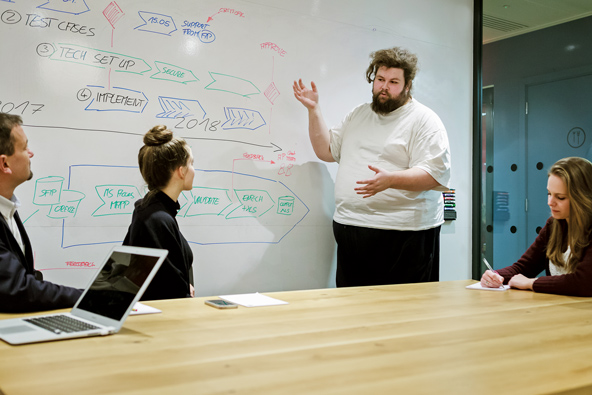 An Auticon consultant leads
a strategy discussion meeting
on feedback with team members
at the London office (Photo courtesy of Grey Corporate)
An Auticon consultant leads
a strategy discussion meeting
on feedback with team members
at the London office (Photo courtesy of Grey Corporate)
Most of Auticon’s consultants, despite their intellectual abilities, struggle socially. Many are hypersensitive to stimuli such as noise and bright lights, prefer set routines, and struggle with prioritization. The majority, consequently, have patchy résumés. “Around 80 percent of our consultants were [previously] unemployed, often long-term, and of the 20 percent who were employed, over half were in jobs that weren’t appropriate to their skill set,” says Auticon UK CEO Ray Coyle, whose London branch employs 23 consultants.
The waste of talent mirrors the wider picture of autism. According to 2016 research by the UK’s National Autistic Society, only 16 percent of autistic adults have a full-time job—yet 77 percent without employment want work. Auticon aims to change that. Founded with investment from the Ananda Social Venture Fund, it seeks to improve autistic people’s prospects, both as an employer itself and by persuading other companies to adopt autism-friendly practices. “We have one obvious goal, and that is to create as many jobs as possible for people on the autism spectrum,” explains Kurt Schöffer, Auticon’s Group CEO. “Then we have a second goal, which isn’t so obvious: By sending our consultants to work inside our clients’ IT teams, we want to change how society perceives autism.”
Now numbering more than 100 consultants across its operations, Auticon has expanded to seven locations in Germany. Having proven itself locally—with clients that include BMW, Siemens, and Allianz—it has opened offices in Paris, London, and Zurich; more offices, including a US launch in summer 2018, are in the works. Andrea Weierich, global head of central functions platforms at Allianz Technology, describes her experience hiring an Auticon consultant for a data project in 2014: “For us, it was really perfect, because his strength is pattern recognition, which is something that [many] people get bored by and sloppy about the more they have to do it.”
Resolutely Commercial
Auticon could have organized its workforce in many different ways. It could have located its consultants centrally and brought tasks to them, or it could have used remote technologies to support employees working from home. It decided to send its consultants out to work with its clients, thereby reaping a double benefit: The consultants get to work inside blue-chip companies on innovative IT projects, and the clients see how including autistic workers can benefit their business.
“We want to give as many people as possible the opportunity to work with an autistic person and to get an understanding that this is something to be embraced and not feared,” Coyle says.
Auticon’s model is resolutely commercial. Müller-Remus could have established it as a charity; instead, he founded a for-profit business that would sink or swim, based on its achievements. “Our belief is that we can have a social impact long-term only if we’re profitable long-term,” Schöffer explains, “because if we’re living on donations or government support, the [foundation] on which we build may not be stable.”
By turning a profit, Auticon challenges the narrative of autism as a handicap and shows other organizations the benefits of employing people who think, and sometimes behave, differently. For one, it charges its consultants out at market rates and pays them a salary in line with the remuneration of IT professionals in similar-sized consultancies. To live up to its own—and its clients’—high standards, however, Auticon must offer support structures well beyond what a startup would normally provide. This begins with recruitment. Applicants go through a rigorous assessment that hinges on their demonstrating capability by solving puzzles and coding challenges. Those who do well take part in a multiday workshop to determine whether they’re right for Auticon and Auticon is right for them.
Once hired, the consultants are paired with job coaches like Kirsty Wilson, who works in Auticon’s London office. She describes her role as giving her colleagues “as much or as little help” as they need to thrive professionally. That might mean supporting someone settling into a new assignment—many autistic people do not adapt readily to change—or negotiating with a client to adjust an Auticon employee’s working environment.
Torsten Schindler, a senior IT consultant in Munich, finds aspects of office life overwhelming, dislikes switching between tasks, and prefers e-mail to verbal discussion. “Autism, in my case, makes me more susceptible to stress, noise, [and] brightness and to colleagues who talk on their phone, causing my concentration to break down,” he writes in an e-mail. With the support of his job coach, he finds ways around these hurdles, such as having a desk placed in a quiet corner of the office and wearing noise-canceling
headphones to filter out distractions.
The coaches also support Auticon’s clients, who may have little knowledge about autism. At the start of each assignment, the job coach explains to the receiving team how the consultant’s autism might express itself in behaviors that to others appear rude. For example, many autistic people shy away from small talk because they trip over its unwritten rules. “There are many nuances that [a lot of] autistic people simply don’t pick up on,” explains Richmal Maybank, lead job coach at the London office. “Is it okay to ask the CEO about their weekend? Why is the weekend a topic for a Friday or a Monday, but not a Wednesday?”
A more thoughtful approach to accommodating autistic difference might bring wider advantages. When companies respect autistic coworkers’ capabilities, says Weierich, they send a message to people who “feel pressured to conform to norms that they find limiting” that they can be themselves and still be valued for their work.
A Budding Multinational
Though Müller-Remus started Auticon, Schöffer led its expansion. An IT entrepreneur by training, Schöffer invested in Auticon’s launch through the Ananda Social Venture Fund and, in 2013, accepted an operational role. For the next three years, the two men ran Auticon jointly. The phased transition worked to the young company’s advantage, allowing Schöffer to establish its operations on a secure footing while Müller-Remus honed the workplace practices required to realize his passionate vision for autistic employment. In 2016, Müller-Remus stepped aside, though he remains a shareholder and trusted advisor.
As CEO, Schöffer has sought investors who believe in Auticon’s mission and have faith in its ability to generate financial returns. He found a kindred spirit in Richard Branson’s Virgin Group, which became a shareholder in 2016. “We tend to invest only behind companies that we think can have the same return as a company without a social-impact cause, because we believe there’s no reason social impact should diminish return,” says Edouard Muuls, an investment director at Virgin Management who worked on the deal.
This willingness to put social goals before quick returns characterizes all of Auticon’s backers, most of whom, according to Schöffer, have some kind of personal connection to autism. As of midway through 2018, not one backer has asked for a dividend or talked of exiting. “For all of our investors, Auticon is more than an investment,” Schöffer notes.
For the small team charged with growing Auticon’s UK presence, the Virgin brand’s backing has generated publicity and opened doors—and the results show. “If you look at the UK, it was cash-flow break-even well before we expected,” says Muuls.
Yet even as it pursues growth, Coyle knows, Auticon has responsibilities to its employees and to society. “If we fail, there’s a danger that people will look at us and think, ‘That’s a business that tried to build financial success on the basis of recruiting people on the autistic spectrum, and it didn’t work,’” he explains.
While it’s less than a decade old, Auticon is competing against mainstream IT consultancies, winning repeat business, attracting investors, and scaling up from a Berlin-based experiment into a budding multinational company. And as it does all this, market by market, client by client, it is achieving its goal. “When one of our consultants sits on a team at BMW or Allianz, the people they work with talk to their colleagues; they talk to their families,” says Schöffer. “In that way, we change the perception of autism in society.”
Read more stories by Alicia Clegg.