


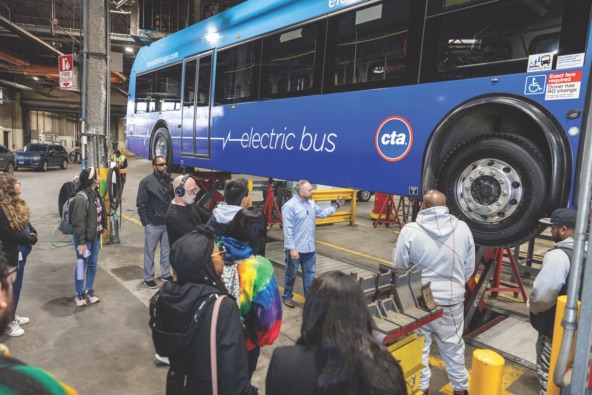
 Candidates learn about electric vehicle charging infrastructure for Chicago Transit Authority bus stations. (Photo courtesy of HIRE360)
Construction jobs, particularly those with union benefits, have long been a gateway to the middle class. However, long-standing exclusionary practices have foreclosed opportunities to many racial minorities and women. In a 2022 overview detailing the legacy of racism in union strongholds, The Philadelphia Inquirer stated that labor discrimination, “couched as union solidarity, has always been a part of the trades.” And a 2023 report from the US Equal Employment Opportunity Commission affirmed that discrimination “in recruitment, apprenticeships, and hiring blocks access to good-paying construction careers while unequal treatment … hinders advancement and pushes many women and workers of color out of the industry.”
Established in 2020, the Chicago nonprofit HIRE360 aims to diversify the industry—which generates approximately $2 trillion annually—by training underrepresented individuals for the construction trades. The organization also works with minority- and women-owned enterprises to expand their knowledge of, and access to, contract opportunities. “Everyone is at the table for the diverse contractors we’re helping to scale up and the candidates we’re helping get into apprenticeship programs,” says HIRE360 executive director Jay Rowell.
HIRE360’s roots date back to 2017, when a group of local developers, labor representatives, and other construction leaders held regular meetings to discuss the industry’s lack of racial and gender diversity. The organization currently consists of an eight-person board with more than 50 partners that include corporations such as Bally’s and Verizon, the Obama Presidential Center, various unions, and prominent local contractors.
Prospective tradespeople based in Illinois who are interested in HIRE360 can get started by filling out an assessment form on the organization’s website. After attending a HIRE360 orientation, applicants complete a sample test to gauge their interest in construction work. Candidates passing the sample test are then invited to take a follow-up aptitude test. Enrollees subsequently undergo approximately 150 hours of paid training with a partner company that involves math, spatial reasoning, and construction knowledge.
Growing up in Chicago’s predominantly Mexican-American Little Village neighborhood, 24-year-old Nicholas Gamino never gave a thought to construction jobs. “When I was in high school, nobody ever talked about the trades,” he says, ultimately having chosen to attend college. But after his mother’s cancer diagnosis, Gamino needed another way to assist his family financially.
When his mother told him about HIRE360 shortly after its founding, Gamino contacted a representative from the organization. He was accepted into the program and is currently enrolled in a five-year apprenticeship in electrical engineering. “I like working with my hands, seeing how things work, and breaking it down,” he says. Eventually, he hopes to be a project manager.
Contractors are also directed to an online form that assesses their needs. The organization then invites selected representatives to discuss business objectives, with a business plan tailored for each firm. HIRE360 provides financial assistance through a loan pool, which typically charges around 5 to 6 percent interest annually. So far, the organization has issued more than 90 loans.
Simply E&C, a family-owned electrical contractor based on Chicago’s West Side, is a HIRE360 business partner that has completed approximately 40 electrical projects since its founding in 2021. Simply E&C’s chief operating officer, Calvin Payne, credits HIRE360 for assisting the company in securing bank credit lines as well as providing funding from the organization’s coffers, which went toward collateral for work projects. “The benefit was more funding and more relationships,” Payne says. “With education, you know how to approach these situations and look at business and customers in a different way.”
HIRE360 has been supported by grants and donations, which in 2024 included more than $9 million from the state of Illinois as well as a $3 million contribution from philanthropist MacKenzie Scott. “I wouldn’t say I’m a big crier, but I started crying when I got it,” Rowell says about the surprise phone call he received from a representative for Scott informing him of the gift. HIRE360 used the money to complete its new 40,000-square-foot training center, which opened last September in Bronzeville, a predominantly African American neighborhood just south of Chicago’s downtown.
Looking ahead, Rowell envisions HIRE360 as helping the construction industry maintain a well-supplied workforce, since 41 percent of current employees are expected to retire by 2031. He also believes that the organization’s mission is especially important for maintaining diversity, equity, and inclusion in a time when such efforts are increasingly being phased out nationwide. “Everyone should have opportunities in this area,” Rowell says.
Read more stories by Kyle Coward.