


 An innovative sandbarcropping
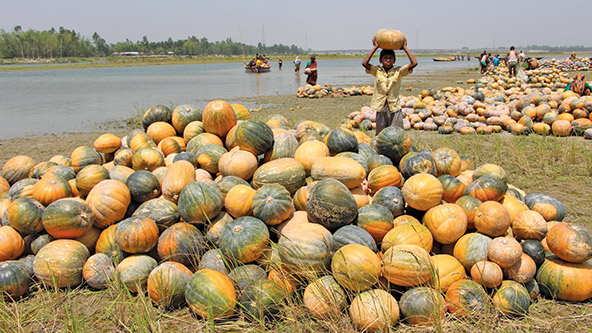
technique has enabled landless farmers in Bangladesh to grow pumpkins. (Photo courtesy of Securing Water for Food)
An innovative sandbarcropping
technique has enabled landless farmers in Bangladesh to grow pumpkins. (Photo courtesy of Securing Water for Food)
As Bangladesh’s annual monsoons give way to the dry season, vast sandbars surface as the rivers recede. Accessible from November until March, when they are swallowed by the returning rains, these sandy islands are, by all accounts, barren. But thanks to what local innovator Nazmul Chowdhury describes as a “Eureka moment,” they are now carpeted with leafy green plants, punctuated by the unmistakable orange of ripe pumpkins.
Nearly 15,000 impoverished, landless farmers, most of whom are women, now cultivate this otherwise unproductive land by digging and filling holes with pumpkin seeds, compost, and manure, resulting in nutrient-rich food to eat and surplus to sell. Chowdhury notes that soon his inventive approach will “be replicated by at least two big government institutions” in other regions of Bangladesh and, later, “in Nepal, Bhutan, and India.” It is projected to benefit millions of farmers, their families, and consumers throughout Southern Asia.
The success of this project, Pumpkins Against Poverty, in addition to dozens of agricultural innovations worldwide, is due to the support of Securing Water for Food (SWFF), one of 10 Grand Challenges for Development through which the United States Agency for International Development (USAID) and its partners address global issues.
SWFF—a collaboration between USAID and its Swedish, Dutch, and South African counterparts—functions as a hybrid incubator/accelerator. Its goal is to advance innovative products, techniques, and systems supporting water-wise crop production, in turn driving solutions to two of society’s most pressing and interconnected issues: freshwater availability and food security.
With a global population projected to reach nine billion by 2050 and freshwater resources under threat from climate change, pollution, salinization, and depletion, producing more food using less water is critical to human survival. Yet, crop yields are declining around the world, particularly in more arid regions—further elevating the gravity of the situation and the urgency for more productive, sustainable farming.
Developing nations are on the front lines of this crisis, which is why SWFF set out to support and scale innovations serving farmers in these communities. Now with 40 projects in 35 countries, SWFF has affected more than six million farmers and their families, produced more than six million tons of food, and enabled more than 19 billion liters of water to be efficiently captured and stored.
Uniting Aid and Innovation
In September 2013, USAID and Sweden’s international development agency convened to identify the most pressing challenges ahead and concluded that freshwater access and efficient food production warranted their immediate focus. The two nations collectively committed $25 million in funding, creating SWFF to “help the world produce more food with less water,” explains Ku McMahan, SWFF’s team lead at USAID’s Global Development Lab. In early 2014, the Dutch joined with another $7 million, and later that year South Africa came on board.
SWFF implemented a rigorous process to select its initial 30 winners from more than 500 innovators around the world seeking funds to grow and scale their projects. Depending on an innovation’s maturity level, SWFF awarded either $500,000 or $2 million over the course of a three-year funding cycle to projects spanning the globe.
Rather than follow the traditional government aid model where grantees are provided funding and simply required to submit progress reports, SWFF looked elsewhere for inspiration: business incubators and accelerators. “SWFF was initially an experiment,” McMahan explains, based on the belief that “grant funding alone was not going to help innovations move forward” but that the addition of “technical assistance and capacity building” could “speed up the rate at which they were growing and scaling and also reduce the number that were failing.”
His hypothesis proved correct: about one in 10 development projects succeeds. In light of SWFF’s novel approach—as well as its decision to condition the second and third years of funding on the innovators’ annual customer growth milestones—SWFF leadership expected a success rate of somewhere between 30 and 35 percent. Remarkably, 65 percent of SWFF innovators either have met or are on track to meet all their milestones, and nearly all SWFF graduates are still operating sustainably.
What makes SWFF different from traditional aid models is what makes it so effective. To set up its innovators for success, USAID contracted with business management consultancy The Kaizen Company to manage SWFF’s Technical Assistance (TA) Facility. It is a system designed to help innovators identify and access support to “overcome challenges that are inhibiting scale and revenue sustainability,” says Kevan Hayes, SWFF’s acceleration facilitator. The TA Facility and innovators work together, with USAID oversight, to determine what types of assistance “will be most valuable to the innovator[s] in achieving their goals,” Hayes explains. Then, following a formal bidding process, local vendors are selected to aid innovators in a range of services, including branding, marketing, and sales strategies; business model development; and strategic expansion planning.
This sustained, targeted support has proved effective for SWFF innovators. For example, Chowdhury’s Pumpkins Against Poverty project initially relied on a charity-based funding model. The TA Facility identified a business and organizational model that, according to Hayes, “would give the [project’s] pumpkin grower association the best opportunity to run a revenue sustainable operation and decrease its dependence [on] financial support.” This shift was transformational for Chowdhury, now a SWFF graduate who has identified dozens of other high-value crops that can be cultivated under similarly challenging conditions.
South Africa-based computer scientist Muthoni Masinde attributes the success of her drought early-warning system, Information Technology and Indigenous Knowledge with Intelligence (ITIKI), to SWFF. Before SWFF, Masinde’s self-financing limited her deployment of ITIKI to her own people, the Mbeere in Eastern Kenya. Masinde’s $500,000 SWFF award, coupled with a branding, sales, and marketing strategy, has enabled ITIKI to expand to South Africa and Mozambique, and is now, she reports, in “the early stages of franchising.”
One of SWFF’s greatest success stories to date takes place in and around West Africa’s Sahel region, where farmers face a serious predicament: There are no wetlands, they know little about water technologies, and there is very limited access to capital. Armed with $2 million in SWFF funding and assistance in developing its business model and forging the most viable paths to its target customers, SkyFox Ltd.’s integrated aquaculture and crop production system now leases ponds and land to farmers in Ghana, Burkina Faso, Sierra Leone, Guinea, and, soon, Liberia.
In just two years, SkyFox helped produce nearly 70,000 tons of catfish and vegetables, serving close to 75,000 people. The program has so profoundly benefited its extremely poor, female-majority customers that SkyFox has recently been invited by the Ghana Securities and Exchange Commission to list on the nation’s alternative stock exchange (the Ghana Alternative Market) for small and medium enterprises. Deputy CEO Oliver Ujah acknowledges SWFF’s assistance in “helping to facilitate the partnership and buy-in of relevant government agencies”—relationships that will likely prove invaluable to SkyFox’s dream of being “able to replicate [its system] in every country in West Africa in the next five to 10 years.”
Amplifying Global Impact
Seven years after the SWFF experiment began, McMahan is enthusiastic about the launch of a new Grand Challenge for Development, Water and Energy for Food (WE4F). Featuring a more robust $61 million budget due to additional funding commitments from Germany and the European Commission, WE4F will build on the successes of SWFF—which is nearing completion—and capitalize on what McMahan considers “lessons learned” to amplify global reach.
For example, recognizing that “being more local is more effective” and “leads to more rapid scale,” McMahan reports that one key new feature will be the addition of “Regional Innovation Hubs” in strategic locations in West Africa, East Africa, the Middle East, and Southeast Asia. A primary goal of these hubs is to promote a more responsive, effective TA Facility by virtue of being closer to the ground and more ensconced in the served communities.
The regional hubs will also foster progress at a higher level. McMahan acknowledges that “as donor governments, we have a role to play.” By working locally, he says, “we will be able to do more” from a “policy and advocacy” perspective, and ultimately “have a lot more impact.”
Another way that WE4F will expand SWFF’s global footprint is by funding and accelerating more mature innovations that are ripe for rapid scaling and external financing. That a number of SWFF innovations—including ITIKI and SkyFox—will receive WE4F’s next-level support underscores SWFF’s legacy.
So too does the continuing impact of SWFF innovations around the world. For example, the once landless farmers growing pumpkins on Bangladesh’s temporary sandbars have, according to McMahan, experienced “significant movement … out of poverty” and have been able to purchase land, start new businesses, and educate their kids. In fact, he reports, interviews with more than 500 farmers around the world “consistently” show “that when farmers make more money,” they “often spend it on putting their kids in school.”
With WE4F poised to scale up SWFF’s impact, the next generation of innovators are on the horizon.
Read more stories by Ariane Sims.