


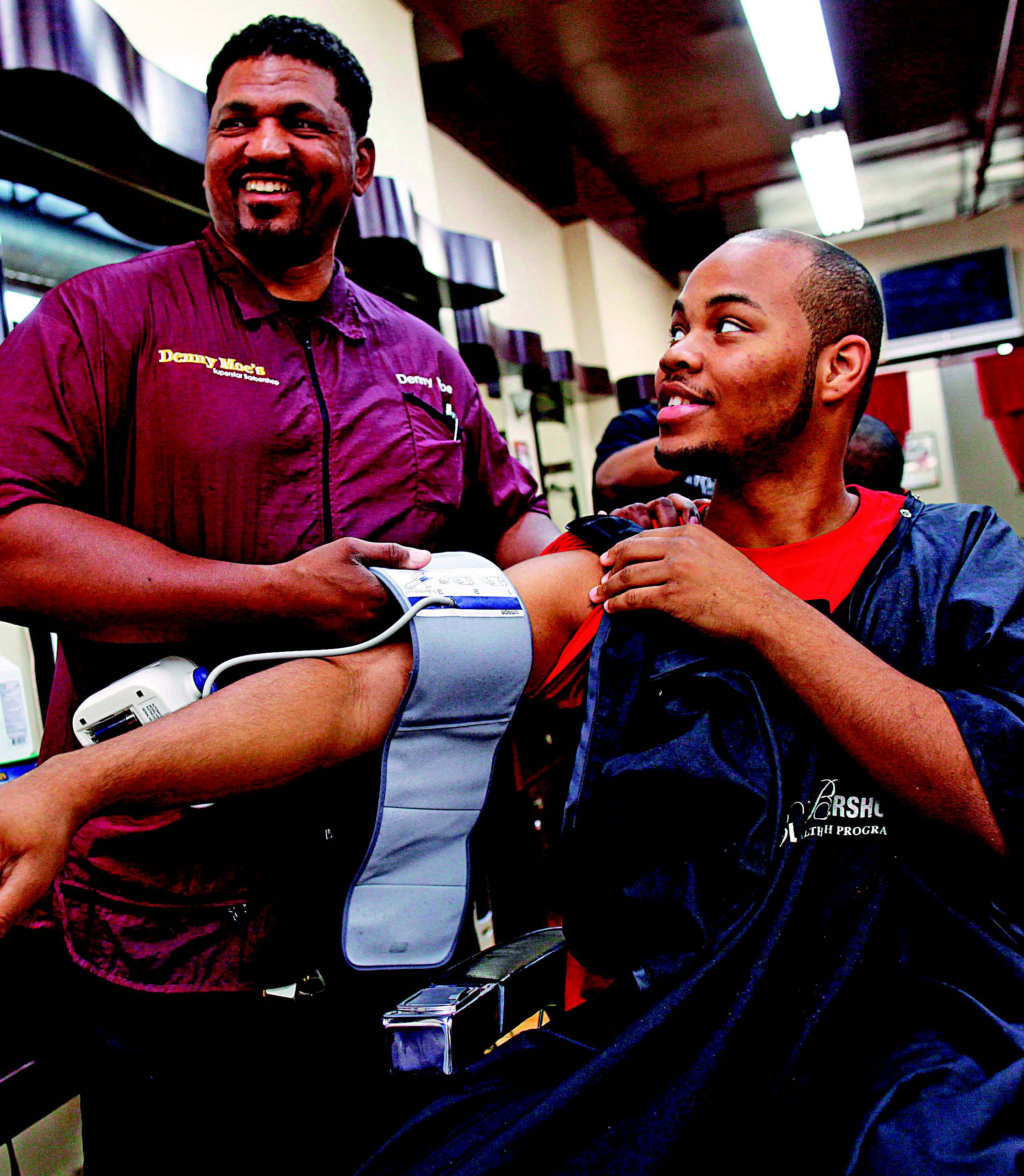
 A barber at Denny Moe’s
Superstar Barbershop
in New York City checks a
customer’s blood pressure. (Photo by Shannon Stapleton, Reuters/Alamy Stock)
A barber at Denny Moe’s
Superstar Barbershop
in New York City checks a
customer’s blood pressure. (Photo by Shannon Stapleton, Reuters/Alamy Stock)
“Jerry,” an African-American man in his 40s, walks into his local barbershop in Dallas for his monthly haircut. While he waits, he notices a large poster on the wall showing a picture of a man he’s seen before at the shop. The poster quotes the man that it pictures, describing his participation in a blood pressure monitoring program run by the barbershop and how it persuaded him to overcome his reluctance to see his doctor and finally get his hypertension under control.
When it’s Jerry’s turn, he sits down in the chair, and the barber runs the clippers through his hair. They begin to chat, but instead of asking about sports or family life, the barber asks Jerry what he knows about hypertension. When the haircut is complete, the barber pulls out a blood pressure cuff and offers to check Jerry’s numbers. He sends Jerry home with a wallet-sized BP Report Card and tells him that if he comes back with the card signed by his doctor, he gets a free haircut.
This kind of scenario is currently playing out in barbershops across the United States, though the details of who does what may vary. It represents an approach we call “embedded education”—the practice of educating people through everyday encounters within organizations or other social relationships that exist primarily for noneducational purposes.
Education about hypertension in a barbershop is just one example. In Guangxi, China, foremen on road construction sites engage work crews in games and in conversations about HIV/AIDS prevention. In Ghana, employees at rural banks invite clients to training sessions on Malaria prevention. And in Zambia, microfinance institutions (MFIs) offer financial education alongside their standard banking services. The list goes on.
Embedded education is an important but largely unsung innovation in education with the potential to reach millions of youth and adults across the globe who would not otherwise have access to lifelong learning opportunities. It capitalizes on what we know about lifelong learning and behavior change, and stands at the frontier of public service delivery innovation. As a sophisticated multisector effort to improve the quality of life, it is an innovation in governance as well.
In this article, we look at the problems that embedded education addresses, what it does, and how it does it. We present examples of how education providers have designed and run these programs and the challenges they face, using three primary case studies and additional examples from across the globe. What we show is that embedded education works, but it remains an innovation with potential rather than an innovation that has been implemented on a large scale, primarily because of the governance challenges it faces.
Why Embedded Education?
Education provides individuals with knowledge and tools to lead healthier, happier, and more productive lives and to realize their full potential. Education is also an engine of social and economic development, of learning in literacy, numeracy, health, parenting, farming techniques, environmental stewardship, money management, disaster preparedness, and other subjects that benefit not only individual learners, but also their families and communities. In an increasingly complex and rapidly changing world, out-ofschool youth and adults have to engage in continuous learning to keep pace with and understand the world in which they are living and trying to make a living.
Organizations across a wide spectrum of social, economic, and public policy arenas have recognized this need for lifelong learning. The United Nations Educational, Scientific, and Cultural Organization’s (UNESCO) Fifth Conference on Adult Education in 1997 ended with the Hamburg Declaration on Adult Learning, which called lifelong education “a key to the twenty-first century” and “both a consequence of active citizenship and a condition for full participation in society.”1
Around the globe, central banks and ministries of finance have recognized the need for the financial education of adults, not only to improve their economic well-being, but also to provide additional stability to the financial system. According to the Organization for Economic Cooperation and Development (OECD), as of August 2014, 55 countries were developing national financial education strategies, which included education for adults.2 And in the area of health policy, a great many initiatives seek to educate individuals on how to decrease morbidity and mortality from diseases and conditions such HIV/AIDS, diabetes, and hypertension.
Still, many adults and out-of-school youth do not have access to high-quality opportunities to gain new knowledge and skills through formal education. They may lack the time or resources; the educational infrastructure may be poor or nonexistent; the formal educational system may not teach what people need or want to learn; or marginalized individuals may simply not feel that formal education is “for me.” There is a tremendous need for new and innovative ways to educate people who do not or cannot access formal education.
To enable people to make informed choices that can improve their lives and well-being, it is vital to find efficient and effective new modes of education. Embedded education is one such method. It takes advantage of existing relationships between individuals and organizations (companies, service providers, public agencies, nonprofits) or within social networks to deliver content that learners can act on—often in the moment or soon after. It is an education model with abundant potential to scale up; the primary constraint is the size of the organization, network, or delivery system through which it operates.
What Is Embedded Educated?
There are many examples of embedded education programs in progress across the globe. We focus on three that exemplify the phenomenon and have undergone enough scrutiny by researchers for us to say that the education process worked.
The first example concerns a health education program developed by a team of public health researchers from US universities. In partnership with the international NGO Freedom from Hunger, the team collaborated with a network of rural banks that offer banking and microfinance services in Ghana. The banks provided clients with group information sessions on malaria when they came to make loan repayments or deposit their savings at the bank each week.
The second example concerns a financial education program developed by Microfinance Opportunities, a nonprofit organization based in Washington, D.C. The program piggybacked on a partnership between VisionFund Zambia (a nonprofit microfinance institution) and a mobile payments platform called Zoona. The goal of the partnership was to use Zoona’s platform and agents to disburse loans to VisionFund clients. With the support of Microfinance Opportunities, the partners provided education about basic money management to their clients alongside education about using the mobile payments platform.
The third example concerns a health education program developed by a team of doctors from US medical institutions. They partnered with barbershops in Dallas to test whether providing blood pressure checks and education to African-American barbershop patrons could help reduce uncontrolled hypertension among clients. Barbers provided blood pressure (BP) checks and education to their customers over a 10-week period.3
When people show up to get a haircut or make a payment on a loan, they may not expect to be on the receiving end of an educational encounter. But it is precisely the routineness of these interactions that makes embedded education such a promising avenue for innovation in education. Whether an individual is interacting with an organization as a customer, constituent, member, or employee, there is a live, in-person meeting during which valuable information can be conveyed. If these individuals learn something interesting and directly relevant to their lives, there is an opportunity for them not only to act on new knowledge but also to share their new knowledge with family, friends, and neighbors.
The online Merriam-Webster Dictionary defines the verb “embed” as “to enclose” or “to make something an integral part of something else.”4 Several levels of meaning are inherent in the idea of “embeddedness” in an embedded education encounter. Educational content is embedded in a meeting between people who have a primary relationship other than that of educator and learner. When a representative of a bank makes a weekly visit to a village in Ghana, her explicit reason for being there is to collect savings deposits and loan repayments. When she invites clients to join an information session on malaria prevention, educational content becomes embedded in a relationship that previously revolved around monetary transactions.
The second level on which the idea of embeddedness operates comes from Stanford University sociologist Mark Granovetter’s famous assertion that economic actors are embedded in social relations and that these relations shape their economic transactions with other actors. In other words, people are more inclined to transact with people they know and trust. The trust inherent in these social relationships greases the wheels of the economic transaction.5
Similarly, embedding education in an existing organization or network makes use of the social relationships and trust that already exist between those entities in that social setting. This dynamic is especially important in the Dallas barbershop case, which takes its strength from the familiarity and camaraderie of the barbershop environment. As the designers of the program note, “Uncontrolled hypertension (HTN) is one of the most important causes of premature disability and death among non-Hispanic black men. … [HTN] is a chronic medical condition that requires frequent physician interaction for initiation and adjustment of prescription BP medication. Compared with black women, men have less frequent physician contact for preventive care and thus substantially lower rates of HTN detection, medical treatment, and control.”6
In other words, African-American men do not necessarily lack access to clinics and hospitals; they simply are reluctant to go. In a TED talk on the subject, Joseph Ravenell, one of the doctors at the helm of the Dallas study, explains, “For many, the doctor’s office is associated with fear, mistrust, disrespect, and unnecessary unpleasantness. … [Y]ou might wait for hours only to get the run-around and to be evaluated by a stoic figure in a white coat who only has 10 minutes to give you, and who doesn’t value the talk.” Ravenell goes on to explain that “because the barbershop is a place of connection, loyalty and trust, it’s a place where you’re more open to have a conversation about health—and especially about high blood pressure.”7
The final level of embeddedness has to do with the position the individuals on the receiving end of the education occupy within their communities. We are all embedded in families, neighborhoods, and social networks. When individuals share what they have learned with the people they know, the learning has ripple effects and eventually becomes, in a sense, embedded in a broader community, which may benefit from the knowledge and ensuing sense of empowerment that the individual brings home from the embedded education encounter. (For a diagram of how this works, see “Embedding Education in an Encounter” below.)
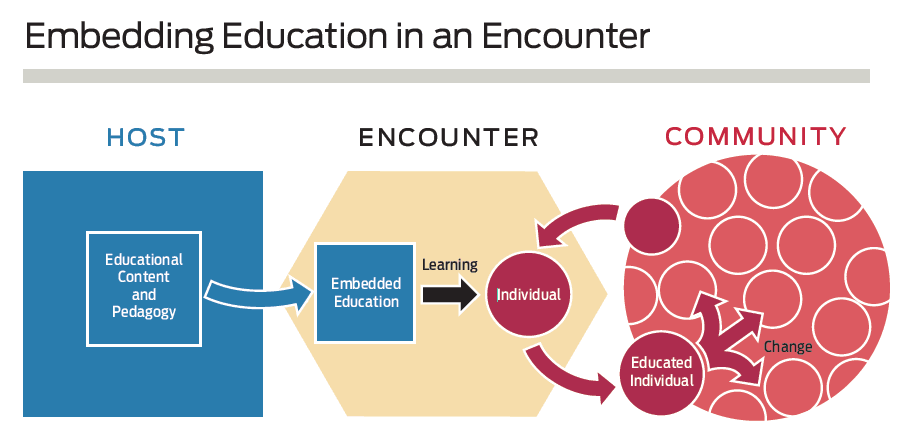
We call the existing organization that hosts the relevant relationship (e.g., the barbershop, bank, or MFI) the “host.” The host comes into contact with an individual, who is situated within a particular community, in a routine encounter. In the embedded education version of the encounter, educational content reaches the individual during the encounter, and learning occurs, creating an opportunity for individual and community change.
Harvard University professor Richard Elmore argues that the core of education is a meaningful interaction between educator and student in the presence of content.8 In taking advantage of previously existing relationships and routine encounters, an embedded education approach has the potential to create this kind of interaction in a way that other efforts to reach those in need of lifelong learning opportunities, such as mass online education or broadcasts, do not.
Where the educational infrastructure is thin or where people have a fundamental mistrust of organizations or networks where they might otherwise receive education, those interested in reaching individuals with knowledge that improves their lives and communities have to take advantage of whatever interactions exist with their target population. Those encounters occur in all sorts of different guises, in many parts of the world. The challenge then becomes how to utilize them for embedded education.
Implementing Embedded Education
To understand how embedded education works, we have to understand two important things: what setting the education is embedded in, and the nature of the education being provided. A wide variety of institutions, networks, and relationships stand as potential channels for the provision of educational content, and an embedded education program could address a wide variety of topics. Some settings may be appropriate for particular types of content, while others may not. Similarly, a particular pedagogy may work in one situation for one type of knowledge but not in another. Implementing an embedded education program means finding the right fit among the target community, the host organization, and the educational content and pedagogy.
Embedded in what? | The organizations that designed, developed, and supported the implementation of the programs (“program designers”) in Ghana, Zambia, and Dallas were focused on creating embedded education programs that produced specific outcomes: malaria prevention, money management, and hypertension control. The host organizations that the program designers chose to work with represented a variety of different organizational types, and differed in the services they delivered and whom they served. In Ghana the hosts were rural banks; in Zambia they were a nonprofit MFI and a B corporation (Zoona); and in Dallas the hosts were for-profit small businesses (barbershops).
The rural banks in Ghana and the MFIs in Zambia provided similar services, though the banks in Ghana provided both savings and loans while VisionFund in Zambia provided only loans. The populations that the banks and MFIs served also shared similar characteristics— low-income, rural women with limited education—though, of course, the Ghanaian and Zambian contexts are very different in terms of culture and geography. The barbershops provided a completely different service—haircuts—to urban, African-American men, most of whom had at least a high school education. These differences are critical to understanding the design and implementation details of the programs.
At a simple level, the choice of host organization depends on whom the program designer is trying to reach—host organizations give access to particular types of people. The program designer also has to think about whether they want to reach a particular group of learners through an organization that is providing a service related to the content of the education. Is an MFI the best vehicle through which to deliver financial education? This is a choice that has implications for both how the education works in practice and how well the interests of the program designer are aligned with the host organization.
At the level of education practice, educational content that is related to the service the host organization provides can enable learners to act immediately on what they learn. In Zambia, the borrowers could use their new skills in tracking income and expenses to make sure that they had enough money to make their loan payment each month. In terms of alignment of interests, this situation seems to be a “win-win-win”—the educator is able to provide content on which learners can act, the learners are better off, and the host benefits from the change in behavior of its customers. But there are downsides to this: What if the staff of the host organization only presents information that highlights the benefits of the product or service that their organization offers? When the education curriculum includes a discussion of other options that happen to be offered by a competitor, will the staff do this in an unbiased manner?
Providing malaria education through a rural bank can also result in a “winwin- win”—the program designers deliver content through a trusted partner, the clients learn how to avoid a debilitating disease that prevents them from working and caring for their children, and the bank has healthier customers who are in a better position to repay their loans and make savings deposits. In this instance, there is no incentive for the host organization staff to “cheat” on the content, because it is all to their benefit. These types of issues are among the governance challenges that embedded education programs face and must overcome to become sustainable in the long run.
Beyond the high-level differences around organization type, services, and customers are more concrete operational details about the location of the encounter between educators and prospective learners and what goes on during the encounter. In Ghana, the bank staff met their learners during weekly meetings when clients made loan repayments, received loan disbursements, or made savings deposits or withdrawals. In Zambia, encounters between VisionFund and their learners took place during group loan meetings with the loan officers and at the MFI’s branches when clients made loan repayments. Clients also had direct contact with Zoona’s mobile money agents—the people who would cash out the loan approval notification that the borrowers received on their mobile phones—when they went to collect their loan disbursements. In Dallas, the encounters took place in the barbershop and included both the time waiting to get a haircut and the time in the chair.
For both the staff and the prospective learners in Ghana and Zambia, the education component was an additional activity that could not be done at the same time as the regular work of financial transactions. This meant that the educational activity increased the time that staff and customers spent in meetings with one another. The hypertension education in the Dallas barbershops was less time-consuming for barbers and patrons, because much of the encounter occurred at the same time as the haircut—as a parallel activity. Barbers delivered messages to customers while they were in the chair, and customers read posters while waiting or sitting in the chair. Nevertheless, unlike in Zambia and Ghana, the program compensated barbers for their participation: $3 for recording a patron’s blood pressure, $10 for getting a patron with high blood pressure to speak with the study nurse about seeing a doctor, and $50 for each BP Report Card that came back with a doctor’s signature.
The practice of compensating barbers is not uniform across all barbershop health education programs, nor is the extent of the barbers’ involvement in delivering the education. In other barbershop initiatives, program designers recruit barbers with an appeal to their sense of community and may use volunteer health workers placed in the barbershops to provide the education.9
At a more mundane level, the physical characteristics of the places where the education happens have consequences for the types of materials that the frontline educators use. In Ghana and Zambia, the education activities took place in a variety of indoor and outdoor settings. This required the training tools (workbooks, posters, instruction sheets) to be portable, durable, and weatherproof. In contrast, in Dallas the education took place inside barbershops—a controlled environment that did not require any special materials for posters, brochures, and other educational materials.
Educational practice | Program designers pay careful attention not only to the existing relationships and settings into which they embed their programs, but also to the structure and content of their curriculum and the pedagogy used to deliver it. In the three examples, the program designers had a particular learning objective in mind: changing the money management behaviors of rural women in Zambia, preventing malaria in Ghana, and increasing hypertension control among African-American men in Dallas. But what content should be delivered, and how, depended on the specific needs of the learners and the nature of the encounters. For example, because African-American men are less likely than their white male counterparts to have contact with a physician, the educational content included concrete action steps to promote contact with a physician. The pedagogy used role models (peers who patronized the same barbershop) to normalize hypertension and make it acceptable for the other customers to do something about it.10
The money management curriculum in Zambia also included concrete steps for women to follow and offered simple tools to enable them to track their income and expenses, create a budget, create a savings plan, and make more informed decisions about when to take out a loan and from whom. Parts of the curriculum were tailored to the specific interests of the women entrepreneurs who were most likely to be VisionFund customers. For example, in the part of the curriculum that covered tracking income and expenses, the women learned about the importance of separating the cash they needed to run their business from the cash they needed to support themselves and their families.
A crucial part of any embedded education program is the training given to the people (“educators”) within the host organization who will deliver the educational content to the learners. This training alone requires the development of a curriculum that will appeal to the would-be educators. The curriculum must both develop their expertise in the subject they are teaching and train them in a pedagogy that will engage the learners. For example, the Colorado Black Health Collaborative, which runs another barbershop program, provides its volunteer educators with a curriculum that covers the cultural significance of the barbershop space, health characteristics of the African- American community, and dietary and genetic predispositions that affect the target population.
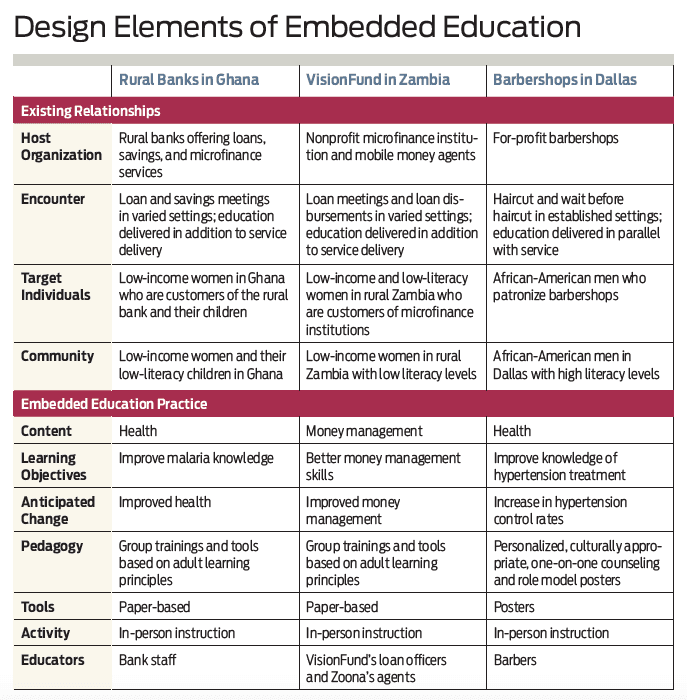
Any embedded education program is grounded in two basic design elements: a set of existing relationships between host organizations and the target population and a set of educational practices. Understanding the composite parts of these two elements and how they interact is important. (See “Design Elements of Embedded Education,” above.)
Inter-Organizational Challenges
An embedded education program cannot function without harmonious interaction and thoughtful coordination between the program designer and the host organization. The program designer’s focus is on education, but the designer has to understand and find common ground with the interests and concerns of the host organization. This is especially important for the long-term sustainability of the program.
In the three examples, the program designers were all conducting research to test the effectiveness of the education.11 They used third-party funding for the development of the program and sought the cooperation of the host organizations to implement it, during a time-bound period; the host was not asked to pay for any of the development costs.12 In Zambia and Dallas, the host organizations were also paid for their participation. The minimal preparatory work and commitment that the program required from host organizations made collaboration less onerous. When the study was over, they could decide for themselves whether to continue the program or not.
The fact that the program designers brought money to the projects they helped implement raises questions about the sustainability of the programs. In Zambia, the financial education continued once the researchers had completed their studies, but not in a systematic manner. In Dallas, the intervention studied by the researchers ended, but barbershop health education programs are increasingly commonplace in American cities.
Other cases we have studied suggest some promising means by which to sustain collaboration between program designers and host organizations. In research we conducted on an HIV/AIDS prevention program implemented by the Asian Development Bank (ADB) at highway construction sites in southern China between 2008 and 2015, we found that the contractors working on the expressways participated in the education programs because they were required to do so as part of the loan agreement between the ADB and the Chinese government.13 The ADB’s “Strategy 2020” commits the development bank to continued support for HIV/AIDS prevention efforts in the infrastructure projects it supports.14 The Chinese government now requires HIV/AIDS prevention education to be included in all road-building contracts it supports, but it is unclear how or whether this is enforced.
Also in China, Business for Social Responsibility (BSR), an international nonprofit organization whose membership includes many large multinational corporations, has been providing embedded health education for women working in members’ supplier factories since 2007. The program has reached more than 100,000 women, and BSR has gathered data to suggest that its efforts had a positive impact on the factories’ bottom line by, for example, reducing workers’ absences due to ill health.15
To ensure a program’s long-term sustainability, those interested in promoting embedded education programs have to pay careful attention to the interests of the host organization and other organizations, such as third-party funders or government regulators. Where there is a potential business argument for the program, as there is for an MFI or bank offering financial education or a factory in China offering health education, the program designer has to document the value that the program creates for the host organization. In instances where the benefits of the program are less likely to accrue to the host organization, such as the barbershops, the program designer has to identify a third-party funder who is willing to commit to funding the program in the long term or find another way to align the interests of the host organization with the objectives of the program.
Intra-Organizational Challenges
Within host organizations, embedded education programs must strive to incorporate the varied concerns of the middle managers and the staff who directly interact with the learners and have priorities other than providing education, such as getting a road built or cutting hair. The malaria education that took place in Ghana required bank staff to make interactive presentations over 10 weeks. Each session lasted 40- 60 minutes. In Zambia, the credit officers reported that the financial education program made their jobs easier, as they saw an improvement in customers’ debt management and, as a result, spent less time chasing down delinquent payers.16 But they also did not implement all of the financial education modules because they deemed some of them not relevant to their clients and therefore a poor use of their time.17
Embedded education relies heavily on those directly delivering the education. The program must be designed to create the necessary space and time for the education to be delivered, but design cannot do it all. The program must consider the concerns and limitations of the amateur educators delivering the education. In many situations, there are likely to be trade-offs, short-term or long-term, between their core activities and the provision of education. The nature of potential trade-offs and how the educators think about them is an important governance issue. When senior management of a host organization agrees to work with a program designer to embed education into her organization, the work of convincing middle managers and other staff of the value of the program remains.
There may also be issues around what the educators are comfortable doing—they were hired to do a certain job, and now they are being asked to do another. This can play out in multiple ways: the core activity and the education activity may turn out to be compatible once the educators get used to it; the education activity may reveal the shortcomings of the way the core activity was done and lead to a new approach, which, in turn, may change the organization’s hiring practices; or the employees may simply leave the organization rather than persevere with the education program.
If an embedded education activity becomes a part of the host organization’s routine business, there are implications for the organization’s overall human resource policies. Human resource managers must determine whether or not their current workforce is capable of delivering the education, and whether the cost of training them is worth the benefit that the education creates for the organization and its customers. If the current workforce is incapable of delivering the education, even with good training, does a manager then change his or her approach to staff recruitment? And, if so, at what cost in terms of changes in recruitment procedures and wages?
These types of questions may also arise in a context where staff turnover is very high. This is certainly the case for MFIs in the developing world, where average staff tenure may be a year or less. The question then becomes: Is the extra training that the embedded education requires worthwhile, given how frequently it must be repeated as new staff come on board? The answer depends on the marginal cost of the additional training, which may be minimal once it is incorporated into the regular training schedule; whether the training can be used to induce greater staff loyalty to the organization because they value the training they receive; and whether the education does have its projected impact on the learners.
Challenges at the Point of Encounter and Beyond
Finally, the success of the project relies heavily on the efforts of the learners who coproduce the outcomes of the education process. Organizations designing the education and host organizations need to test their assumptions about the learners and understand their preferences and concerns before they can appeal to their intrinsic needs and values and tap their capacity for learning and change.18 In the first instance, the program design can and must address these issues, but the host organization and its educators have to be prepared to work with both learners and program designers to adjust the design to accommodate the concerns of the learners and engage them in a co-learning process.
A simple example of this is learner attendance at education sessions. In Ghana, the researchers found that attendance at the malaria education sessions was not 100 percent for all 10 sessions.19 The program anticipated this and designed sessions “to combat inconsistent attendance by actively encouraging attendees to share what they learned with absent clients and by reviewing key points at each new session.” The researchers were “unable to measure how successful these strategies were” but noted that “nevertheless, the lack of any significant differences in knowledge between women attending regularly and those attending infrequently … suggests that these strategies were likely to have been effective.” 20 In other words, the embedded education program relied on the learners to educate their peers who could not make it to all the sessions. The sessions were designed to address this, but, ultimately, it was up to the learners to respond appropriately.
Those developing and implementing an embedded education program cannot take for granted the collaboration of all the stakeholders involved. They cannot assume that a loan officer will willingly deliver content during a loan meeting when part of her pay is contingent on the number of loan applications she can successfully get approved. They cannot assume that the learner is not just sitting through the education encounter in order to get the loan that she so badly needs. They cannot assume that the owner of a barbershop is willing to ensure that each of his barbers raises the issue of hypertension with every customer sitting in his chair. And they cannot assume that the barbers will be capable of raising the issue appropriately, even after training. Although the design of an embedded education program can address these issues at the operational level, these governance challenges require the active engagement of different stakeholders and an ability to respond to their concerns by changing the design as needed.
Scaling Sustainable Embedded Education
Billions of youth and adults need lifelong learning to gain control over their own well-being and that of their environment in this increasingly complex and dynamic world. The case studies from Ghana, Zambia, and Dallas show that embedded education works.
In Ghana, at the end of the study, the bank clients who received the malaria education knew more about malaria and were more likely to own insecticide-treated bed nets to protect themselves and their families from mosquitoes than other groups in the study who either did not get the malaria education or did not get it through a bank.
In Zambia, the program got positive reviews from the staff of VisionFund, and pre- and posteducation surveys revealed changes in both the knowledge and the behavior of the clients. Those who received the financial education tended to be more conservative in how much they applied to borrow after they received the education. This reflected one of the key lessons in the debt management module of the curriculum, which taught learners to borrow only what they could afford and needed for the particular purpose they had in mind for the loan.
In Dallas, the barbershop customers who received education on hypertension from their barbers showed higher rates of hypertension control than customers who did not receive any education or received only literature.21
These three case studies demonstrate how embedded education is an innovation that accomplishes social goals more efficiently, more effectively, and more equitably.22 They also provide three important lessons for those interested in creating embedded education programs:
- By leveraging existing assets and infrastructure (such as distribution networks and service encounters), one can deliver education and reach hard-to-reach target groups much more efficiently than if one had to create new channels from scratch. Piggybacking is a huge cost-saver.
- By creating real educational encounters rather than broadcasting information, embedded education is a more effective way to change behaviors; it engages clients as learners and draws on pedagogical principles associated with deeper learning and internalization of the educational content.
- By focusing on disadvantaged individuals and communities that do not have access or have not had access to formal education and other services that can help them improve their lives, embedded education contributes to an equitable distribution of knowledge, skills, and information.23
The key to the success of the education programs in Ghana, Zambia, and Dallas was a well-thought-out educational encounter in which amateur educators delivered information directly relevant to the learners in an engaging manner, with clear recommendations for “next steps.” Nevertheless, these programs, and others like them, face challenges that may explain why embedded education remains an innovation with great potential, and not yet an innovation that has achieved a large scale. One of the biggest challenges is around governance, something that can undermine even the best-designed programs. But these challenges can be overcome through a strategic approach that recognizes the vested interests of stakeholders and lines up resources to take those interests into account.
To those interested in improving the lives of disadvantaged youth and adults, the world offers up a myriad of potential venues and topics for embedded education. As Ravenell asks listeners in his TED talk, “What do you see? What is your barbershop? Where is that place for you where people who are affected by a unique problem can meet a unique solution?” He ends by exhorting the audience: “When you find that place, seize the opportunity.”
Read more stories by Guy Stuart, Jorrit de Jong & Linda Kaboolian.