


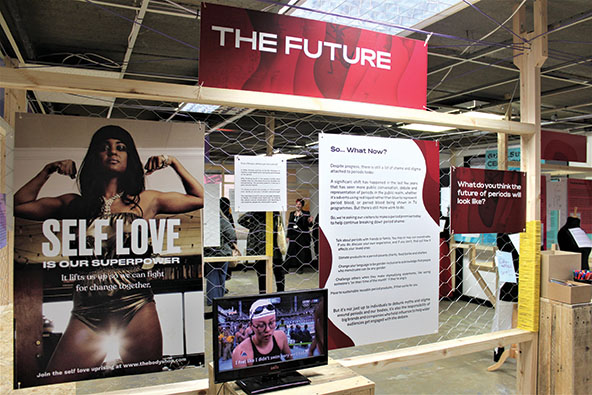
 A display from the Vagina Museum’s temporary exhibition “Periods: A Brief History,” in 2022. (Photo courtesy of Vagina Museum)
Decades of research bias and underfunding, a persistent lack of gynecological education, and increasing attacks on the rights of women, trans, and gender-diverse people hamper many from seeking health care or just information about how their bodies work.
To erase stigma around the body and gynecological anatomy, science communicator Florence Schechter launched the Vagina Museum, the world’s first-ever museum dedicated to gynecological anatomy and health, in 2017. The museum is an accessible, feminist, and trans-inclusive space whose exhibitions and events respond to today’s anti-trans political climate by raising awareness, challenging normative behaviors and beliefs about gender and sexuality, and providing forums for LGBTQ+ and women’s rights organizing.
Schechter was inspired to create the Vagina Museum after learning about the existence of a penis museum in Reykjavík, Iceland. “[The museum] started as a fun idea,” she says. “But as I talked to more people, I realized that it could do a lot of good. A lot of people were concerned with health awareness and activism, and that informs a lot of what the Vagina Museum does today.”
The museum held a series of pop-up exhibitions and events before moving into its first dedicated building in November 2019. Within months, however, the COVID-19 pandemic forced the museum to close its doors. It reopened at a new temporary site early last year, then launched a crowdfunding campaign last April to raise £85,000 ($109,000) to fund a permanent location that will open to the public in late 2023. “Because things have been unstable, we haven’t been able to grow or settle or serve our audiences in the best way possible,” Schechter says.
In addition to struggling to find a permanent location, the Vagina Museum faces recurring censorship online that undermines its educational mission and limits its outreach to would-be fans and funders. On Facebook and Instagram, social-media posts including words like vagina and clitoris are often flagged as adult content and removed. Schechter says the museum must constantly appeal decisions about removed posts and cannot do paid advertising on the platforms. Nonetheless, the museum has developed a dedicated global following through a clever social-media strategy, evocative posters and digital billboard ads in London,and significant press outreach. In 2023, Schechter also published a book informed by the museum’s work: V: An Empowering Celebration of the Vulva and Vagina.
The museum’s following helped propel its crowdfunding campaign, raising almost £90,000 ($115,000) through more than 2,500 individual donations in just two months. Past support has also come from the skin-care company The Body Shop, which sponsored the museum’s “Periods: A Brief History” exhibition, and the Swedish philanthropic investment group The Case for Her, whose mission is to address issues around menstruation and women’s sexual health and pleasure.
“People want to know about their bodies,” says Polly Cohen, an academic clinical fellow in community sexual and reproductive health at University College Hospital and Mortimer Market Centre, London, who joined the Vagina Museum’s board of trustees this year. Cohen says the Vagina Museum’s exhibitions and resources “go a long way to helping people feel empowered about their health.”
Thanks to its crowdfunding campaign, the Vagina Museum has secured a new location in East London with three galleries, a multipurpose event space, and room for a café. When it opens later this year, it will host an expanded edition of its permanent exhibition, “From A to V,” which focuses on anatomy, health, vulva diversity, and activism.
The museum also plans to invest in new outreach programs and partnerships, including collaborating with Endometriosis CaRe Oxford and the Wellcome Centre for Human Genetics at the University of Oxford on a temporary exhibition about endometriosis. “We want to create opportunities for our researchers to speak directly to the public and hear directly from people affected by whatever condition they study,” says Brian Mackenwells, the public engagement officer at the Wellcome Centre for Human Genetics, who facilitated the partnership.
Nura Fitnat Topbas Selcuki, a researcher in the Endometriosis CaRe group who is contributing research on adenomyosis to the upcoming exhibition, says working with the Vagina Museum is exciting because it provides “a comfortable zone to talk, learn, or see things that are stigmatized elsewhere.”
Read more stories by Marianne Dhenin.