


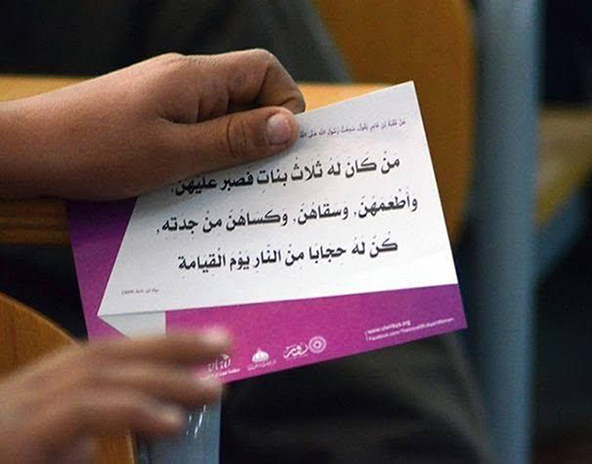
 Advocacy materials for the Voice of Libyan Women’s Noor Campaign carried Quranic verses and hadiths affirmed by Libya’s Dar al-Ifta, the national institution responsible for religious rulings. (Photo courtesy of Voice of Libyan Women)
The social sector has spent the last five years congratulating itself for discovering trust. Championing unrestricted grants, multi-year commitments, and deference to community judgment, trust-based philanthropy is now the field’s favorite innovation, complete with conferences, pledges, and a growing literature on why funders should stop treating grantees like suspects. Only two months ago, someone stopped me mid-sentence when I said “grantees” and asked me to use “partners” instead to honor this new trust and power dynamic.
The discovery is roughly 14 centuries late. In some traditions, longer.
Faith-aligned finance—including zakat, waqf, tithe, tzedakah, dasond, and other religious giving traditions—has operated as codified trust capital for centuries. These systems operate with a consistency, scale and nuance most institutional funders struggle to fathom, through mechanisms that took on the sector’s hardest problems long before the sector existed.
Development finance largely treats faith-aligned finance as a niche pool of capital to tap or faith institutions as delivery partners to enlist. However, the arrangements through which religious traditions govern giving, establish legitimacy, and hold stewards accountable are of greater value. These already exist within traditions. The unfinished work is connecting them with public and philanthropic financing without stripping away the obligations that make them meaningful. Development finance should study their design, not simply fundraise from it.
How I Learned This
I came to this through failure. In 2011, the Libyan revolution broke out. I was a final-year medical student in Zawia and founded Voice of Libyan Women, an organization that campaigned for inclusive security leadership and women’s agency. The team’s early work led with the language of international advocacy: rights, conventions, statistics. Embassies thought we were darling, but both they and the people who attended our events were already persuaded of our cause. For most families, the message was accurate, but it felt unauthorized; they heard it as something that arrived from outside the community’s moral framing.
So we rebuilt and reframed, working directly with Libya’s Dar al-Ifta, the national institution responsible for religious rulings, to formally endorse the Quranic verses and hadiths (sayings and traditions of the Prophet Muhammad) that supported women’s agency and leadership. The endorsement took more than a year—we showed up at their offices whenever they would see us and answered their questions on their terms and on their timeline—but it changed the source of authority behind the argument for women’s agency; what the community originally heard as an imported rights claim now carried religious legitimacy. It also opened doors to local funding. We then launched the Noor Campaign (noor means “light” in Arabic) as a public initiative of Voice of Libyan Women.
People in the oasis city of Sabha and people in the coastal city of Zawia hear each other very differently, so we also built city teams led by teachers, doctors, faith leaders, mothers, and young people whom local communities already trusted. Many told us that they had agreed with the organization’s position from the beginning but engaged only after we made it more socially acceptable for them to participate publicly.
Funders usually agree on the need. What they lack are structures capable of satisfying fiduciary and religious obligations at the same time.
Development practice often assumes that the binding constraint is supply, yet many well-designed interventions fail at implementation—vaccines expire in warehouses, books sit unopened. Despite cold-chain investment, intensive surveillance, and political negotiation, for example, Northern Nigeria’s polio resurgence in the early 2000s didn’t resolve until religious and traditional leaders helped rebuild public confidence, allowing immunization campaigns to resume. Similarly, the Noor Campaign meant that the same argument that had stalled for months traveled across the country—appearing in Friday sermons and on national television during Ramadan—in weeks. I came to think of “permission” as the collective social authorization that determines whether people feel they can act on an option that technically exists. I later called the distance between what communities materially need and what they feel morally or socially sanctioned to accept the “permission gap.”
I have watched the permission gap operate from every side of the table since. Leading a conflict-prevention firm, I saw its inverse. Where legitimate institutions vacate the permission space, violent actors can move into it, financing themselves through distorted claims on the very same sacred obligations. Trust is not inherently virtuous; the same combination of moral authority, networks, and capital can legitimize exclusion as readily as access. Transnational “family values” campaigns, funded by religious networks in the United States and Netherlands, demonstrate this across parts of Africa. The case for engaging faith-aligned finance rests on its influence, not its moral exceptionalism: Faith shapes who gives, whose judgment carries weight, and what communities consider legitimate. Those are forms of power that any serious account of development finance has to take seriously.
Years later, directing global advocacy and policy at one of the world’s largest foundations, I watched the gap manifest at institutional scale. Immaculately designed technical programs underperformed wherever uptake required that people act against the principles they understood their faith or community sanctioned. What startled me wasn’t the pattern; Libya had taught me that a decade earlier. It was the altitude at which it survived. Permission was often absent from program design because the tools organizations used to plan programs did not see it.
The Original Trust Architecture
Faith-aligned finance can help close the permission gap by embedding religious legitimacy in the financing itself. Consider zakat, a Quranic obligation requiring that Muslims transfer 2.5 percent of qualifying wealth each year. The Quran specifies eight categories of eligible recipients, including the poor, the indebted, and those in bondage, creating an eligibility standard set at origin and resistant to donor or institutional drift. The obligation is enforced primarily by conscience rather than a revenue authority, and conscience is a remarkably effective collector: Humanitarian financing analyses describe zakat as one of the largest sources of humanitarian funding in the world. Estimates of total annual giving range from $200 billion to $1 trillion. Even the lower estimate exceeds all tracked global humanitarian assistance several times over.
Waqf, its endowment counterpart, solves for perpetuity by permanently dedicating an asset to a charitable purpose. As governments rise and fall, its principal cannot be sold, seized, or repurposed. For example, Al-Qarawiyyin in Fez, founded by Fatima al-Fihri in 859 and sustained through waqf, remains among the world's oldest continuously operating universities. Accountability has a religious dimension: A zakat payer understands the transfer as a religious obligation, and the intermediary holds a responsibility that is both fiduciary and sacred.
Taken together, these mechanisms address problems conventional philanthropy repeatedly struggles with, including who is eligible, what the money may be used for, how long the obligation lasts, and who the steward is accountable to. They also attach legitimacy to the capital before it arrives.
I call this potential advantage the “permission premium.” It can operate at two points: when a giver recognizes a financing structure as a legitimate way to fulfill an obligation, and when a community recognizes that the services it supports are legitimate to use. Evidence of the first does not, by itself, establish the second.
The Permission Premium in Practice
The Noor Campaign left me with a recurring question: What if philanthropy treated faith institutions not merely as messengers or implementers, but as part of the infrastructure determining what communities trust, finance, and use?
In 2022, I began pitching a financing vehicle built on that premise, and after more than a year of building a strategy, financing model, and coalition, I created For Mama, the first zakat-eligible, Muslim-led funder collaborative for maternal and newborn health. The collaborative made maternal and newborn health legible within zakat giving, and raised $13 million in our first Ramadan campaign. Across three Ramadan campaigns, For Mama, now known as Every Pregnancy, has raised $125 million from more than 190,000 individual donors, including many outside traditional global health financing.
The multilateral system has also built structures that make participation religiously legitimate for donors, if unevenly. UNHCR’s Refugee Zakat Fund, which launched in 2017, has dedicated rules for collecting and distributing zakat. Islamic legal opinions known as fatwas, support these, giving donors a way to fulfill a religious obligation through a compliant structure.
Capital markets offer another example. When the International Finance Facility for Immunization, which raises capital-market financing for Gavi, the Vaccine Alliance, issued its first vaccine sukuk (an investment certificate that’s compliant with the body of religious law called Sharia and is often compared with a bond) in 2014, it raised $500 million—the largest debut sukuk of its kind. A second issuance raised $200 million the following year—roughly three-quarters of a billion dollars, mobilized through an instrument the development establishment still files under “niche.”
The evidence isn’t universal, but where faith-aligned instruments are governed credibly, they repeatedly mobilize capital by embedding religious legitimacy, donor intent, and accountability into the instrument itself. The pattern extends far beyond Islam. The Franciscan monti di pietà of 15th-century Italy are described as precursors to modern microcredit. The Jewish tradition of interest-free lending inspired the Hebrew Free Loan Societies, and New York's has operated since 1892. The Buddhist Tzu Chi Foundation began in 1966 with 30 Taiwanese housewives saving coins in bamboo banks and grew into a major global humanitarian organization. Even modern environmental, social, and governance investing partly descends from faith-aligned financing, including Methodist and Quaker investment screens. Across traditions, the architecture differs, but the design principle—that shared moral commitments shape how institutions raise, govern, and sustain capital—recurs.
The Missing Infrastructure
In my work on financing maternal health, child flourishing, displacement, climate, and humanitarian response, I find that prospective funders usually agree on the need. What they lack are structures capable of satisfying fiduciary and religious obligations at the same time. In commercial Islamic finance, bodies such as the Accounting and Auditing Organization for Islamic Financial Institutions and the Islamic Financial Services Board have developed standards that help institutions assess financial products and governance across markets. For faith-aligned social finance, the practical challenge remains: How can institutions operating under different religious and fiduciary rules finance the same project?
Building blocks exist. UNHCR, for example, has built dedicated accounts, eligibility rules, compliance review, and religious guidance for its Refugee Zakat Fund. But it doesn't provide a framework for co-financing. If a government, a local zakat institution, a waqf trustee, a philanthropist, and a development finance institution all want to finance the same maternal health facility, they may have no common basis for determining which costs are zakat-eligible, how a waqf can endow or hold the asset, or what evidence will satisfy a Sharia board, foundation trustees, and an investment committee. Getting them into a single structure today would require months of bespoke legal, scholarly, and financial work that most deals do not survive.
This helps explain an apparent paradox. Hundreds of billions may move through zakat each year, yet formal zakat institutions are estimated to capture only $10 billion to $15 billion of total zakat giving. Read carelessly, this looks like inefficiency awaiting formalization. But it is the thesis in miniature: Givers need confidence that their money reaches eligible recipients and is distributed according to the rules of the obligation. Some gain that confidence by giving directly to people they know; others rely on a local institution or a larger fund with credible religious oversight and clear reporting.
The task for development finance is to design accordingly and meet those requirements, not assume that institutional scale itself earns trust. What is missing is the connective tissue.
What To Do About It
Before a foundation or government commits money to a program, it decides whom the program will serve, how people will access it, which organizations will deliver it, and how they will measure success. This is the moment when it should also ask: Whose trust does this program need to earn before people will use it, and have those people helped shape how it is financed and delivered? Too often, faith leaders enter a program after its design is fixed, asked to endorse a vaccination drive or announce a clinic they had no hand in shaping. By then their role is persuasion, with little room to change the decisions that may have made the program unacceptable in the first place.
Asking early may reveal barriers that a communications campaign cannot solve after a clinic has opened or a program has launched. UNICEF’s Faith for Positive Change initiative, which builds influence mapping, faith engagement, co-design, and measurement into program design offers one approach to involving faith communities in program planning and implementation.
Beyond individual programs, the field faces the larger question of how different financing systems can work together. Here, climate finance offers a useful precedent. Green Bond Principles gave issuers and investors a common framework for identifying eligible projects and reporting how funds were used. Indonesia’s sovereign green sukuk shows what this can look like in practice: a Sharia-compliant instrument built against a green-finance framework legible to conventional, Islamic, and sustainability investors alike.
Faith-aligned and conventional institutions can build the missing architecture: agreed processes for determining zakat eligibility, waqf-compatible legal templates for development assets, and measurement frameworks that allow Sharia boards and investment committees to assess the same opportunity. Governments should meanwhile identify public priorities that these structures could finance, clarify how waqf assets and public funds can legally sit alongside other capital, and set clear rules for oversight. Larger funders should bring real projects and say what would make them willing to co-finance them, and philanthropists can provide catalytic capital to test the structures.
A practical starting point is to agree which costs each source of funding can cover. For a child-health program, that could mean establishing which services for eligible children zakat may finance, subject to the relevant religious approval, and which remaining costs government or philanthropic funding would meet. Each contributor could then support a shared objective while retaining its own obligations and accounting.
At the same time, researchers should test the permission premium rather than assume it exists. On the financing side, the question is whether these structures attract additional giving, redirect existing giving, or sustain support over longer periods. On the service side, researchers should compare otherwise similar programs and examine whether people know how they are financed, whether that knowledge affects their trust, and whether it influences their use of services. Those comparisons must account for differences in quality, cost, access, and community engagement. Researchers should also examine whether these structures sustain funding over time. I’m currently building toward that evidence through a multifaith compact and an interfaith financing facility that put these principles into practice for children’s survival and flourishing.
The scale these shared structures could unlock matters. If even 1 percent of the most conservative zakat estimate flowed through them, it would mean $2 billion a year for children—capital that can grow precisely because it is native to the contexts where permission binds hardest. The larger opportunity is to enable faith institutions, governments, and philanthropies to finance shared public priorities repeatedly, without rebuilding the legal and financial arrangements for every project. The real value should be judged by what they make possible for the people they serve.
From building the Noor Campaign in Libya to creating For Mama, I’ve seen what changes when people recognize the values and obligations built into an initiative. Too often, development finance asks communities to trust structures designed without them. The sector’s trust deficit is partly the legacy of financing structures that still presume communities must prove themselves to distant funders. Faith traditions have spent centuries building ways to give, govern, and account for money through shared commitments, and that architecture deserves to shape what we build next.
Read more stories by Alaa Murabit.