


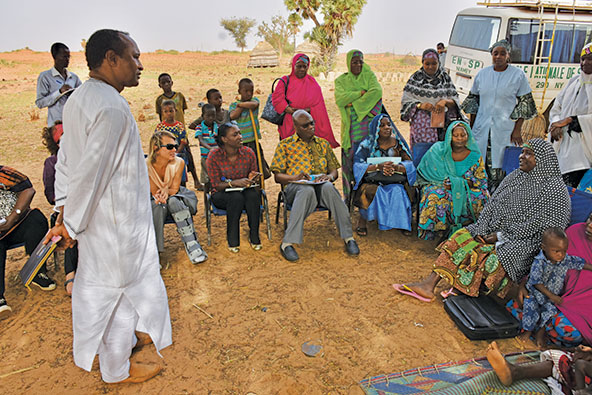
 A Ouagadougou Partnership donor caravan meets with the local community in Niamey, Niger. (Photo courtesy of Etrilabs/Yves-Constant Tamomo)
The 10th annual meeting of the Ouagadougou Partnership (OP), a multisector family planning coalition, took place in December 2021 in Ouagadougou, Burkina Faso. More than 1,000 people attended the three-day conference in person or via Zoom, discussing topics both serious and celebratory. Youth leaders contributed to a word cloud that reflected their emotions in real time—“happy,” “satisfied,” and “joyful” were the most prominent bubbles.
They had good reason to celebrate, says Marie Ba, director of the Ouagadougou Partnership Coordination Unit (OPCU), the OP’s coordination and communications hub. The OPCU supports and accelerates family planning efforts, including making contraception more accessible, in Francophone West Africa. They do this work in the face of strong conservative political and cultural headwinds that have contributed to persistently high maternal, infant, and under-5 child mortality rates in the region.
Fertility is woven into the cultural fabric of Francophone West Africa. A woman’s status depends upon the number of offspring she produces. Large families are desirable—a notion supported by conservative religious leaders in this heavily Muslim part of the world. Discussions of family planning and sex outside of marriage remain taboo.
Before the OP’s launch in 2011, only around 11 percent of women in Francophone West Africa used modern contraception like pills, condoms, and intrauterine devices, according to Track20, an organization that provides governments with data to track family planning indicators, such as the number of unintended pregnancies and the number of unsafe abortions averted due to modern contraceptive use. On average, women were having between four and eight children, depending on the country, during their reproductive years. Globally, contraception use averted around 44 percent of maternal deaths in 2008, but Francophone West Africa—Benin, Burkina Faso, Côte d’Ivoire, Guinea, Mali, Mauritania, Niger, Senegal, and Togo—had remained a stubborn outlier.
Between 2012 and 2021, however, Francophone West Africa had one of the fastest increases in modern contraception rates among developing regions, and family planning funding from donors to the OP almost tripled, from $80 million to $212 million. Over the past decade, according to Track20, the OP helped increase modern contraception use by more than four million voluntary users in the region, for a total of seven million contraception users. This growth prevented an estimated 21.6 million unwanted pregnancies and saved the lives of around 71,500 women.
“Most of the countries in Francophone West Africa have doubled their contraceptive prevalence rates over the past decade,” Ba says. “For example, Senegal went from 12 percent in 2011 to around 24 percent today.”
The cultural shift was obvious, too. “When I first joined the organization, you could hardly talk about family planning,” Ba says. “You had to use the term ‘birth spacing’ to be listened to and to make everyone comfortable in the room. But I think the world is changing—it seems that people have been much more open to talking about family planning.”
Adverse Conditions
Pivotal to the OP’s launch and future success was President Barack Obama’s repeal of the Mexico City Policy in January 2009—commonly referred to as the “global gag rule,” which terminated US funding to many women’s health and family planning programs outside the United States. After the repeal, representatives from the William & Flora Hewlett Foundation, the US Agency for International Development, the French Development Agency, and the Bill & Melinda Gates Foundation were able to approach the French government with an idea for a partnership to promote family planning in Francophone West Africa—an area of tremendous need “for investment and change,” says Perri Sutton, a program officer on the family planning team at the Gates Foundation. “Some of the world’s highest rates of maternal mortality are here,” she adds.
Prior to the OP’s founding, international donors were not very engaged in the region, largely due to the relatively small size of the countries. “When a country’s population is small, the potential for impact is also small,” Sutton notes. Banding the countries together as a partnership gives the region more prominence and thus the ability to attract more donors. In addition, the countries’ close ties and shared network of resources presents an opportunity for donor impact to spread beyond the borders of any single country and “to impact the region as a whole,” Sutton says.
Family planning also tends to attract less funding than other causes due to its preventive—as opposed to curative—nature. “People tend to put their efforts and money into fighting malaria or HIV, because it’s much more tangible than family planning in terms of impact,” Ba says. Plus, it can take more than a decade to see the effects of a family planning initiative, and politics moves at a faster pace.
Since the OP’s inception, the Gates and Hewlett foundations have jointly funded the OPCU and its meetings and events, including the first conference in Ouagadougou in early 2011.
From this first OP conference came the idea of Costed Implementation Plans (CIPs)—family planning, donor-funded “road maps” tailored to each individual country, detailing reproductive health priorities and strategies adjusted to each country’s available budget and resources. The CIPs were to be used as a benchmark by which each country could measure its own progress and the progress of other OP countries.
To create these CIPs, each country needed tools and resources to calculate and validate its family planning data. This information revealed some critical issues specific to each country that enabled the respective health agencies to draft country-specific CIPs. “For example, in Niger, sex before marriage is rare, so there your target is young married women and trying to get them to delay their first or second birth,” says Emily Sonneveldt, director of Track20. “But in Côte d’Ivoire, where people tend to marry later and there’s more sexual activity outside of marriage, family planning programs must meet the needs of both unmarried and married adolescents.” Early CIPs were “wildly aspirational,” according to Sonneveldt, because they were drafted without knowledge of the number of families using or willing to use contraception. But as more finely tuned data trickled in over time, they were able to set more realistic contraception-adoption goals. “Data equals accountability,” Sonneveldt contends. With accurate data, “conversations are moored in reality,” she says.
To attract donor funding, former OPCU director Fatimata Sy, who retired in 2016, knew it was imperative to conduct on-site visits with potential donors so that they could see the impact of funding on a community level. She referred to this effort as a “donor caravan,” which evolved into an annual event that included local policy makers, funders, youth leaders, and religious leaders on these site visits and sparked conversations that led to more government engagement with the issue—as well as increased donor funding.
OP’s overall success came from a coordinated effort on the part of many different stakeholders with the shared goal of reducing maternal, infant, and under-5 child mortality rates in the region, by way of 6.5 million additional modern contraception users by 2030. “This shared goal allows for mutual accountability and friendly competition between countries,” says Janet Holt, a program officer for the Hewlett Foundation’s gender equity and governance program, manifested in ways like campaign-poster competitions and awards for best media coverage of the OP.
Cautious Optimism
In Ba’s keynote address at the 2021 conference, she qualified the partnership’s success with a note of caution, saying that the rate of increase in contraceptive use has slowed, even though the rates met the OP’s 2021 goal. “This [decline] is in part due to COVID-19,” she reasoned, “but also security and climate-related crises have impacted women’s access to family planning.” Furthermore, recent flooding displaced communities in several OP countries, she said, increasing the number of refugees and the internally displaced. When you get a new cohort of refugees, Ba says, “the number of births nine months later tends to spike up,” in part due to rape and incest, so it’s vital that family planning and contraception be part of any humanitarian package.
Data from Track20 also revealed that most countries were investing in meeting current demand for family planning over building additional demand. “That was a red flag that momentum would slow without more intentionally addressing demand-side barriers to contraception,” Sonneveldt says.
Ba also recognizes that demand creation must be a major focus for the OP over the next decade. “By now we have reached all of the low-hanging fruit, and if we keep on doing business as usual, we will not see the progress we saw over the past decade,” she says.
One major point of pride for Ba is the recent transfer of OPCU leadership to Speak Up Africa, a policy and advocacy organization based in Dakar, Senegal, and founded and run by women. (Prior to this, OPCU was managed by InterHealth, a US-based global health nonprofit.) The advantages of working with a local organization are many, Ba says, not the least of which is circumventing the language barrier. “With international organizations, a lot of time French is not the first, second, or even third language within that organization,” she explains. In addition, leadership by African women makes changing the narrative around family planning “more authentic” and compelling—not something that’s so easy to do “when you’re called Bill & Melinda Gates Foundation,” she says.
Working with youth leaders on shifting social norms and using tools like social media to reach a young audience is integral to the OP’s future success. “We feel like there’s a plethora of other young stakeholders we can reach out to, who will join the youth movement that we’re trying to build,” Ba adds. “We can do much more and much better in terms of outreach, and I think really embolden a generation of youth to adopt voluntary family planning.”
Read more stories by Adrienne Day.