


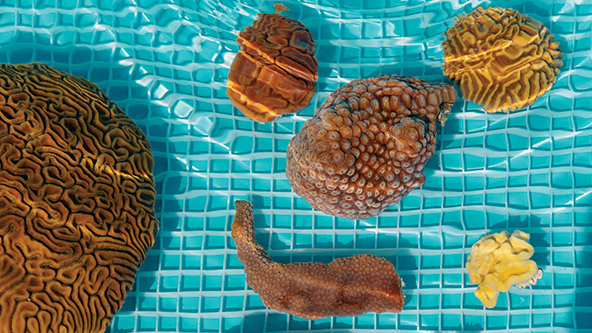
 Land-based coral farming allows for breakthrough methods that unlock greater species diversity, accelerate growth rates, and strengthen resilience to climate change threats. (Photo Courtesy for WeWork)
Coral reefs are among the most diverse and remunerative of the world’s ecosystems. While they cover less than 1 percent of the planet’s surface, they help sustain approximately 25 percent of marine species, and more than half a billion people rely on them for jobs, sustenance, and income. They also protect coastlines and harbor animals and plants with great medicinal potential for treating human diseases.
But these benefits are under threat. Over the last 30 years, half of all coral reefs have died, and scientists estimate that 90 percent could disappear by 2050. The oceans increasing acidity hampers coral growth and makes them more vulnerable to disease. Warmer water temperatures have led to coral bleaching; rising sea levels place coral farther underwater, making it harder for the coral’s life-sustaining algae to get the necessary sunlight; hurricanes and cyclones, occurring with increasing regularity and strength, can rip up and damage reefs.
“Coral reef degradation is one of the most critical threats facing humanity and wildlife worldwide,” Sam Teicher says. He and his business partner, Gator Halpern, endeavor to reverse this trend. Their organization, Coral Vita, focuses on reef restoration and seeks to incorporate local stakeholders and provide educational opportunities in the process. Through their for-profit company, they hope to create a marketplace for reef restoration. Coral Vita has attracted the attention of potential customers, such as ecotourism operators and cruises. And it earned tens of thousands of dollars in its early stages by getting individuals to adopt coral.
The company uses a pioneering technique called microfragmenting, which enables them to grow coral in land-based farms up to 50 times faster than they grow naturally—months instead of decades. Coral Vita harvests a coral colony and cuts it into fragments, triggering them to heal through reproduction. The pieces are then planted alongside each other in tanks, where they fuse back together. After cultivating the coral, the team transplants it into damaged or depleting coral reefs.
The company, which was founded in 2015, has one facility in Freeport, Grand Bahama, for which Teicher and Halpern raised just over $2 million to finance its creation and maintenance. They raised the money through a diverse combination of angel and impact investors and venture capitalists, ranging from Major League Baseball player Max Scherzer and his wife, Erica May-Scherzer, to the cofounders’ alma mater, Yale University. But Hurricane Dorian in August 2019 set back Coral Vita’s growth; while its infrastructure survived the storm’s battering, the company lost all its coral, and new coral has since been replanted.
Coral Vita doesn’t just endeavor to restore reefs. Because its land-based farms are more accessible than ocean reefs, they can also serve as education centers and ecotourism attractions. The company has partnered with the Grand Bahama Port Authority and Grand Bahama Development Company, as well as with leading institutes conducting coral research, such as Mote Marine Laboratory in Sarasota, Florida, and the Gates Coral Lab in Kaneohe, Hawaii. Coral Vita has played a role in policy advocacy, too, as a contributor to the United Nations’ recent Nature-Based Solutions for the Climate Action Summit, an initiative whereby nature is used to mitigate some of the harmful effects of climate change.
The company has already launched its second round of fundraising, seeking another $2 million so they can expand their facility in Grand Bahama this year, with the goal of becoming the largest land-based farm in the world. After expanding their facility, they want to implement their model elsewhere in the world, too.
While Coral Vita’s land-based farm offers unique benefits, it has its complicating factors. “The biggest drawback is space and scale,” says Jessica Levy, reef restoration program manager at Coral Restoration Foundation, which primarily uses field-based farming in the ocean. “The scale that you can work at will always be limited in a land-based farm. You can only build on so much property. Field-based, your limit is the seafloor and the permits that you’re working under.”
Teicher also acknowledges that up-front capital costs for land-based farming—acquiring the equipment and building out the infrastructure—are considerably higher than those for field-based farming. But he contends that the Coral Vita farms become cost-effective as they scale. He also suggests that they are more easily scalable, both in terms of the business model and because land-based farms are protected from disruptions that many field-based farms are not. With “ocean-based farms,” he explains, “you have to dive to tend the corals, which takes time—not to mention if it’s a bad day you can’t get out there and get them.”
Teicher also stresses that restoration is not a solution to climate change. “At the end of the day, our company shouldn’t exist,” Teicher says. “We shouldn’t be living in a world where we have to grow corals to restore dying reefs. Ultimately the best thing to do is to protect them.”
Read more stories by Noor Noman.