


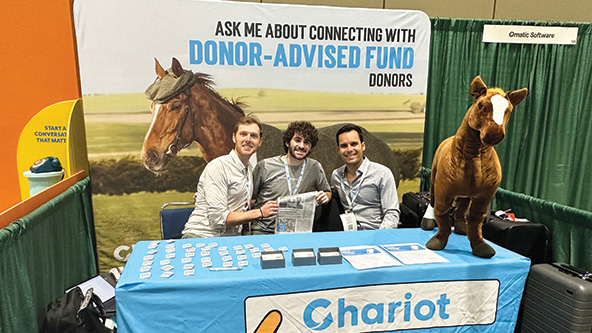
 From left: Chariot cofounders Aaron Kahane, Drew Schneider, and Salomon Serfati attend an April 2023 fundraising conference in New Orleans. (Photo courtesy of Chariot)
US charitable giving is booming, in part because more benefactors are finding their way to donor-advised funds (DAFs). Managed by third parties such as foundations and investment firms, DAF accounts total nearly 1.3 million nationwide and hold approximately $234 billion in cash and noncash assets, according to the National Philanthropic Trust.
More than $45 billion in DAF grants were donated to charities in 2021. That same year, Chariot was launched to streamline giving through DAFs. Based in New York City, the company grew out of the commitment that cofounders Salomon Serfati, Aaron Kahane, and Drew Schneider made after college to give 10 percent of their incomes to philanthropic causes. Even though a majority of Americans conduct financial transactions digitally, Serfati, Kahane, and Schneider thought online solutions for DAF giving were convoluted and inefficient.
“We were visiting nonprofits’ websites and seeing there was an option to donate with a credit card, Google, and PayPal, but there was no option to donate with your donor-advised fund,” says Serfati, Chariot’s CEO.
Chariot researched more than 50 nonprofit and for-profit DAF portals and determined that the process of online giving entails on average 15 clicks, 10 redirects, 4 webpages, and several minutes. Chariot’s platform wants to increase donor engagement by reducing this process to 3 clicks in just 15 seconds.
After downloading the Chariot app, a donor is directed to select among various DAF providers connected to the platform. Once a DAF fund is identified and authenticated on Chariot’s site, users can make donations from their particular fund to the charity of their choice. The platform’s dashboard tracks the status of donations.
Chariot’s COO, Kahane, touts the platform as “the first and only fully integrated solution for DAF-giving on a nonprofit’s website.” It supports donations from more than 1,000 DAF providers and is integrated into more than 20,000 nonprofit fundraising portals.
Chariot’s services are free for donors, while price plans for nonprofits vary according to their size. “One of our principles is that we want to make sure every nonprofit of every size can use our technology,” Serfati says.
Nonprofits using a fundraising platform that Chariot is integrated with can be connected to the company’s website to accept donations. For each donation, nonprofits are charged 2.9 percent by Chariot to process DAF transactions. The company also offers an annual payment option to nonprofits to reduce fees. “We see a real benefit of people opening up donor-advised funds, and we want to help facilitate that growth as well,” Kahane says.
Critics contend that DAFs operate mostly for wealthy investors’ benefit, with some funds requiring initial contributions of at least five figures. Fundholders can also use DAFs to take advantage of financial windfalls, such as a tax deduction of up to 60 percent on adjusted gross income, fueling the belief that DAFs are the domain of well-heeled, tax-code-savvy individuals.
Yet nonprofit leaders like Shannon Farley, the cofounder and executive director of San Francisco-based tech-nonprofit accelerator Fast Forward, believe in DAFs’ potential for charitable fundraising. “We want people giving away as much money as they can, not just to avoid the tax bill,” she says. “If donor-advised funds are one of the ways we get monies in, that’s good.”
And to encourage giving, DAFs from the charitable-investment arms of financial-services corporations like Fidelity Investments and Charles Schwab have nixed some initial contribution requirements, while others do not require minimum donations.
To date, Chariot has raised $4 million from seed investors, including Y Combinator, Spark Capital, and SV Angel. As a public benefit corporation, Chariot can maintain for-profit ownership so long as it allocates some proceeds—an unspecified amount—for giving. Farley worries about the consequences of this business structure for nonprofit revenues, since nonprofits rely on companies like Chariot for services. “I don’t want the end beneficiary to lose out in their income model,” she says.
In the near term, Chariot plans to grow their staff—currently at about a dozen employees—and partner with more than 50,000 nonprofits. In the long term, it hopes to participate in a Series A funding round. As for navigating the fine line between profit motives and charitable ambitions, Chariot is confident that it can be both profitable and charitable.
“Our soul, hopefully for the lifetime of the company,” Serfati says, “is to make sure this world is becoming better.”
Read more stories by Kyle Coward.