


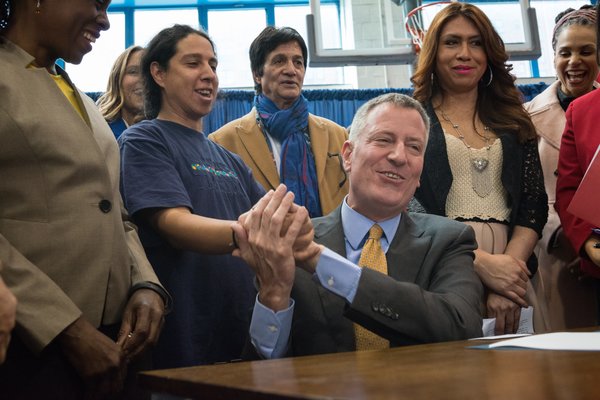
 New York mayor Bill de Blasio signs an order mandating that everyone have access to single-sex restrooms consistent with their gender identity. (Photograph by Pacific Press/Corbis)
In early March, New York City mayor Bill de Blasio signed an executive order requiring every city agency to ensure that its employees and members of the public are given access to single-sex facilities consistent with the gender with which they identify—regardless of the gender listed on their birth certificates or other identification documents. “Access to bathrooms and other single-sex facilities is a fundamental human right that should not be restricted or denied to anyone,” the mayor said.
The order was an effort to promote “New York values”: a commitment to diversity, inclusivity, and protection of the rights of all who make up one of the world’s most cosmopolitan cities, including the approximately 25,000 transgender and gender non-conforming people who call it home.
Given that everyone poops, public restrooms are—in theory—fundamentally democratic spaces. But because they turn what is typically a private area into a communal zone, shared with strangers, they’re often contested spaces, too. In March, following a Charlotte, N.C., city council decision that made it legal for transgendered people to use the restroom of their choice, the North Carolina state legislature passed a bill barring municipalities from creating such laws, effectively overturning the city’s decision.
Directives on bathroom use have a long history. In 1887, Massachusetts passed a law requiring any workplace that employed five or more people to maintain “separate and distinct water-closets” if at least one female person worked there. In the Jim Crow era, public restrooms were segregated by race and gender.
Mayor de Blasio’s executive order in March was an attempt to clarify and publicize anti-discrimination regulations that have existed in New York since 2002, when the city expanded the scope of its broadbased New York City Human Rights Law to include genderbased protections. Under that law, any provider of single-sex public accommodations, such as restrooms or locker rooms, must provide access in ways consistent with the users’ gender identities. The law doesn’t apply just to city agencies: If a commercial business or a nonprofit homeless shelter offers single-sex facilities, it must comply as well. Entities that violate the law can incur penalties up to $250,000 and additional compensatory and punitive damages.
Last year, Mayor de Blasio appointed attorney Carmelyn Malalis to lead the city’s Commission on Human Rights, the agency that enforces the 2002 law. Under her leadership, the commission published legal guidance in December 2015 that clarified what constitutes a violation and signaled the city’s intent to begin investigating and prosecuting claims of discrimination more proactively. “Everyone deserves safe and equal access to bathrooms,” says a commission spokesman. “New York City’s bathroom policy should be the gold standard in gender identity protections across the country.”
“For me as a transgender woman, this initiative is a grand achievement,” said Bianey Garcia, a justice organizer for social justice group Make the Road New York, when de Blasio signed the executive order. “For years we’ve endured verbal and physical aggression for wanting to use gender-affirming bathrooms.”
New York hopes to set a strong example with its own agencies, which maintain 55 buildings and approximately 2,200 restrooms across the city. Under the mayor’s order, city agencies must post signs near these restrooms to explain that people can choose the facilities that are consistent with their gender identities, and city employees must complete training on this policy within two years.
This is welcome news to many people troubled by the recent pushbacks against LGBT rights elsewhere in the country. To protest North Carolina’s controversial “bathroom bill,” PayPal reversed its plans to open a new global operations center in Charlotte, and Bruce Springsteen cancelled a concert in Greensboro. But in the long run, the most persuasive form of protest may be practices like New York’s. Opponents of gender-identity-inclusive restroom laws generally claim that they will give male sexual predators a pretext for entering women’s restrooms—but that hasn’t happened in New York City.
According to Cathryn Oakley, senior legislative counsel for the Human Rights Campaign, a Washington, D.C.-based LGBT advocacy organization, “It sends a powerful message when the mayor and the commission are basically doubling down and saying, ‘We support these laws. It works here and we’re proud of it. These are New York values.’”
Read more stories by Greg Beato.