


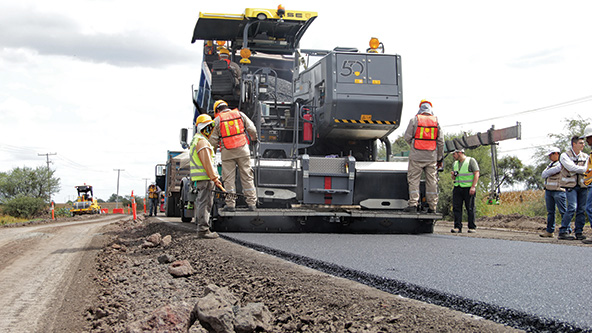
 Road workers lay the world’s first federal highway made with modified asphalt, in the municipalities of Irapuato and Cuerámaro in the state of Guanajuato, Mexico. (Photo courtesy of Dow Mexico)
Soon, if you hit the road in central Mexico, you could drive on flexible plastic that otherwise would be in a landfill. The country claims to have paved the world’s first federal highway made with modified asphalt, using 1.7 tons of postconsumer plastic—equivalent to around 425,000 items of plastic packaging.
The initiative comprises a mere 2.5-mile highway that connects the municipalities of Irapuato and Cuerámaro in the state of Guanajuato. Yet, as a response to the global epidemic of waste plastic, the “eco-road” promises to deliver much more.
The project was developed by a consortium led by Dow Mexico, part of multinational chemical corporation Dow, with the support of Mexico’s Secretariat of Communications and Transportation (SCT) last October.
“This innovation was born precisely when trying to find a real and applicable solution for waste management—in this case, specifically for plastics,” says Iván Trillo Minutti, the director of sustainability and packaging at Dow Mexico. Standard paved roads are made of 90 percent rock, limestone, and sand. The remaining 10 percent is made from bitumen—an extract from crude oil—as binding. Unique to the Mexico project is the altered design and formulation of the modified asphalt with postconsumer plastic combined with flexible polymer—a chemical type of resin—to reduce the use of bitumen. This change aligns with the 2015 Paris Agreement goal to decrease the use of fossil fuels.
The new technology can also potentially prolong the lifespan of highways by 50 percent compared with those made of traditional crude oil asphalt, according to Dow Mexico, by reducing cracks and deformation and improving durability, stability, and strength.
On World Environment Day in 2018, the United Nations warned that each year more than 400 million tons of plastic waste are produced in the world, of which only 9 percent is recycled and 12 percent incinerated. In Mexico the problem is worse. According to the Universidad Nacional Autónoma de México, the country recycles or reuses only about 3 percent of all plastic.
Environmental NGOs argue that it is not enough to rely on recycling programs; rather, the production and consumption of plastics must be reduced overall. “A circular economy is not synonymous with recycling,” says Miguel Rivas, oceans campaigner at Greenpeace Mexico. “Companies continue to sell their products in recyclable containers that will never be recycled.”
Sergio Alonso-Romero, chief researcher at the National Council of Science and Technology of Mexico, does not see the plastic roads becoming a global trend. “The real trend is the search for alternatives to the use of plastic,” he observes. “I think the eco-road is more like a response to the contaminating effect of plastic that brings environmental and image benefits to the company.”
Nonetheless, there are 25 million miles of roads in the world, and if these can be paved using waste plastic—like the eco-highway in Mexico—crude oil usage can potentially be reduced by hundreds of millions of barrels.
While Dow’s material is a unique blend of materials built on its own technology, similar initiatives using modified asphalts have already taken off around the world. India, the global leader in recycled-plastic roads, has built more than 1,500 miles of them since 2002. And the UK Department of Transportation has allocated £1.6 million ($2 million) to the Scottish company MacRebur to pave local roads with a modified asphalt that uses locally discarded plastic.
“What we want is that plastic road be a standard so when a road is repaved or a pothole is filled, it’s not a question whether plastics are in there but part of the standard that plastics must be in there,” MacRebur CEO Toby McCartney says. “That’s what we are hoping for at the end of this trial.”
Countries such as the United States, Mexico, New Zealand, and Australia have used crumbled rubber in their roadwork for decades. “But the challenge that they have with rubber is that rubber does not melt into the mix,” McCartney explains, “and therefore [the rubber] creates the potential of microplastic being released back into the environment.”
Dow Mexico, which is developing similar projects in Asia, Europe, and North America, did not disclose the cost of plastic asphalt compared with traditional asphalt using bitumen. But a study commissioned by the UK’s Department for International Development has shown that the innovation could save about 11 percent of total cost, or $670/km.
“Analysis on incorporating this asphalting model on a big scale is still undergoing,” Trillo Minutti explains. “Even though we can’t share specific data, we can tell that our goal is to make this an affordable option in the market.”
Read more stories by Yula Rocha.