

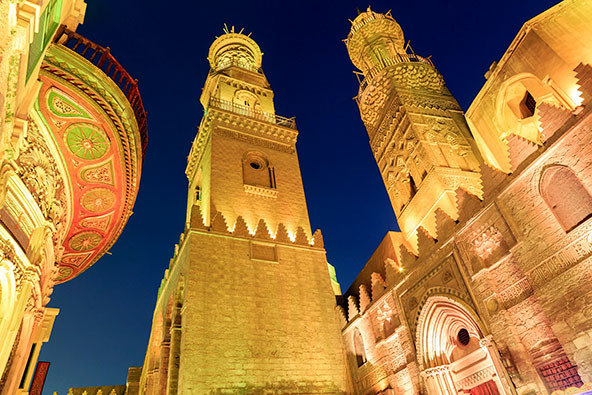
 The Qalawun complex on al-Muizz Street in Cairo was built in 1284-85 and once housed a hospital, the Bimaristan al-Mansuri. Fragments of the hospital survive behind the façade, and part of the site operates as an eye clinic today. Left: A public drinking fountain, or sabil, built in 1828. (Photo by iStock/EgyptianStudio)
You walk into a hospital, and no one asks what you do for a living, where you are from, or how you intend to cover your bill. The hospital’s founding provisions instruct staff not to even “hint” at a patient’s inability to pay. If you feel anxiety, you will not be left alone with it: Salaried musicians play each evening to lift patients’ spirits. There is no discharge date on your admission, because no one has decided in advance how long recovering should take; the provisions simply require that the hospital keep patients “until they are completely recovered.” When you leave, you could be given clothes and a cash sum to help resume your life.
This sounds like an idealistic proposal, but it is not. It is a compressed account of the Bimaristan al-Mansuri, a hospital built in Cairo in 1284 by the Mamluk sultan al-Mansur Qalawun. The hospital was sustained by a waqf, a form of charitable endowment that emerged in the early Islamic period. The waqf was a civic backbone in Mamluk Cairo, and Muslim-majority societies continue to leverage it today. The Bimaristan is worth examining not as utopian nostalgia—it had its own limitations and failures—but because its design logic belongs to a different philanthropic tradition, and that difference makes some of the assumptions of today’s metrics-driven philanthropy easier to see.
Philanthropy as Micro-Level Optimization
In her recent SSIR article, “Why Don’t Philanthropists Build Anymore?”, Sarah Cone argues that today’s wealthiest donors have largely stopped building new institutions, and that a culture trained on “tractable interventions, short feedback loops, and quantifiable outputs” underinvests in institutions whose benefits are diffuse and slow to appear. I agree, but it is worth pushing the argument upstream: The measurement norm shapes not only which institutions get funding, but which ones the field imagines at all.
Much of modern philanthropy begins from scarcity. It asks: Given a finite pool of resources, what is the most we can accomplish? But budget constraints need not constrain imagination. The pool is not a natural constant; it can grow, change structure, or join other sources of long-term support.
That scarcity logic found a particularly powerful instrument in the randomized controlled trial. But a trial needs its object to have boundaries, be capable of randomization, and be measurable against a counterfactual, and that requirement can shape not only what researchers evaluate, but also what philanthropy conceives as fundable. A hospital that treats everyone, with no eligibility test and no discharge date, is hard to express as a single treatment effect or to justify on underlying efficiency grounds. The difficulty of measuring it can become its own disqualification.
Some recent philanthropic movements have pushed back against this narrowness by relocating the target of intervention. Systems change philanthropy moves it from an individual’s outcome to the policies, markets, and institutions that produce outcomes at scale, and place-based philanthropy applies a similar systems logic geographically. Both broaden the unit of analysis, but they still generally start from a problem and ask what change would address it.
But other cases ask a different starting question: What should people be able to count on in order to live well and flourish, independent of any specific problem needing a fix. Rather than treating society as a collection of individual needs to address one intervention at a time, provision logic asks what people should be able to encounter, and what kinds of relationships, dignity, and shared experience those provisions make possible.
Generative Philanthropy
This provision logic belongs to a category worth naming; I call it “generative philanthropy.” Allocative approaches to philanthropy take a given pool of resources and ask how to distribute it most efficiently. They let the size of the budget determine the size of the ambition and how it is delivered. Even when the pool of resources grows, it grows to buy more of whatever unit is the cheapest per outcome. Generative philanthropy, as I use it, inverts that order. It starts by imagining what people should be able to count on to live well and flourish, and it lets that standard determine what gets provided. Then it creates the resources to match. A giver can endow assets, liquid or physical, so that returns sustain giving in perpetuity; draw on contributions from other institutions; or assemble other donors, large or small, to keep something running beyond a single gift.
The Bimaristan described above was sustained by precisely the kind of institutional mechanism that makes generative provision possible. The waqf is fundamentally a legal and financial mechanism. In Arabic, the word means “stopping”: a founder takes income-producing property, such as land, shops, or rental buildings, out of private circulation and dedicates its revenues to a named purpose in perpetuity. The endowed asset is generally inalienable so that its productive capacity can continue serving that purpose. The instruments themselves keep evolving; contemporary waqf can take the form of endowed company shares, government bonds, pooled cash, or other financial assets whose returns support public provisions.
The mechanism suits ideas central to Islamic giving. Sadaqa jariya, or “ongoing charity,” holds that a gift which continues to benefit others is rewarding for the giver, even after death. The Bimaristan treated patients for more than five centuries, and its site is still used as an eye clinic today. Charity is also meant to protect the recipient’s dignity, never becoming an occasion for humiliation, indebtedness, or display, which helps explain why the Bimaristan took a stance against “hints” at payment. Giving is expected to embody ihsan—the act of doing anything well, generously, and with excellence, rather than minimally. The measure of a well-given gift is that it is the same as or better than what the giver would want for themselves. Together, these ideas point toward an expansive conception of obligation. In the hospital case, the question is not simply how to remedy an ailment efficiently, but to provide what a person needs to recover. There is a striking resonance with Amartya Sen’s much later capability approach, which evaluates well-being by what people are able to do and be.
The waqf gave that expansive conception of obligation a durable financial form. The giving not only funds a provision, it creates a structure capable of continuing to fund it on its own.
Waqf founders and contributors are historically not limited to sultans and emirs. Merchants, scholars, women, and Christian and Jewish communities living under Islamic rule all participated. While scaled or lasting giving is often assumed to be a matter for billionaires, the waqf is a form that many could take part in, either with their own dedicated fund or as a small contribution to an existing fund.
The waqf system produced, and still produces, an enormous range of institutions and provisions, built around the dedication of assets to public benefit. On the non-institutional front, a student’s tuition, a patient’s medical costs, or access to a particular medical capability can all become objects of endowed giving. The contemporary Health Waqf Fund in Malaysia, for example, is designed to cover the cost of molecular testing to determine whether cancer patients can receive targeted therapies, with the aim of giving patients access to testing regardless of their ability to pay. The significance is easy to miss because the technology itself is no longer extraordinary, but even in high-income countries, access to advanced molecular testing remains uneven, with coverage varying by payer, test, and location. The waqf treats access to the capability itself as something worth making broadly available.
The same logic can produce physical places. From roughly the 14th to the 19th century, sabil-kuttabs—public drinking fountains with small Quranic schools stacked directly above them—were a particularly popular choice in Cairo. These joined two very different goods, water and literacy, and offered them to whoever showed up, with no test of need. The fountains were deliberately beautiful and easily accessible, often curving out into a path or sitting in its center with openings on all sides. Carved stone, marble, glazed tile, and the play of light and moving water was part of the offering and turned the act of getting water into an experience beyond function. The school upstairs taught children to read and recite the Quran, making literacy itself a provision rather than treating education principally as a route into the labor market. These were a different object from what education philanthropy tends to measure today, where the outcome is a score or a graduation rate aimed at ultimate employment and income.
Another form of generative philanthropy, in the sense that it starts with asking what should exist and takes an expansive view, shows up in Andrew Carnegie’s library philanthropy centuries later. Carnegie credited his own ability to learn and flourish to his access to a private library and described it as the reason he sought to boost access. Between 1883 and 1929, he funded more than 2,500 public libraries, some 1,700 of them in the United States, but he rarely simply paid for a building outright. His standard offer required that the receiving town supply the land and, importantly, pass a tax or otherwise guarantee ongoing public funding to staff and maintain the library once it opened. Carnegie was explicit about why, drawing a hard line between what he called philanthropy and mere charity. Carnegie used a one-time construction grant to convert local governments into permanent co-funders, effectively demonstrating an American model of tax-supported public libraries as a byproduct of how he structured his gifts. He was part of a wave of Gilded Age donors who built rather than gave—Cone’s essay cites Rockefeller’s research institute, Mellon’s National Gallery, and Rosenwald’s schools.
Provision logic is not only historical. Sir Magdi Yacoub, an Egyptian heart surgeon, returned to Egypt after decades of work in the United Kingdom and built a world-class heart center not in Cairo but south in Aswan, within reach of Egypt’s poorest communities. Since 2009, the Aswan Heart Centre has performed complex cardiac surgery, much of it on children, free of charge, while training a generation of Egyptian clinicians and running its own research program, funded by donations. And when the center drew more patients, from across and outside of Egypt, than it could serve, the answer was not to dilute the standard of care but to call on other donors and set out to build a second, larger center outside of Cairo.
These founders imagined something beyond the ordinary. Few towns in 1883 regarded a public library as a necessity, yet Carnegie’s libraries ultimately carried the same civic register as sabil-kuttabs, and more than a century later, several hundred of the original buildings are still functioning as libraries. Sir Magdi Yacoub’s imagination started where the Bimaristan did: with what a sick person should be able to count on.
These examples arrived at the same sequencing from continents and centuries apart, which is itself worth noticing. The means were, in an important sense, divergent, with some self-funding in perpetuity, others leveraging a single gift into someone else’s permanent obligation, and still others sustained through ongoing giving. But they started from imagining what should exist for flourishing lives and societies, then built the resources to make it possible.
Of course, mechanisms like the waqf are not immune to failures. Endowments can grow rigid under founders’ unrevisable terms, people indifferent to the purpose can capture administration, and changing circumstances (like piped water and mass schooling in the case of the sabil-kuttabs) can leave funds that don’t adapt obsolete. Nor is any of this an argument for abandoning measurement. Ignoring whether a program works has its own long history of donor vanity and wasted money. Evidence can tell you whether something works. But it should not necessarily shape what philanthropy is willing to imagine providing. Generative philanthropy reveals what gets lost when the process of addressing societal needs is reversed—when rigorous, isolable, comparable evidence is the entry price for an idea. Careful evaluation earns its place when a good’s value is genuinely unclear. But shaping a solution until it fits the accounting already on hand is its own kind of distortion in imagining the possible. Philanthropy’s harder task is not choosing between building and solving. It is asking what people and societies actually need to live well and flourish, before asking how to prove that it is worth building.
Read more stories by Sarah Mousa.