


 (Illustration by Ross MacDonald)
In 1891, Leland Stanford was 61 years old and worth what would today amount to roughly $1.9 billion. He could have endowed a chair at Harvard University, funded a wing at a hospital, or written large checks to the charities of his day. Instead, he and his wife, Jane, took 8,180 acres of their Palo Alto horse farm and founded a university bearing the name of their late son. Not a building or a program, but an entire university that would, over the next century, become the intellectual engine of Silicon Valley and perhaps the most consequential incubator of technological innovation in human history. Stanford did not donate to an institution. He created one.
This was not unusual behavior for a magnate of his era, but a defining impulse of Gilded Age philanthropy. The period between roughly 1870 and 1920 produced an astonishing concentration of wealth in the hands of industrialists—most notably Andrew Carnegie, John D. Rockefeller, John Pierpont Morgan, Andrew Mellon, and Cornelius Vanderbilt—who, for all their ruthlessness in business, channeled their fortunes into creating institutions that fundamentally reshaped American life.
The phrase “Gilded Age” was coined ironically by Mark Twain and Charles Dudley Warner in their 1873 novel, The Gilded Age: A Tale of Today. Their point was not that the age was truly golden, but that it was gold-plated: glittering on the surface, corrupt and unstable beneath. To invoke the term now is not to romanticize the first Gilded Age, whose fortunes were often built through monopoly, labor exploitation, political patronage, and violent coercion. It is rather to note a structural resemblance: extraordinary private wealth amassed amid public strain, and a corresponding question about what, if anything, that wealth owes the society from which it was extracted.
Today’s Gilded Age rivals the first in concentration of wealth, scale of inequality, and sheer volume of philanthropic capital available. Yet the ambition of the original Gilded Age philanthropists to build institutions seems to have faded. The richest people in America today are far more likely to write checks to organizations founded by Carnegie or Rockefeller than to create anything comparably new. The result is not merely a philanthropic failure; it is a civilizational one. We are living through an era of institutional fragility, and the reluctance of today’s billionaire class to build enduring institutions is both a symptom and a cause.
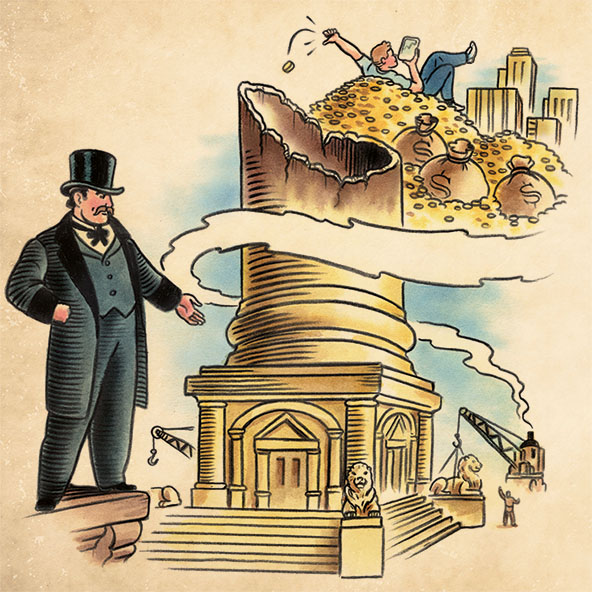
A peculiar irony sits at the heart of modern philanthropy: The richest generation in human history, commanding more wealth than the pharaohs, the Medicis, and the Carnegies combined, has proven surprisingly unwilling to convert that wealth into new, durable civic institutions. Today’s moguls build companies of extraordinary complexity and scale—platforms that connect billions of people, algorithms that can generate human-like prose, rockets that land themselves on barges in the ocean—yet when it comes time to give back, they write a check to a university founded before the automobile existed. They do not use their organizational genius to create public good at a scale that matches their private ambitions. They know how to build, but they don’t build the civic infrastructures that society needs at a time when those needs are acute.
The New Gilded Age
The parallels between the first Gilded Age and our own are not just rhetorical. In 1890, the top 1 percent of American households controlled a little more than half of the nation's wealth, according to estimates by economists Jeffrey Williamson and Peter Lindert. By the mid-20th century, that figure had fallen dramatically, bottoming out at around 23 percent in the late 1970s. Today, it has climbed back to approximately 32 percent, and the concentration at the very top—the top 0.01 percent—has reached levels not seen since the age of the robber barons. In 1982, the Forbes 400 list required a net worth of $75 million for entry, roughly $230 million in today’s dollars. In 2025, the threshold was $3.8 billion. The combined wealth of the Forbes 400 reached $6.6 trillion—greater than the GDP of every country on Earth except the United States and China.
The geographic concentration of this wealth mirrors the original era as well. Just as the fortunes of the 1890s clustered in New York, Pittsburgh, and the railroad hubs, today’s wealth pools in San Francisco, Seattle, and the corridors of Big Tech. The company towns of the first Gilded Age—Pullman, Illinois; Hershey, Pennsylvania—find modern counterparts in the campuses of Google, Apple, and Meta, where private employers provide health care, transportation, meals, and even housing, creating miniature welfare states within the shell of the public one.
The scale of today’s individual fortunes now rivals what the robber barons commanded relative to the national economy. John D. Rockefeller’s peak wealth in 1913 represented approximately 2.3 percent of US GDP. Andrew Carnegie’s 1901 sale of Carnegie Steel amounted to roughly 2.1 percent. Today, no single fortune has quite matched those proportions, but the billionaire class is immense: The Forbes 400 holds about 3.6 percent of total US household net worth. And if Elon Musk’s net worth reaches $1 trillion, as some projections suggest, he will command roughly 3.2 percent of GDP—a figure that would make him, in proportional terms, the wealthiest American since Rockefeller himself. The technology sector has produced fortunes that would have astonished the railroad barons: Musk’s net worth has at times exceeded $250 billion; Jeff Bezos has built a fortune of more than $200 billion; Mark Zuckerberg, Larry Ellison, Bill Gates, Larry Page, and Sergey Brin each command resources on a scale with little precedent outside the original Gilded Age.
The Builders
Nevertheless, our era’s titans lack the creative instincts that yesterday’s moguls demonstrated. What made the earlier philanthropists distinctive was not the size of their gifts, enormous though those often were, but the nature of what they built. They did not merely fund existing organizations; they conceived, designed, and endowed new institutions, many of which became cornerstones of American public life. They founded hospitals, libraries, universities, research institutes, museums, and foundations—not as vanity projects, but as permanent infrastructure for a civilization they believed they could improve.
Andrew Carnegie’s story is instructive. As a poor Scottish immigrant, Carnegie had benefited enormously from a local businessman (Colonel James Anderson) who opened his private library to working boys in Pittsburgh. Carnegie credited that access with transforming his life, and he spent the rest of it trying to replicate that opportunity for others.
Between 1883 and 1929, Carnegie funded the construction of 2,509 public libraries across the English-speaking world, including 1,689 in the United States, 660 in Britain and Ireland, 156 in Canada, and others in Australia, New Zealand, Serbia, the Caribbean, South Africa, Belgium, France, Mauritius, Malaysia, and Fiji. These were not donations to existing library systems. In most cases, there was no library to donate to. Carnegie created the physical infrastructure of public knowledge from whole cloth, demanding only that the host community commit to funding the library’s ongoing operations, a mechanism that ensured local ownership and sustainability long after Carnegie’s money was spent. He also founded Carnegie Mellon University, the Carnegie Institution for Science (now Carnegie Science), Carnegie Hall, and the Carnegie Endowment for International Peace. Each was a new entity, purpose built to address a gap Carnegie had identified in the existing landscape. Each still exists today.
John D. Rockefeller operated on a similarly institutional scale. In 1901, he founded the Rockefeller Institute for Medical Research (now Rockefeller University), the first biomedical-research institute in the United States. This was not a gift to an existing medical school but the creation of an entirely new model for organizing scientific research—independent of teaching responsibilities and focused solely on discovery. Rockefeller researchers would go on to make fundamental contributions to virology, cell biology, and immunology. Rockefeller founded the University of Chicago in 1890 with an initial gift of $600,000, eventually pouring more than $80 million—more than $2 billion in today’s dollars—into the institution. And in 1913 he created the Rockefeller Foundation, which pioneered the modern model of strategic philanthropy, funding the development of penicillin; the Green Revolution in agriculture, which vastly increased global crop yields in the postwar era; and public-health campaigns that eradicated hookworm across the American South.
Andrew Mellon established the National Gallery of Art in 1937, donating not only his personal art collection—one of the finest in private hands—but the neoclassical building to house it. He stipulated that the gallery should bear the nation’s name, not his own, because he wanted other collectors to contribute without feeling as if they were adorning someone else’s monument. The strategy worked: The National Gallery became a magnet for subsequent donations from the Widener, Kress, and Dale collections.
Johns Hopkins, a Baltimore merchant who made his fortune in railroads, left a $7 million bequest—the largest philanthropic gift in American history at the time—to create both a hospital and a university from scratch. Johns Hopkins Hospital, which opened in 1889, developed the residency-training model that became the standard for American medical education.
None of these men should be sentimentalized. The same men who endowed libraries, laboratories, and universities also benefited from industrial systems marked by coercion, labor repression, and democratic distortion; their giving could serve a dual function as genuine civic construction and as reputation management, social discipline, or the conversion of private wealth into moral authority. To say that Carnegie and Rockefeller built institutions is not to say that their power was legitimate in every respect. It is to insist on a distinction that has become hard to ignore: However compromised their motives, they often translated private fortune into durable, public-facing infrastructure, rather than merely redistributing money through the prestige circuits of existing elite organizations.
This impulse extended beyond the ultrawealthy. Julius Rosenwald, the president of Sears, Roebuck and Company, partnered with Booker T. Washington to build more than 5,300 schools for Black children across the Jim Crow South between 1912 and 1932. These Rosenwald Schools educated a generation of African Americans who had been systematically excluded from public education. J. P. Morgan effectively created the modern Metropolitan Museum of Art (The Met), transforming it from a modest collection into one of the world’s great encyclopedic museums. In 1907, Margaret Olivia Sage, spouse of industrialist Russell Sage, founded the Russell Sage Foundation, which pioneered the field of social-science research and influenced everything from urban planning to labor law.
The common thread is unmistakable: Gilded Age philanthropists saw institution building as a central task. They were not content merely to improve what already existed. They identified structural absences in American civic life—the lack of public libraries, research universities, medical-research institutes, art museums, and scientific foundations—and attempted to fill those absences by creating new, permanent, self-sustaining organizations designed to outlive them.
The Check Writers
Today’s billionaire philanthropists operate in a different mode. Rather than creating new institutions, they overwhelmingly donate to existing ones, including those built by the Gilded Age philanthropists more than a century ago.
The tragedy is that these billionaires are giving passively—transferring wealth to organizations that other people built.
Consider the landscape of major gifts to higher education. In 2018, Michael Bloomberg gave $1.8 billion to Johns Hopkins University, his alma mater. Kenneth Griffin has given hundreds of millions to Harvard University, which was founded in 1636. Phil Knight gave $500 million to Stanford University, Leland Stanford’s creation. David Geffen gave $100 million to Lincoln Center for the Performing Arts—built through the efforts of John D. Rockefeller III—and $150 million to the Museum of Modern Art. Stephen Schwarzman gave $150 million to Yale University, $100 million to the New York Public Library—originally built with funds from Andrew Carnegie and others—and $350 million to MIT.
These generous gifts flow to institutions that are already among the wealthiest and most established in the world. Harvard’s endowment exceeds $50 billion, Stanford’s $36 billion, and MIT’s $27 billion. They are the philanthropic equivalents of blue-chip stocks—safe, prestigious, and unlikely to fail. A building bearing a person’s name at Harvard confers a kind of social immortality, but it does not fill a structural gap in American life. It adds a wing to a mansion that has 200 rooms already.
The contrast with the Gilded Age is stark. When John D. Rockefeller founded the University of Chicago, the city had no world-class research university. The creation of one transformed the intellectual and social life of the region. When Carnegie built his libraries, most US towns had no public library at all. Before Rosenwald built his schools, Black children in the South had almost nowhere dedicated to their education. Today’s equivalent gaps are everywhere—in rural health care, workforce training, civic infrastructure for the digital age, housing, and mental health—yet philanthropic dollars flow, again and again, to the same handful of elite institutions that have been accumulating gifts for more than a century.
To say this is not to claim that no wealthy donor today ever founds anything new. Contemporary philanthropy does produce new think tanks, charter-school networks, biomedical ventures, media nonprofits, fellowship programs, policy shops, and startup-style social enterprises. But relatively little of this activity adds up to what earlier philanthropists attempted more readily: broad, durable, civic infrastructure meant to serve a public larger than a donor’s ideology, sector, alma mater, or professional tribe. The issue is not a total absence of novelty. It is the relative scarcity of new institutions with the scale, permanence, and public orientation of those created in the Gilded Age.
Part of the explanation is social: Giving to Harvard or The Met or the New York Public Library confers status in ways that the uncertainty of founding a new institution does not. Existing institutions have professional-development offices; sophisticated fundraising operations; and the ability to name buildings, endow chairs, and host galas. They make giving easy and prestigious. A new institution, by contrast, requires vision, risk, operational involvement, and a willingness to be associated with something that might fail. The Gilded Age philanthropists had the stomach for that kind of risk. Today’s, by and large, do not.
Part of the explanation is also ideological. The prevailing philosophy of modern philanthropy, shaped by the effective altruism movement and the consultancies that serve the ultrawealthy, prizes impact, measurability, and efficiency above all else. The Gates Foundation's approach to global health—targeting specific diseases with quantifiable metrics, funding vaccine-distribution campaigns where cost per life saved can be calculated to two decimal places—represents this philosophy at its most rigorous. But what can be measured most cleanly is not always what matters most to society. A philanthropic culture trained to privilege tractable interventions, short feedback loops, and quantifiable outputs will tend, over time, to underinvest in institutions whose benefits are diffuse, cumulative, and legible only across decades.
The issue is not that measurement is bad; it is that a civilization cannot be rebuilt on metrics alone, and institution building resists quantification. When Rockefeller founded the University of Chicago, he could not have measured its “impact” in any meaningful way for decades. The discoveries that would emerge from its laboratories, the leaders who would graduate from its classrooms, and the ideas debated in its seminars were unknowable at the moment of its founding.
Watch a conversation with Sarah and SSIR Academic Editor Mitchell Stevens about Sarah’s article and the state of philanthropy today.
An Era of Institutional Decline
No doubt, the institutions that Gilded Age philanthropists built have been enormously successful. But it need not follow that today’s philanthropists should adhere to the same model. One might argue that, on the contrary, we need to simply maintain or revitalize such institutions, rather than create new ones.
 (Illustration by Ross MacDonald)
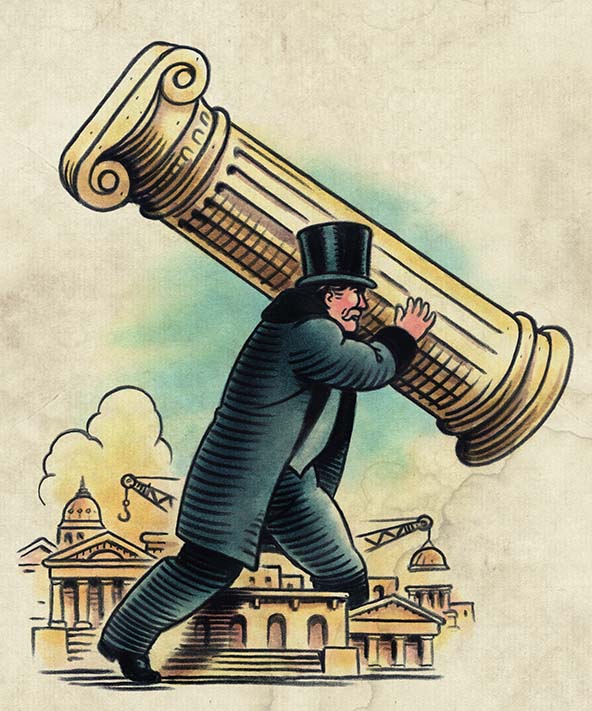
The evidence, however, suggests otherwise. We are not just failing to build new institutions; many older ones are deteriorating in ways that no amount of donor-naming rights can fix.
The decline is measurable across virtually every domain. Public confidence in American institutions has collapsed to historic lows. Gallup's long-running confidence series shows that Americans' average confidence across major institutions—including the church, the military, the Supreme Court, banks, public schools, newspapers, Congress, organized labor, and big business—stands at just 28 percent, in the fourth consecutive year below 30 percent and near the lowest point in 46 years of measurement. Only 17 percent of Americans trust the federal government to do what is right most of the time. Trust in mass media has fallen to 28 percent, and 70 percent of Americans say they trust media "not very much" or "none at all." These are not soft indicators. They represent a broad, sustained loss of faith in the institutional architecture of American life.
Higher education—the crown jewel of Gilded Age philanthropy—illustrates the pattern with painful clarity. US student-loan debt reached $1.66 trillion by the end of 2025, and 9.6 percent of balances were 90 or more days delinquent. Institutions built to democratize knowledge have become engines of debt for millions of Americans. Public confidence has eroded accordingly: Gallup finds that only 36 percent of Americans had “a great deal” or “quite a lot” of confidence in higher education in 2024, down from 57 percent in 2015. Nor are universities functioning as the innovation factories that their advocates proclaim them to be: Despite more than $109 billion in research funding in fiscal year 2024, gross licensing income fell 24 percent, and running royalties dropped 41 percent—a commercialization downshift even as inputs rise. And a widely cited Nature analysis that finds that papers and patents are becoming less disruptive over time across fields suggests that the research enterprise itself is producing fewer breakthroughs per dollar invested.
Hospitals, another signature product of Gilded Age philanthropy, are buckling under the weight of Baumol’s cost disease—health care is the sort of labor-intensive work that resists productivity gains and is subject to rising costs. A nurse still needs roughly the same time to care for a patient as in 1970, but wages must rise to compete with sectors where productivity is improving. The result has been relentless cost escalation. Hospital spending per capita has risen from roughly $1,674 in 1980 to more than $4,807 today in inflation-adjusted terms. Hospital care alone now consumes about 31 percent of all national health expenditures—roughly $1.5 trillion annually. And the cost crisis is not merely making hospitals expensive; it is making them disappear. More than 150 rural hospitals have closed since 2010, and roughly 600 more—nearly 30 percent of all rural hospitals—are considered financially vulnerable.
Local journalism has suffered a collapse that Carnegie would have recognized as a structural emergency. Between 2005 and 2024, roughly 2,900 newspapers in the United States closed or merged, creating vast news deserts where no local outlet covers city-council meetings, school-board decisions, or police conduct. This is precisely the kind of absence a Gilded Age philanthropist might have recognized as requiring new infrastructure—not by purchasing a newspaper founded in the Gilded Age, as Jeff Bezos did with the Washington Post, but by creating an institution designed to sustain local reporting in the digital age. Carnegie saw that American towns had no libraries and built a national infrastructure to provide them. Today’s towns lack newsrooms, but almost no one is building anything to replace them.
The pattern repeats across domain after domain. The United States is overdue for a wave of institution building as ambitious as anything the Gilded Age produced. Consider the breadth of what is broken and the perverse incentives that preserve the status quo: prisons paid per prisoner day, with no stake in keeping former inmates from returning; psychiatric care that warehouses the severely mentally ill in jails because the asylums closed and nothing replaced them; drug-rehabilitation programs paid for per admission, rather than per lasting recovery; homeless shelters funded by bed nights, creating a permanent industry with no incentive to end homelessness; child-welfare agencies funded by the number of children in the system, which then have a perverse incentive to remove children and keep cases open; public defenders so overloaded they meet clients at arraignment; rural communities with no primary care and no institution designed to provide it; schools that teach to the median and are paid on attendance, not on whether struggling students eventually find their footing; workforce-training programs with no accountability for whether graduates get jobs; reentry programs so thin that people leave prison with $40 and no support; special-education systems that pay schools to label children, rather than integrate them; centers for disease control with no operational-surge capacity and no clear accountability for population-health outcomes; an early-childhood system that treats prenatal care, pediatrics, and pre-K as unrelated problems; a civil-justice system in which 86 percent of the legal needs of low-income Americans go entirely unmet; and a local-news ecosystem so degraded that entire communities have lost any institutional mechanism for civic accountability.
In every one of these domains, the failure is not primarily one of funding—it is one of incentive design. The institutions we have were built for a different era, and they reward inputs, rather than outcomes; process, rather than results; and survival, rather than transformation. The Gilded Age philanthropists were not content to improve what existed; they built new structures from the ground up when they identified a gap. Today, the gaps are not hard to find. Many areas of civic life are failing and would benefit from new, purpose-built institutions. Instead of tackling such challenges by thinking about grand architecture, the philanthropic class largely writes checks to floundering institutions, offering money where institutional imagination is needed.
The question is whether these immense private fortunes will continue to decorate the surviving prestige institutions of an older America, or whether they will help construct new organizational forms in the spaces where both market and state have plainly failed. The problem is not that billionaires exert too much influence over public life; it is that the influence they do exert is so often cautious, imitative, and constrained by elite social signaling, not directed toward building bold, lasting institutions.
The Builder’s Obligation
Contrast the mentality of Andrew Carnegie. His essay “The Gospel of Wealth,” published in 1889, is still read today, but his argument is almost universally misunderstood. His central claim was not simply that rich people should give away their money—that was the easy part. He argued that the men who had demonstrated the ability to organize vast enterprises, to manage complexity, and to build things that functioned at scale had an obligation to apply those same skills to public problems. Money was merely the fuel. The real philanthropic resource was organizational genius. Carnegie personally designed the incentive structure of his library program, requiring each community to fund ongoing operations before he would pay for construction—a mechanism that ensured local ownership and sustainability. Rockefeller recruited Frederick T. Gates and later Wickliffe Rose to build the Rockefeller Foundation into an organization that could identify problems, recruit talent, and execute multidecade strategies with the same rigor he had applied to Standard Oil. Julius Rosenwald embedded matching-grant requirements into his school-building program, demanding that Black communities and local governments contribute funds and labor, thereby creating political and financial stakes that would outlast his involvement. These men treated philanthropy as an operational challenge, not merely a financial transaction.
When today’s billionaires default to writing nine-figure checks to Harvard or naming a wing at The Met, the public loses something more valuable than money: It loses the application of the skills that made those fortunes possible in the first place. Jeff Bezos built Amazon into the most sophisticated logistics-and-distribution network in human history—imagine that operational mind applied to redesigning rural health-care delivery or vaccine-distribution infrastructure, not as a onetime gift but as the founder of a permanent institution built for the task. Elon Musk demonstrated at SpaceX that an organization could be built from scratch to do what only governments had previously accomplished, and at a fraction of the cost, yet his philanthropic efforts have been negligible relative to his wealth, and certainly nothing approaching the creation of a new civic institution. The tragedy is not that these billionaires are hoarding their money. Many are giving generously, at least by conventional standards. The tragedy is that they are giving passively—transferring wealth to organizations that other people built, instead of doing the difficult, unglamorous, personal work of building new institutions themselves. The public is not short of philanthropic dollars. It is short of philanthropic builders.
Between selling Oculus to Facebook in 2014 for $2.7 billion and founding Anduril Industries, Palmer Luckey spent time developing a concept that, had he pursued it, would have been among the most genuinely Carnegian philanthropic acts of the 21st century: a nonprofit private-prison chain designed to be paid only when its former inmates stayed out of prison after release. The idea inverted the incentive structure of American incarceration, where private-prison operators profit from recidivism and have no financial reason to rehabilitate. Luckey ultimately abandoned the project—he concluded it would require too much lobbying work—and went on to build a defense-technology company now valued at tens of billions of dollars. But the abandoned prison concept is exactly the kind of institutional thinking this essay is arguing for. Luckey was not proposing to donate to an existing prison-reform nonprofit. He was planning a new model with a novel organizational structure, a self-correcting incentive mechanism, and the potential to demonstrate, at scale, that incarceration could be reimagined. The skills that made Luckey capable of building Anduril from nothing—the same skills that allowed him to build Oculus in his parents’ garage as a teenager—are precisely the skills that Carnegie argued the wealthy had an obligation to deploy for the public good. The nonprofit prison might have been a new institution for a broken system. Instead, the system remains broken, and the builder has moved on.
The Spend-Down Mentality and the Death of Permanence
Creating new institutions requires patience and long-term vision. Perhaps the most telling difference between Gilded Age philanthropy and its modern counterpart lies in its attitude toward time. The Carnegie Corporation of New York, established in 1911, is still operating more than a century later. The Rockefeller Foundation, founded in 1913, continues to fund research and development worldwide. Stanford University, the University of Chicago, The Met—these were conceived as enduring entities, vehicles through which a philanthropist’s resources could generate value long after the philanthropist was dead.
Have we lost the capacity to build? That claim would be inaccurate. Rather, we have simply privatized it.
Today’s philanthropists increasingly reject this model in favor of what is known as “spend-down” philanthropy, the practice of disbursing a foundation’s assets within a set period, typically the lifetime of the donor or within a fixed number of years after the donor’s death. The intellectual case for spend-down was articulated most influentially by Atlantic Philanthropies founder Chuck Feeney, who gave away his entire $8 billion fortune by 2020 and dissolved his foundation. Julius Rosenwald himself was an early advocate, arguing that each generation should address its own problems, rather than relying on the dead hand of perpetual endowments.
The complementary philanthropic movement known as trust-based giving—whose most prominent practitioner is MacKenzie Scott—represents a genuine corrective to the paternalism and bureaucratic overhead of traditional foundation grantmaking, and its instinct to yield power and resources to communities closest to the problems is not wrong. But as a theory of change, it is incomplete in a way that matters. Unrestricted cash grants can sustain and improve organizations that are already working; they cannot redesign the incentive structures that make so many organizations fail in the first place. A homeless shelter given an unrestricted grant is better resourced, but it is still paid by the bed night. A drug-rehabilitation program with more operating runway is still paid per admission. Trust-based philanthropy addresses the symptoms of institutional failure with dignity and speed, but it leaves the underlying architecture intact—the broken feedback loops, the perverse payment structures, the misaligned accountability systems that produce the same outcomes generation after generation. The great institution builders of the Gilded Age were not simply moving money to people who needed it. They were designing new organisms: new structures with new incentives, new accountability mechanisms, new theories of how to organize human effort toward a public end. That is harder, slower, and less legible than writing a large check to an existing nonprofit—but it is the work that actually changes what is possible.
The most prominent vehicle is the Giving Pledge, initiated by Warren Buffett and Bill and Melinda Gates in 2010, which asks billionaires to commit to giving away most of their wealth during their lifetimes or in their wills. More than 240 individuals and families have signed the pledge, representing over $600 billion in promised philanthropy. The ethos is admirable in one sense: It rejects dynastic hoarding and insists that fortunes be put to public use. But the emphasis on giving quickly, rather than building something permanent, reveals a fundamental lack of institutional imagination. The Gates Foundation, the largest private foundation in the world, announced in 2024 that it plans to spend down its roughly $75 billion endowment within 25 years of the deaths of its founders. John Arnold, the former hedge-fund manager turned philanthropist, has explicitly committed to spending down his and his wife, Laura’s, fortune within their lifetimes, arguing that perpetual foundations become sclerotic and lose focus.
The spend-down philosophy does have a reasonable argument embedded within it. Perpetual foundations can indeed become bureaucratic, cautious, and disconnected from the problems they were created to solve. The Ford Foundation, established by Edsel Ford in 1936, became a canonical example for critics of philanthropic drift when Henry Ford II resigned from its board in 1976, complaining that its mission had become diffuse and estranged from the capitalist system that made it possible. And, as this essay has argued, many institutions built during the Gilded Age are no longer serving their original purposes. But the wholesale abandonment of permanence represents a failure of a different kind.
The relevant divide is not between perpetual foundations and spend-down foundations. Both forms can decay into self-importance or drift. The question is whether philanthropy creates durable mission-bearing architecture—organizations, norms, training pipelines, research bodies, civic platforms—that can persist for as long as a real public need persists. Some problems require urgency; others require patience; many require both. A philanthropic culture that can imagine only immediate disbursement is as distorted as one that can imagine only permanent endowment. What is missing today is not just longevity but institutional form equal to the time horizon of the problem.
The spend-down mentality, for all its urgency, is fundamentally presentist. It assumes that the most important problems are the ones we can see right now; that the most efficient use of philanthropic capital is to deploy it against today’s crises; and that future generations will produce their own billionaires to solve their own problems. These assumptions may prove spectacularly wrong. The Rockefeller Foundation’s investment in Norman Borlaug’s agricultural research in the 1940s did not yield the Green Revolution until the 1960s—two decades of patient, unglamorous institutional support that eventually saved an estimated one billion lives from famine. No spend-down foundation operating under a 20-year sunset clause with strict measurements for disability-adjusted life years would have sustained that bet. The Carnegie Corporation’s early investments in public broadcasting bore fruit decades later with the creation of PBS and Sesame Street. These were not “quick wins”; they were slow institutional bets that required the kind of patience only a permanent endowment can provide.
The right answer need not require perpetuity: Organizations should exist as long as they fulfill their purpose, and we need new philanthropic structures capable of embodying that principle—institutions designed with built-in mechanisms for renewal, self-assessment, and, when necessary, graceful closure. Neither the sclerosis of the Ford Foundation nor the planned evaporation of the Gates Foundation represents an adequate model. What we need are institutions built to last as long as they are accomplishing their goals—and not a day longer.
The Empty Plinth
Have we, in the end, lost the capacity to build? That claim would be inaccurate. Rather, we have simply privatized it. The contemporary elite still found organizations, recruit talent, solve coordination problems, and scale systems across continents. But they express these capacities through companies, not civic institutions. We still produce builders. But, unlike in the Gilded Age, we no longer have builders who train in the private markets, then use their skills to build for the public good.
The Gilded Age philanthropists understood something their successors have largely forgotten: The highest form of philanthropy is not the transfer of wealth but the creation of structure. A library is not a pile of books. It is an institution—a set of norms, practices, relationships, and physical spaces—that organizes knowledge and makes it available to anyone who walks through the door. A university is not a collection of classrooms. It is a self-perpetuating community of inquiry, a machine for producing discoveries that no one can foresee. A research foundation is not a checkbook. It is an organizational intelligence, capable of identifying problems, recruiting talent, and sustaining effort over decades.
These are the structures that make civilization. Not individual acts of generosity, however large, but institutions—durable, self-renewing, capable of operating long after their founders are forgotten. Roman aqueducts still carry water; the universities of medieval Bologna and Oxford still produce cutting-edge scholarship; Carnegie’s libraries still lend books. These structures endure because they were designed to endure, because their creators understood that the most valuable gift one generation can give to the next is not money but enduring frameworks within which human effort can be organized and sustained.
The money exists. The will to build does not. The spend-down model tells today’s philanthropists to deploy capital quickly, against measurable problems, within their own lifetimes. The social dynamics of elite philanthropy tell them to give where their names will be seen by the right people—on the facade of a building at their alma mater, on a gallery wall at The Met, on a concert hall that already bears three other donors’ names. And so the checks flow to the same institutions, the endowments of the wealthy grow wealthier, and the structural absences in American life—the missing institutions, the ungoverned spaces, the problems no one has built an organization to solve—remain unfilled.
What we need today is a recovery of institutional ambition under conditions more responsive, more self-critical, and more historically honest than those of the first Gilded Age. The task is not to celebrate oligarchs for behaving like quasi sovereigns; it is to ask why, in a society so rich in technical talent, managerial sophistication, and private capital, so little of that capacity is being converted into durable structures for common life.
We are living on the institutional inheritance of the Gilded Age. We are spending it down, and we are not replenishing it. The libraries are still open, the universities still teach, the museums still hang their paintings—but these are the creations of the dead, maintained by the living, and supplemented by almost nothing new. The plinth is empty. The men and women who built the technologies that define our era—who proved, in the marketplace, that they could create organizations of astonishing power and scale—have not yet turned those abilities toward the permanent public good. The Gilded Age philanthropists left us the scaffolding of civilization. We have left it standing, but we have built little upon it. And when the scaffolding finally fails, as all structures eventually do, we will discover that the richest generation in human history has bequeathed to its descendants only the memory of how much money it once had, and how little of that went toward building anything that lasts.
Editor's note: A previous version of this story misstated the amount of wealth the top 1 percent of American households controlled in 1890. We regret the error.
Read more stories by Sarah Cone.