


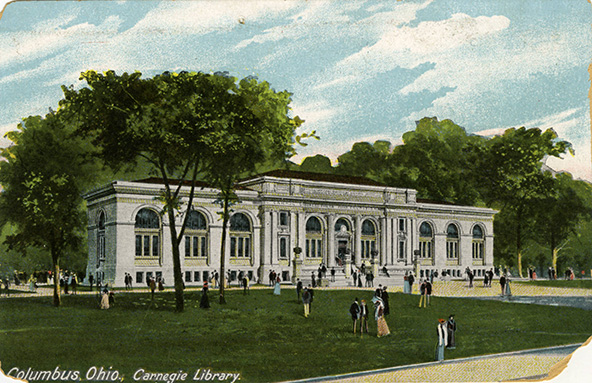
 (Illustration courtesy of Columbus Metropolitan Library)
With AI companies like OpenAI and Anthropic expected to generate enormous personal fortunes in the years ahead, speculation is already mounting about how this new class of ultra-wealthy individuals will direct this windfall, and what that might mean for society. It is reasonable to assume that at least a portion of these fortunes will flow into philanthropy, potentially adding hundreds of billions of dollars in new charitable giving over time.
Predictably, much of the public discourse has focused on which problems these new philanthropists should choose to address and the practical questions that follow: What funding strategies will be most effective? What kinds of organizations should be built or scaled? What infrastructure, talent, and organizational forms will be required to translate these resources into meaningful impact?
These are important questions but perhaps not the most important for our time. The more weighty question is what responsibilities accompany extraordinary wealth in a world beset with declining trust in institutions, deep polarization, and widespread feelings of political and economic disenfranchisement.
Many of the recent generations of wealth creators, including Gates, Zuckerberg, and Bloomberg, accumulated their fortunes during a period of extraordinary technological transformation, much like the current one. Their philanthropic endeavors reflected a distinctly technocratic ethos: identify a tractable but underinvested problem, assemble the best experts, fund solutions, measure outcomes, and scale what works. This model has produced extraordinary advances in global health, scientific research, education, and public policy.
Yet it has also revealed the limits of expertise, resources, and good intentions as levers for social change. Some of the most ambitious interventions of the past two decades struggled not because they lacked funding or rigor but because they underestimated the importance of legitimacy, trust, and community ownership. Mark Zuckerberg’s $100 million effort to reform public schools in Newark remains a case study in the limits of top-down philanthropy.
The challenge facing this new era of philanthropy is compounded by the fact that the institutions that have traditionally mediated between citizens and power are themselves struggling. Civil society organizations, from nonprofits to universities to the media, are confronting their own crises of legitimacy, representation, and public confidence. Critics from across the political spectrum increasingly view these institutions as unresponsive to the concerns of ordinary citizens, even if they may disagree about the causes. Some see them as captured by economic and political elites, while others see them as beholden to ideological agendas that have displaced their core missions. With moral authority in scarce supply, the ability to navigate competing interests, values, and constituencies will be critical for any individual or organization attempting to address social problems.
Resources, expertise, and ambition will be insufficient on their own to repair the fractures in our social order. The defining challenge for this new generation of billionaire philanthropists is therefore not simply determining what to fund but how to exercise influence in a society where trust is fragile and legitimacy cannot be bought. They will need to envision a broader role for themselves, one that casts them not merely as investors and orchestrators of social outcomes but as stewards of the civic conditions that build trust, participation, and shared purpose.
Ironically, despite Andrew Carnegie’s many flaws as an industrialist, his philanthropy was animated by a belief that wealth carried obligations beyond charitable giving alone. Libraries were not simply a service to be delivered, they were civic organizations designed to expand opportunity, agency, and enable broader participation in public life. Likewise, many of the universities, museums, and public institutions established during that era were conceived as enduring infrastructure for a democratic society. That broader conception of philanthropy, as a form of civic leadership rather than provision of goods and services that markets or government are unable to deliver, feels increasingly relevant today.
For that task, the next generation of philanthropists may need guides. Ironically, some of the most valuable lessons may be found within the very institutions many new philanthropists are inclined to dismiss: professionally managed legacy foundations. While the organizational forms and program strategies of foundations such as Ford, MacArthur, Hewlett, and Packard may appear anachronistic to a generation steeped in entrepreneurial culture, it would be a mistake to overlook the experience these organizations have accumulated operating at the difficult boundary between markets, states, and civil society.
The defining challenge for this new generation of billionaire philanthropists is therefore not simply determining what to fund but how to exercise influence in a society where trust is fragile and legitimacy cannot be bought.
To be clear, legacy foundations are hardly immune from the broader crisis of confidence affecting civil society. They have found themselves criticized from several directions—variously accused of being paternalistic, elitist, unaccountable, or ideologically driven. Yet, they remain among the few civic intermediaries whose work routinely spans sectors and time horizons. Over decades, these foundations have helped seed and sustain entire ecosystems of organizations, research fields, civic institutions, and public-interest infrastructure that continue to shape society today. They have supported efforts to expand civil rights, advanced gender equality, strengthened environmental protections, improved public health, and broadened opportunities for historically marginalized communities. Their record is far from flawless, but it demonstrates a capacity not only for institution-building but for helping to catalyze meaningful social change within complex systems.
Their leaders have spent decades navigating the very hurdles that the next generation of philanthropists is likely to encounter: competing constituencies, conflicting values, and persistent questions of legitimacy and authority in a pluralistic society. Few other institutions have accumulated comparable experience operating amid such persistent contestation.
The intellectual and political translation work that foundation leaders perform every day, between trustees, staff, grantees, policy makers, community leaders, and the broader public, may prove increasingly valuable in the years ahead. They have spent decades confronting the limits of philanthropic power and understand that lasting social change rarely emerges from expertise or resources alone. More often, it depends on coalition-building and public buy-in.
Consider the aforementioned example of Newark Public Schools. What if, instead of arriving with a largely predetermined reform agenda, the effort had begun with a period of community listening? What if a meaningful portion of the funding had been devoted to cultivating local leadership, supporting parent organizing, and creating governance structures through which residents could shape priorities and hold institutions accountable? It is impossible to know if the educational outcomes would have been different, but the intervention might have delivered more lasting civic infrastructure.
Such an approach requires a fundamentally different mindset than one that has typically driven technological innovation. It asks philanthropists to see philanthropy not simply as a mechanism for social problem solving but as a means of broadening the agency of communities and strengthening their capacity to shape their own futures.
In the 1960s, the Ford Foundation funded the Bedford-Stuyvesant Restoration Corporation, the first community development corporation in the United States. That initiative helped seed what became the modern community development movement by demonstrating how philanthropy could strengthen neighborhood-based organizations. Over time, the model spread to thousands of communities across the country, contributing to affordable housing development, neighborhood revitalization, and local economic growth while leaving behind a legacy of civic capacity and local leadership that lasted far beyond the original philanthropic investments.
The next generation of philanthropists will undoubtedly fund scientific breakthroughs, accelerate technological innovation, and tackle some of humanity’s most pressing challenges. Yet they will also inherit a society grappling with declining trust, weakened institutions, and deep social divides. Even the most elegant interventions can falter when the institutions leading them lack legitimacy or when the communities they seek to serve feel excluded from the process. Scientific discovery, economic opportunity, public health, educational attainment, and even the most responsible development of artificial intelligence ultimately depend on levels of trust and social cooperation that cannot be taken for granted.
This is not simply a moral argument for civic leadership, but a practical one. The most consequential question facing this new era of philanthropy may not be what problems wealth can solve, but how wealth can be exercised in ways that strengthen the democratic foundations upon which all lasting progress ultimately depends.
Read more stories by Priya Shanker.