


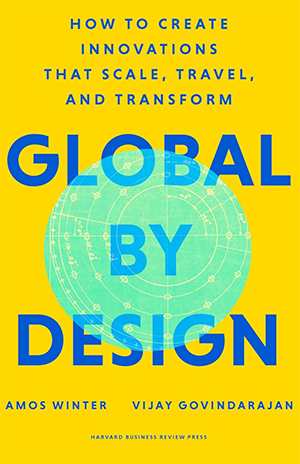
Global by Design: How to Create Innovations That Scale, Travel, and Transform
Amos Winter and Vijay Govindarajan
325 pages, Harvard Business Review Press, 2026
It’s human to want to help those in need. We’ve all watched heart-wrenching images on the news of people suffering from war, disease, and poverty. These images inspire many of us to want to do something about these challenges. Few of us have the capacity to make substantive contributions, however, and so problem solvers often feel a sense of desperation and to want to do something. After all, something must be better than nothing?
However, misguided or ill-conceived innovation aimed at helping those in need can sometimes cause more harm than good. Cautionary examples from international development programs include donated clothing that disrupts local textile industries and retail markets, food aid that depresses local crop prices, and poorly managed well construction that leaves communities without reliable access to water when pumps break and no spare parts are available.
The following expert from our book, Global by Design: How to Create Innovations that Scale, Travel, and Transform, describes the predicament many innovators face when deciding whether and how to tackle a global challenge. As you will read, “something” is not always better than nothing. The main lesson is to understand the conditions required for success and positive impact, and to assess whether you have the resources, skills, and time needed to create meaningful, lasting change.—Amos Winter and Vijay Govindarjan
* * *
Unfortunately, the developing world has countless product graveyards filled with devices delivered with good intentions, but which had no chance of actually making a positive impact. Go to any developing world hospital and there is likely a room full of broken medical equipment that can never be locally or affordably repaired. When a population is in dire need of help, but appropriate, viable, and sustainable solutions cannot be delivered, it can sometimes be easy to slip into a mentality that providing a stopgap solution is appropriate, because at least “it’s better than nothing”. This is not always true, and in many cases can cause further harm.
The Free Wheelchair Mission, a charity that provides low-cost wheelchairs to developing countries, fell into the “it’s better than nothing trap” early in its operations. The founders of the company started with the admirable objective of providing the lowest cost wheelchair available that was appropriate for poor, rugged communities. Fixated on price, they conceived of a plastic lawn chair surrounded by a steel frame with mountain bike wheels, which indeed was the lowest cost developing world wheelchair available at $45 delivered. Though cheap, it fell short on most other user requirements. The wide seat made it difficult to grasp the push rims to propel the chair. The plastic easily cracked. The chair was initially provided without a cushion, with the hard seat easily causing pressure sores for spinal cord injury victims, earning it the nickname “the chair of death” by many in the developing world wheelchair community. It was common to find the Gen_1 Free Wheelchair Mission wheelchair relegated to being used only in the shower, given the plastic seat was waterproof.
Thankfully the Free Wheelchair Mission recognized the issues with the Gen_1 product (now retired), engaged experts in the developing world wheelchair community, and created a much-improved product (called the Gen_3) that addresses a suite of daily life activity, postural support, and transport needs of users while still being extremely low-cost; the average cost of manufacturing and shipping for a Gen_3 Free Wheelchair Mission chair is $96.
Society celebrates last ditch efforts against all odds that are triumphant in the end—any recent Marvel superhero movie will demonstrate this plot line. But when your back is against the wall, and the odds are a million-to-one, the most likely result is failure, despite the statistically incongruous outcomes Hollywood likes to portray. Innovators should be mindful about when they might slip into such a scenario, praying for a moonshot and trying anything because “it’s better than nothing”.
This dynamic played out during the early days of the COVID-19 pandemic, when there was a tragic shortage of ventilators for patients in ICUs around the world; in the US, it was estimated that 98,000 ventilators were available, but the government ordered an additional 187,000 by the end of 2020. Heroically, many innovators stepped up to the challenge to create low-cost ventilators to provide life-saving support, which could be rapidly manufactured and deployed using technology like 3D printing. At that dark time, society needed glimmers of hope, and the press turned its spotlight to innovators around the world aggressively trying to make low-cost, rapidly deployable ventilators. In early spring 2020, multiple articles appeared about young engineers, such as those at Nocca Robotics in India and Rice University in the US, who were still in the early stages of prototyping a device but were a long way away from showing real viability for human patients.
In contrast to simple personal protective equipment, like face shields that were successfully designed, fabricated, and disseminated quickly during the onset of the pandemic, ventilators are much more complicated and sensitive devices. Ventilation entails more than just blowing oxygenated air into the lungs. Pumping too fast or at too high of a pressure can cause injuries; having an “it’s better than nothing” attitude with ventilators could kill someone. In the US, ventilators are regulated by the Food and Drug Administration (FDA), which issued an emergency use authorization (EUA) on March 24, 2020 to allow many foreign ventilators to be imported and used in the US, as well as other devices such as anesthesia gas machines and positive pressure breathing devices to be modified and used as ventilators. Manufacturers of these devices still had to submit proof of acceptable performance to be included on the FDA’s EUA-approved ventilator list.
Impressively, Rice University’s ventilator, called the Apollo ABVM and licensed by Stuart & Stevenson, was approved under the FDA EUA in June of 2020, as was the Mechanical Ventilator Milano (MVM) created by a large international team primarily from Italy (May 2020) and the O2U ventilator designed at Stanford (March 2021). However, it is unclear how many, or if any, of these rapidly-designed units were ever actually used in hospitals. Outside of the US, Nocca Robotics is likely the most successful in terms of numbers: it has produced 3500+ of its ventilators in India. At 4.5 Lakh ($18,400), they claim to be 25% to 35% cheaper than other ventilators on the market, but are a far cry away from their original target price of 0.5 Lakh and other ventilators that existed on the Indian market before the pandemic that cost 2 Lakh.
Objectively, rapidly-designed, low-cost ventilators did not save the day during the COVID-19 pandemic. Most of these projects never grew beyond a concept or prototype. The ones that were refined and commercialized did not fill the large global gap between ventilator demand and available supply. Over time, medical professionals received more traditional ventilators as the manufacturing and supply chain caught up, and learned how to effectively employ non-ventilating interventions like oxygenation.
Were the rapidly-designed ventilators “better than nothing”? Medically and statistically, likely no. In terms of inspiring the public with a heroic effort, likely yes. We applaud the innovators who had the drive and compulsion to help their fellow global citizens in a time of need. Even at a million-to-one odds, sometimes you do win, as in the case of the hacked-together air purifier that saved the lives of the Apollo 13 astronauts, famously depicted in the movie Apollo 13. Yet part of being an innovator is being a tempered dreamer, realizing where you can or are likely to make impact, and where your resources, reach, time, or capabilities may be limited. Thoughtful reflection about these factors, the risk you are willing to take, the impact of success, and your likelihood of achieving it will help you avoid the trap of “it’s better than nothing.”
Reprinted by permission of Harvard Business Review Press. Excerpted from Global by Design: How to Create Innovations That Scale, Travel, and Transform by Amos Winter and Vijay Govindarajan. Copyright 2026 Amos Winter and Govindarajan. All rights reserved.