


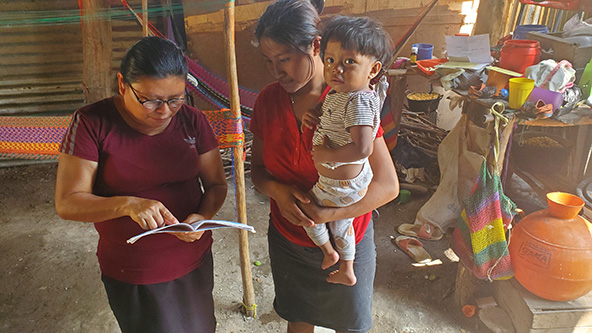
 Lucia Sanchez Martinez, project coordinator at La Asociación de Campesinos para El Desarrollo Humano (Peasants for Human Development, or CDH), tracks the growth of a young community member. (Photo by Joel Sawady)
Since January 2025, government cuts to international development assistance have closed clinics, cut jobs, and left communities without care. The toll is mounting: A count in June estimated 124,000 adult and 259,000 child deaths as a result.
Even in a best-case scenario, it will take years for most lower- and middle-income countries (LMICs) that received outside support to step up their own health funding. Philanthropic capital can’t fill this vacuum. However, US foundations alone hold more than $1.6 trillion, US donor-advised funds hold more than $250 billion, and other major global foundations have multi-billion-dollar war chests. And because so many international aid programs have closed or been cut back, a veritable army of skilled global health workers is at hand. For a sense of size, cuts at the United States Agency for International Development (USAID) have led to more than 20,000 layoffs in the United States and nearly 240,000 globally. Meanwhile, the World Health Organization deployed a 21 percent budget cut in May 2025, reducing its management team by half and laying off nearly 400 staff as of August 2025.
Recent well-intentioned efforts to close the funding gap have yet to attract the capital they need to fully operate. For example, the Center for Global Development’s Project Resource Optimization initiative connects private donors to a vetted list of high-impact, former USAID partners. It generated $110 million in funding for various programs as of September 2025, but for comparison, USAID’s congressional appropriation was more than $35 billion in 2024 alone. Another effort, Unlock Aid’s Foreign Aid Bridge Fund, raised $2 million from small donors, but couldn’t garner support from large philanthropic partners and shut down in April 2025.
Two persistent roadblocks stand in the way of efforts like these: 1) philanthropy’s inability to respond quickly to challenges, and 2) funders’ fear of deploying capital without enough information. Surmounting these barriers requires that foundations and other funders set aside traditional tactics and work in new ways. Only by leaning into trust-based philanthropy and recognizing that on-the-ground partners have the knowledge and skillsets to solve their own problems can funders respond in time and increase the pace of progress.
Impact on the Ground
When local leaders have resources, they build lasting change. A striking example is La Asociación de Campesinos para El Desarrollo Humano (Peasants for Human Development, or CDH), a locally led group in a poor rural community in northeast El Salvador. After their country’s 12-year civil war ended in the early 1990s, international NGOs trained community members as health promoters and lay educators. By the early 2000s, the training ended, and the NGOs left, but these local leaders refused to let care disappear and built an organization from scratch. CDH has thrived for 22 years and now delivers a wide range of services including health care, microfinance lending, water and sanitation improvements, and climate resilient interventions.
Grassroots organizations like CDH offer safety nets for marginalized communities battling inequality. They are agile and possess the networks and expertise to respond to emerging crises. In our own work as funders and supporters of grassroots organizations, three best practices have proven effective time and again. While these ideas aren’t new, we believe that global philanthropy must embrace them much more earnestly and urgently in this moment:
- Invest in local leaders in LMICs
- Make large, unrestricted, multi-year commitments
- Use networks to learn from and identify strong nonprofit partners
Invest in Local Leaders
As foreign aid recedes, philanthropy can support grassroots leaders—especially leaders from marginalized groups—as they develop their organizations, grow their skills, and advocate with local governments. Supporting local leadership capacity supports both quick response to changing conditions and long-term change.
An example is José Ramiro Cortez Argueta, known as Ramiro, who trained as a health promoter after the civil war in El Salvador and 10 years later became CDH’s founding executive director. Now, 22 years later, he hires doctors, engineers, accountants, and lawyers, and writes competitive grants for national and international funders, all based on priorities identified within his community. Most recently, he and other CDH leaders have started work on a community-based treatment program in response to rising cases of diabetes and hypertension. The program addresses two major health care issues in LMICs in a manner that’s tailored to the local context. Without the philanthropic capital that supported Ramiro during his time as executive director, CDH would have closed years ago.
Similarly, American Jewish World Service (AJWS) supports thousands of frontline grassroots leaders worldwide through trust-based philanthropy. In March, Busia Survivors—a grantee delivering HIV treatment and prevention services in Kenya and Uganda—had to shutter specialized clinics and suspend services due to US foreign assistance cuts. Although government clinics remained open, Busia Survivors’ staff saw that people who previously came to their clinics—including sex workers and other patients vulnerable to stigma and discrimination, and at risk of arrest—stopped seeking out help. In response, the organization quickly negotiated with government hospitals to use two shipping container units as satellite clinics. It then worked with AJWS to draft an agreement with the government to ensure that the clinics remained safe spaces for marginalized patients seeking treatment, contraceptives, counseling, and other support.
Make Large, Unrestricted, Multi-Year Commitments
Most philanthropists know that big, unrestricted, multi-year gifts stabilize locally led initiatives and give them the flexibility they need to operate resilient, adaptable systems that protect community health. They also signal high confidence to other funders and can create a momentum of giving that helps grassroots organizations thrive. More funders need to actually do it now.
 Girls participate in an advocacy and leadership training at Nyanza Initiative for Girls' Education and Empowerment (NIGEE). (Photo courtesy of NIGEE)
Multi-year support has produced several concrete outcomes for CDH. A stable source of income gives leaders and their families a sense of security, drawing local talent to CDH and improving staff retention. It also allows leaders to focus on long-term strategy rather than short-term organizational survival, and to pursue additional funding based on community priorities. Finally, multi-year support allowed CDH to invest in its own administrative infrastructure, which was then leveraged to secure new international and local government funding for a bridge over a local river, as well as water and sanitation improvements.
Another example is AJWS’s long-term, flexible funding of the Nyanza Initiative for Girls' Education and Empowerment (NIGEE), which focuses on engaging village elders and local leaders on issues related to sexual health and rights and gender-based violence. After the United States ended its foreign assistance, NIGEE noticed a rise in teenage pregnancies and HIV infections. In response, it paused regular outreach activities and began focusing on training leaders within the community to speak with parents, escort girls to government clinics to acquire contraceptives, and provide counseling. NIGEE’s nearly two decades of experience empowering girls combined with the availability of flexible funding allowed it to respond to the situation immediately; it could pivot with confidence knowing it would still have funding to continue its regular work when the crisis abated.
Use Networks
Some funders are identifying locally led organizations within LMICs and trusting them enough to make unrestricted multi-year commitments. But considering the scale of need, it’s not nearly enough. Tapping into existing networks to vet and connect with new grantee partners is an important piece of the puzzle, and the post-USAID era provides ample opportunities for this. Funders can find organizations within existing lists of USAID’s previous investments, many of which are now shutting down for lack of funds. They can also use alliances, such as the Community Health Impact Coalition and the CORE Group, and networks established by intermediary funders like AJWS. These groups already have longstanding relationships with locally led partners and a track record of sustained impact.
Funders can also double-down on their support for existing grantees. In March, for example, The Launders Trust renewed grants for Edesia Nutrition and the Solar Electric Light Fund, two grantees hit hard by international development cuts. It also plans to award multiyear general operating support to new grantees and find ways to inspire governments to invest. Meanwhile, several initiatives have emerged as a result of conversations with nonprofit partners, including virtual capacity building workshops on finance and fundraising, convenings to share strategies and resources, and listening sessions where the trust’s staff and trustees learn from grantees.
Stepping Into the Gap
The health infrastructure in many LMICs has been reliant on foreign assistance. Dramatic cuts to funding mean that diseases like HIV and TB will return to places where they were once controlled, emerging diseases will be harder to combat, and the work of addressing chronic illness will lose important champions. And because diseases do not respect borders, vulnerable LMICs leave everyone more vulnerable.
Philanthropy can and must help mitigate these threats now by partnering with local leaders, using multi-year investments, and leveraging networks. The money is there. Health experts are ready. If funders wait for perfect conditions, they will lose the opportunity to save lives. If they act with courage, they can seize the moment.
Read more stories by Caitlin Orth, Shari Turitz & Joel Sawady.