


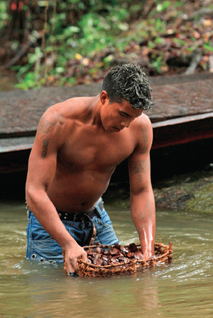
 A grower in the Amazonian
region of Brazil
washes nuts to be sold to
Ekos for use in its skin
and hair care products. (Photo courtesy of Ekos)
A grower in the Amazonian
region of Brazil
washes nuts to be sold to
Ekos for use in its skin
and hair care products. (Photo courtesy of Ekos)
Ten years ago, Hélène Menu was clicking through the website of Brazilian cosmetics company Natura when its new line of skin and hair care products caught her eye. The line, called Ekos, uses the roots, leaves, fruits, and nuts that Brazil’s indigenous communities have long harvested for food and remedies.
“I want that,” Menu thought. A Brazil-based agronomist, she has long admired Natura for its environmental and social practices. In Menu’s fieldwork in Madagascar and southern Brazil, she had come across native species that smelled and felt luscious, but she had never heard of Ekos’s andiroba or murumuru palm. She also knew that if Natura began hiring traditional communities to farm native plants, it could help alleviate poverty and protect the quickly shrinking Amazon rain forest. If a commercial outlet opened up for their products, Amazon farmers would be less enticed to log timber illegally or clear-cut forests for cattle grazing, cash crops, and mining.
Menu immediately sent her curriculum vitae to Natura, which was looking for three agronomists to join its Ekos team. She was hired for all three positions. The reason? Menu had just spent five years working on a challenging agrarian reform project with a remote traditional community in the Caatinga region of Brazil. And her future boss liked her answer to the question “If you had to develop a new cosmetic, what would it be?” “I said I would develop a cream for hands based on pequi oil,” Menu says. “Because I knew that in the state of Minas Gerais, the old ladies who cook pequi and then smash the fruit into paste have hands of young ladies.”
Natura never made a pequi hand cream, but it would come to consider Ekos the darling of its company. Two years after Ekos’s launch in 2000, Natura’s net profits jumped from $15.2 million to $33.7 million, pulling the company, which was founded in 1969, out of a three-year financial stagnation.
In 2005, Natura ventured into the international natural cosmetics market, opening an Ekos-heavy boutique in Paris’s fashionable 6th arrondissement. A year later it set up a research and development team in Paris that would determine French consumers’ preferences and begin training Avon-style direct sellers, Natura’s retail model, throughout France. (Natura now contracts with 3,000 direct sellers in France, more than 1 million in Brazil, and another 200,000 in Mexico, Peru, Argentina, Colombia, and Chile.) Last year Natura’s revenues jumped 20 percent to $2.9 billion. It holds almost a quarter—the biggest share—of the cosmetics market in Latin America.
Ekos’s social and environmental practices also have flourished. Ekos currently works with 2,301 families in 25 communities to grow 31 native species. Last year, Natura paid these communities $4.96 million for cost of goods, benefit sharing agreements, and use of image, as well as training and advisory services.
Leonardo Letelier, founder and CEO of sitawi, Brazil’s first social enterprise fund, thinks Ekos’s success probably boils down to Natura being a Brazilian company. A local company faces less suspicion from native people, can stay attentive to them because of proximity, and understands the “complex” way that Brazilians do business, says Letelier.
Pedro Passos, Natura’s co-chairman, credits Ekos’s success to its nationality as well as to the company’s core beliefs of valuing relationships, diversity, truthfulness, and constant innovation. “We entered a field in which a willingness to learn and to engage in dialogue needs to be cultivated on a permanent basis,” he says.
CORRECT PORTUGUESE
Ekos was dreamed up in 1997, when Natura decided it was ready to compete with global cosmetics leaders such as Avon, L’Oréal, Procter & Gamble, and Unilever, and needed a starring line. Ekos was expected to stand out from this crowd because of its use of Brazil’s exotic plant species and its support of rain forest conservation. Passos says the new line would also reinforce Natura’s reputation for socio-environmental responsibility back home in Brazil.
Natura did its research, noting other social businesses’ errors. Ben & Jerry’s had just discontinued its Rainforest Crunch ice cream because the small Amazonian cooperative that harvested the ice cream maker’s Brazil nuts could not keep up with demand, forcing the company to turn to large-scale producers. The Body Shop, which had been buying Brazil nuts from the Amazonian Kayapo tribe for its top-selling conditioner, switched to a larger-scale cooperative and small growers in Peru after the tribe’s chief sued the company for using his image without permission.
By establishing relationships with communities, NGOs, and government agencies and reinforcing the “Brazilian-ness” of its brand, Natura set itself apart internationally.
To avoid such problems, Menu (now a sustainability expert at the Brazilian subsidiary of German chemicals giant BASF) developed a routine for meeting new communities. She would wear jeans and a T-shirt instead of a business suit, arrive after work hours when entire families would be present, and try hard to adopt the community’s Portuguese accent. “The point was to respect their time and be very transparent about the project and the objectives and conditions we could offer,” says Menu. “I’d give them several weeks to think about everything, and then come back to answer questions. If everyone was OK with the project, we worked together to build the schedule and all the next steps. Everything was formalized in minutes and signed by everyone in the community.”
Still, clear communication took time. After two years of working with a community that grew priprioca, a grass Ekos uses for fragrance, Menu returned with a colleague who would become that community’s primary contact at Natura. An elderly woman interrupted the meeting to ask, “How long will it take this person to speak in a way we can understand?” Menu responded, “How long did it take for me to speak ‘correct’ Portuguese?” “About six months,” the woman answered, and everyone laughed.
Natura’s founder, Antônio Luiz Seabra, and top executives Guilherme Leal and Passos also made special efforts to understand the needs of their suppliers, visiting one of the regions where Ekos products would be sourced. Two months later, they invited 13 community leaders to Natura’s Cajamar headquarters to discuss image rights, benefit sharing agreements, and farming information exchanges among indigenous communities.
Natura pursued other kinds of relationships in developing Ekos. Menu connected Natura to university research teams already documenting Brazil’s vast array of flora. (Although 22 percent of the Earth’s species are in Brazil, only 1 percent had been cataloged by 2001, and only 8 percent had been evaluated for phytotherapeutic use.) She also found NGOs and government agencies that specialized in sustainability and identified tools for measuring Natura’s impact on native communities. When problems arose, she negotiated among these groups; though the only real problem, she insists, was that some communities couldn’t meet deadlines set by Natura’s oil processor. “We solved that by working the schedule around their cultural and agricultural practices,” Menu says.
By establishing these relationships and reinforcing the “Brazilian-ness” of its brand, Natura set itself apart internationally, Passos says. “Those innovations allowed us to achieve an international standard of quality, and more important, to avoid direct conflict with our competitors’ technologies.” The only relationship Natura might have rethought, he says, is the purchase in 1999 of Flora Medicinal, a Rio de Janeiro phytotherapeutics company. “The business itself has not brought the expected results, especially because of regulatory difficulties,” he says. “Still, it allowed us to have contact with a fantastic collection of ingredients and the knowledge that contributed to our development.”
INTO THE AMAZON
Ekos’ accomplishments have inspired Natura to take its social and environmental efforts further. Natura now uses indigenous ingredients in its other product lines and applies Ekos’s sustainability goals to its entire supply chain. In Mexico and Peru, for instance, it now transports products by ship instead of by airplane or truck. The company plans to replace all mineral- and animal-based ingredients with renewable, vegetable-based alternatives, and it has introduced a glass polymer jar processed at 20 percent lower temperatures as well as a fully recyclable refill package made from sugarcane. Such changes have helped the company reduce its carbon emissions by 21 percent since 2007.
Menu hopes Natura will enable communities to be more entrepreneurial. In her observation, the families that started businesses with their Ekos paychecks “looked much happier” and also improved their existing businesses; one community bought a bus to transport its goods into the city. Letelier wishes the company would fund “unsafe” causes, such as abortion rights or prostitutes’ rights, not just education reform. Since 1995, Natura has invested proceeds from its Crer Para Ver line into public school improvement programs in Brazil and across Latin America. “What’s needed in Brazil is anything related to human rights,” Letelier says. “Natura is a strong brand with soul, almost a complete person—so you can see it having a controversial point of view and weathering the storm.”
In the next few years, Passos says Natura will partner with 3,000 more families, many of them in the impoverished but greatly biodiverse Amazon region. In keeping with its core beliefs, Natura also will share its production and development models with other companies wanting to promote the sustainable use of Brazil’s biodiversity.
“It is completely possible to develop innovative business models around sustainability,” Passos says. “There are many challenges, but there isn’t one correct path. What matters most is to believe and go on.”
Read more stories by Jennifer Roberts.