


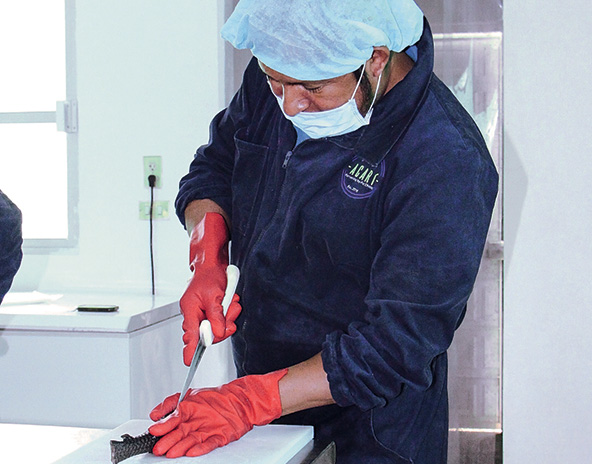
 Acari Fish production manager Francisco Felix Mendoza fillets devil fish in preparation for their processing into Pezzy Pets treats and toppers. (Photo courtesy of Acari Fish)
In Mexico’s southeastern state of Tabasco, an invasive species has threatened local livelihoods, species diversity, and environmental conditions. The armored catfish—nicknamed the “devil fish”—is a freshwater bottom dweller in ponds and rivers that reproduces quickly and feeds on the eggs of indigenous fish. It has plagued fishermen throughout Tabasco for several years.
Francisco Felix Mendoza, a third-generation fisherman, first noticed the devil fish during flooding in 2015. Two years later, he saw that the devil fish had flourished, crowding out the native species that he and other fishermen would sell to residents and restaurants to earn a living.
“We used to earn 700 pesos [$35 USD] in a day catching about 20 to 25 kilograms of native species, but once the devil fish arrived, we called it the plague that no one wanted,” Mendoza says. “Now, a fisherman is lucky to earn 200 to 250 pesos [$10 to $13] in a day catching 5 to 6 kilograms.”
Mike Mitchell, who moved to Tabasco in 2014 on a Fulbright scholarship, learned about the invasive catfish when interviewing fishermen for his research on the socioeconomic impact of small-scale fisheries in Tabasco. “There was a lot of stigma—everything from the devil fish being made in a lab to people growing gills after eating it,” he observes.
Seeking to change attitudes, Mitchell partnered with local chef Lupita Vidal to host community workshops about how it could be cooked and eaten as a protein source. Yet, only a few restaurants were persuaded to buy fillets.
In summer 2017, Mitchell and Vidal dehydrated some fillets into jerky, which was well received by Mitchell’s family, friends, and acquaintances. Not long after enrolling in a development studies graduate program at the University of California, Berkeley, that fall, Mitchell teamed with classmate Sam Bordia to develop the fish jerky idea into a business. Acari Fish—named after the moniker used for the devil fish in Brazil—was established the following spring.
They found early success at the 2018 Big Ideas competition, where UC students pitch early-stage social innovation business ideas. Mitchell and Bordia were awarded $7,000 and eight months of networking and mentorship from entrepreneurs as the first runners-up. The cofounders also raised $100,000 in startup funds from friends and family.
A supply-chain challenge arose in late spring 2018, just prior to Acari sending a shipment of the devil fish to Chicago for processing. The US government notified them that Mexico was not allowed to export catfish for human consumption into the United States. To work around this restriction, Mitchell and Bordia launched as a Canadian company in February 2020. However, they shuttered the company after failing to win over Canadian consumers as well as being unable to market the product in person due to the COVID-19 pandemic restrictions.
But the pair persisted. When they learned that American regulations allow catfish imports from Mexico destined for animal consumption, they pivoted their business to pet food and relaunched Acari Fish from Berkeley, California, in August 2021. The company now has a processing plant in Tabasco staffed by five locals, including Mendoza, who manages production. It also relies on about 10 local fishermen to supply it with devil fish from nearby lakes.
As of summer 2022, Acari has removed about 85 tons of devil fish from the lakes of Tabasco to produce its jerky in addition to powdered pet-food toppers. Both are marketed under the name Pezzy Pets and sell online and in a few dozen local pet stores.
Despite this progress, the company still faces challenges: a lack of infrastructure in Mexico to expand production and poor financing. Over the next year, Mitchell hopes to raise $350,000 from investors and a Kickstarter project, which in part will be used to meet regulatory compliance for a second processing plant being established by Universidad Juárez Autónoma de Tabasco’s extension program, where students will work in exchange for training.
Mitchell envisions a franchise model for future processing plants in Mexico.
“We’re product agnostic,” he explains. “We need to look at what product will sell the most fish so we can have the most impact in this community. The main motivating factor behind what we do is to get the fishermen to be self-sufficient and earn a great living.”
Read more stories by Kristine Wong.