


 (Illustration by Ben Wiseman)
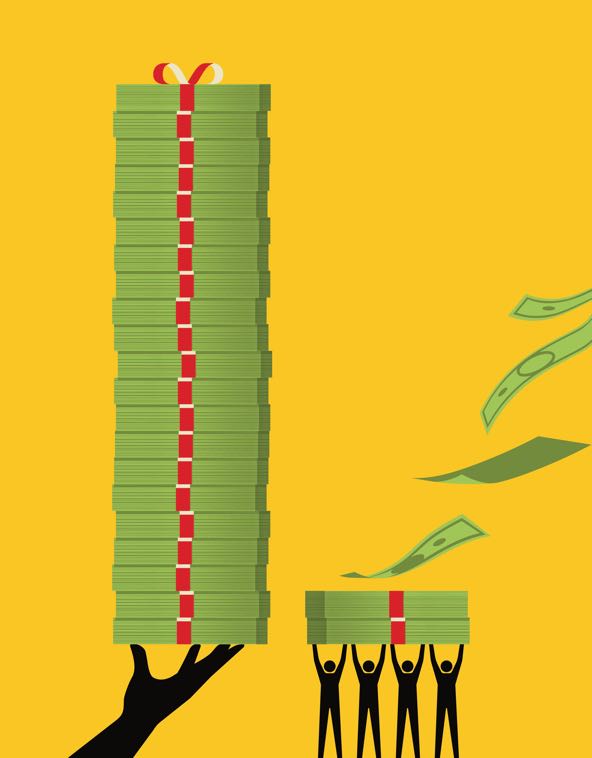
The headline numbers for philanthropy can seem healthy. Total charitable giving reached $592.5 billion in 2024, a new record high.1 However, that figure masks a dangerous concentration in who is giving: For five consecutive years, the total number of Americans giving to charity has declined, having dropped 4.5 percent in 2024 alone, and accelerating a now decades-long trend.2 Two-thirds of American households donated to charity in 2000, a number that has fallen to about half, at a loss of about 20 million giving households.3 These millions of missing donors aren’t billionaires. If the very wealthy are still giving, even giving more, their dollars are taking the place of those of all the teachers, nurses, small-business owners, retirees on fixed incomes, and young people—the grassroots base—whose contributions continue to decline.
The fact that just 3 percent of donors now provide 78 percent of all charitable dollars represents an existential threat to social innovation.4 Community-based organizations depend on modest local contributions not simply for revenue but for validation, stakeholder investment, and social capital. When the community base erodes, organizations become dependent on foundation grants and government contracts—funding sources that constrain autonomy, impose short time frames, and disappear when priorities shift. Social innovation means testing new approaches to persistent problems, developing community-led solutions, and taking calculated risks. But if funding depends only on the preferences of a narrowing elite, the diversity of perspectives, distributed experimentation, and patient capital that innovation requires simply disappears.
The Collapse Is Real—and Accelerating
The Fundraising Effectiveness Project, which tracks real-time data from more than 12,500 organizations, has documented the decline in small-dollar donors quarter by quarter, showing a clear and consistent pattern across organization types, geographies, and cause areas: While major gifts over $5,000 grew modestly in 2024, every other donor segment has been in steady decline. The steepest drop has been in the under-$100 group, the grassroots base representing 50 percent of all donors (though that number, too, is likely shrinking).5
The retention crisis cuts even deeper. While organizations invest heavily in acquiring new donors—through direct mail, digital advertising, and events—80 percent vanish after only a single gift, and as of 2025, overall retention—the percentage of prior-year donors who give again—had fallen to just 31.9 percent.6 Nonprofits that lose more than half their donors annually are running on a treadmill, working furiously just to stay in place.
Research from the Lilly Family School of Philanthropy shows giving rates declined across all demographic groups between 2000 and 2018, with variations by race, income, and age.7 But younger donors present particular challenges. They start from lower giving baselines, express less institutional trust, face delayed life milestones (marriage, homeownership, parenthood) that historically triggered philanthropic engagement, and increasingly prefer alternative giving mechanisms like crowdfunding and direct peer-to-peer transfers. Yet these are the donors who will sustain our missions in the decades to come. Without rebuilding this pipeline through authentic engagement now, we risk a generational collapse in institutional philanthropy.
Why This Is Happening
At least five major causes help to explain the broad decline in grassroots giving.
1. Tax Policies Make Giving More Expensive | When the 2017 Tax Cuts and Jobs Act nearly doubled the standard deduction, eliminating itemization benefits for 9 in 10 taxpayers, economists predicted that people would give less, and they did. Research from the National Bureau of Economic Research estimates that this policy change reduced giving by nearly $20 billion in 2018 alone.8 The Urban-Brookings Tax Policy Center documented the corresponding drop in household participation, from about 37 million households claiming an itemized deduction for charitable gifts to 16 million in 2018 (the share of middle-income households dropped from 17 percent to just 5.5 percent).9
When traditional institutions lose their gravitational pull, particularly among younger Americans, they take with them not just tithes but the broader culture of giving they cultivated.
Legislative attempts to correct the problem have produced only mixed results. While lawmakers enacted a permanent $1,000 charitable deduction for nonitemizers, which will begin in 2026, they also imposed new floors and caps for itemizers’ deductions.10 The $1,000 cap makes it unlikely to meaningfully expand the donor base or increase giving levels among participating donors.
2. Trust in Nonprofits at Historic Lows | It has become idiomatic that Americans have lost faith in institutions generally, and the loss of trust affects nonprofits as well.11 For example, the “overhead myth” persists, despite efforts like author and activist Dan Pallotta’s viral TED talk, GuideStar’s transparency initiatives, and joint campaigns by evaluator organizations: Too many donors still equate “low overhead” with “high impact,” pressuring nonprofits to underinvest in infrastructure, talent, and evaluation—the very capabilities that produce effectiveness.12
Trust issues are particularly compounded by perceived values misalignment. When philanthropists perceive that institutions they once supported—particularly universities—have shifted ideologically in ways that make continued support uncomfortable, it doesn’t matter whether these concerns reflect genuine philosophical differences or culture-war narratives; they matter when donors decide institutions no longer deserve support. It’s worth noting, however, that while only 58 percent trust “the nonprofit sector” as a whole, more than 80 percent of donors trust the specific organizations they do support.13 This makes sense—why would donors support organizations they don’t trust?—but it suggests that the problem is less with individual organizations than with sector-wide perceptions about effectiveness, transparency, and values alignment.
3. Economic Pressure Squeezes Household Budgets | When households have to choose between retirement savings and charitable donations, retirement usually wins. This is a rational response to circumstances, not a moral failure. But generally positive aggregate economic indicators tend to overshadow how many households are making this very rational response to their particular circumstances. Despite a GDP growth of 5.3 percent and an S&P 500 surge of 23.3 percent in 2024, housing costs have exploded in many regions, health-care expenses consume growing budget shares, student debt delays wealth accumulation, and real wages for many workers have stagnated now for decades.14
In short, discretionary income determines giving capacity, and for much of the middle class, that capacity has contracted. Moreover, single women who lost earnings during COVID-19 showed less resilience in continuing to give than men or married couples facing similar losses, suggesting that economic vulnerability disproportionately affects certain donor segments.15
 (Illustration by Ben Wiseman)
4. Communities of Giving Are Eroding | Americans today are experiencing what the World Health Organization has labeled a crisis of social connection, and this erosion of social fabric directly threatens the relational networks that sustain charitable giving.16 Philanthropy doesn’t operate in a vacuum: We give when friends ask us to join them at fundraising events, when colleagues champion workplace giving campaigns, and when we belong to communities where generosity is the norm. But shrinking social networks mean we’re losing the web of reciprocal relationships that made asking for support feel natural, rather than transactional.
Technology has only accelerated this trend, giving us more online connections but fewer deep relationships. We scroll through causes but rarely experience the sustained peer influence that drives giving behavior. And the broad decline in religious institutions has accelerated this trend in ways that extend far beyond Sunday attendance. Faith communities have historically functioned as philanthropy’s training grounds, creating habits of regular giving, modeling generosity as a core value, and providing the social accountability that sustains charitable behavior. (Religious giving has declined from 56 percent of charitable dollars in the mid-’80s to just 25 percent.)17 When these institutions lose their gravitational pull, particularly among younger Americans, they take with them not just tithes but the broader culture of giving they cultivated.
Meanwhile, the traditional life milestones that historically activated philanthropic engagement are arriving later—or not at all—for younger generations. Charitable giving typically increases after marriage and parenthood, perhaps because these transitions heighten our sense of investment in community infrastructure: schools, parks, safety nets. But when millennials and Gen Z reach these milestones in their mid- to late 30s, rather than their 20s, we compress decades of potential giving behavior into a narrower window.
5. Alternative Giving Mechanisms Fragment the Landscape | Younger donors are still giving—millennial participation has increased by 16 percent, and Gen Z participation has grown by 22 percent, since 2021—but research shows that they’re giving differently, through mechanisms that bypass the sustained relationship building that has traditionally anchored American philanthropy.18
For example, crowdfunding platforms like GoFundMe enable direct person-to-person giving, but platforms bypassing nonprofit intermediaries—which excel at responding to acute individual crises, such as medical emergencies, disaster relief, or funeral expenses—cannot fund the sustained, systemic interventions that nonprofits provide. Impact investing might deploy significant wealth toward good causes—over $1.19 trillion in social-impact funds, globally, going toward ventures promising both financial returns and social benefits—but this works better for interventions like affordable housing, renewable energy, or microfinance and cannot substitute for the grant funding of pure public goods like advocacy or services for populations unable to pay.19 Finally, “conscious consumption” represents another alternative, for younger consumers who especially tend to view purchasing decisions as expressions of their values, treating commerce as philanthropy by other means.
These mechanisms certainly shouldn’t be dismissed as mere competition. But for organizations pursuing comprehensive social change, they fragment the resources available. A thousand small crowdfunding campaigns generate impressive dollars only in the aggregate, lacking the coordination required to reform education systems or address mass incarceration.
The Threat to Social Innovation
Can today’s philanthropic environment continue to support the kind of patient funding that social innovation requires? If grassroots giving continues to decline and fragment, what effect will that have on the broader field?
Global innovation suffers if global engagement disproportionately reflects elite perspectives and priorities. Democratized philanthropy generates more contextually grounded approaches.
After all, Geoffrey Canada spent years developing the Harlem Children’s Zone model before demonstrating the kind of results that could (and did) attract major philanthropic investment. The model required patience: comprehensive services from early childhood through college, intensive family support, community transformation over decades. It worked—but it took sustained, up-front commitment from partners through long learning cycles before outcomes materialized.
When funding concentrates, innovation narrows. Nonprofits become exquisitely attentive not only to major donors’ preferences but also to their intolerance for risk. Major donors understandably tend to prefer proven approaches, and organizations facing declining donor bases and collapsing retention tend to prioritize short-term stability. The result, however, is that innovation gets squeezed. Organizations testing community-led solutions, experimenting with prevention, rather than remediation, and developing long-term, systemic interventions—in short, the most innovative organizations in the sector—are precisely those most vulnerable. You can’t pilot radical new approaches when scrambling to make payroll.
Meanwhile, philanthropic resources flowing through elite gatekeepers systematically disadvantage the perspectives from the margins most needed for breakthrough innovation, while organizations led by and serving communities of color consistently receive disproportionately less funding relative to need. The best ideas about addressing poverty come from people who have experienced it: Effective criminal-justice reforms emerge from formerly incarcerated individuals and their communities, and educational innovations require input from students, families, and teachers in struggling schools. When grassroots organizations lack resources to participate in innovation ecosystems, we lose precisely the perspectives most needed for breakthrough solutions.
Consider what happens, sector-wide, as the community-based organizations that historically relied on hundreds of modest local contributions become dependent on foundation grants and government contracts. These funding sources impose reporting requirements that consume staff time, constrain programmatic flexibility, and create precarity when priorities shift. The resulting fragility makes sustained operation, let alone innovation, difficult. When thousands of community organizations experience financial instability simultaneously, the reverberations extend beyond individual organizations. Service gaps emerge, employment contracts, and communities lose the infrastructure that enables residents to address local challenges collectively.
Global innovation suffers as well if concentration causes global engagement to disproportionately reflect elite perspectives and priorities. A more democratized American philanthropic base—including diaspora communities maintaining connections to origin countries—generates more contextually grounded approaches. For example, an immigrant nurse sending money to a clinic in her home country may understand local health challenges in different ways than distant foundation program officers, however sophisticated their frameworks.
Seven Strategies That Are Reversing the Decline
The trends are troubling, but some organizations are bucking them. In what follows, I offer seven strategies that have proven effective in rebuilding donor bases to sustain support for innovative programming.
1. Making Monthly Giving the Default | While overall retention stands at 42.9 percent, retention rates for monthly donors often exceed 80 percent.20 The subscription model—familiar from Netflix, Spotify, and meal kits—resonates with donors seeking simple, budget-friendly ways to support causes. Rather than treating recurring giving as an opt-in add-on, leading organizations make it the default presentation. Their donation forms prominently feature monthly options, explain the cumulative impact (“$25 monthly provides 300 meals annually”), and emphasize convenience.
In practice, this looks like animal shelters converting one-time adopters to monthly “guardian” programs, environmental organizations offering recurring memberships with quarterly impact updates, and food banks framing monthly giving as joining a community committed to ending hunger (not just writing checks). Organizations that successfully convert even 20 percent of donors to monthly giving see dramatic improvements in lifetime value and revenue predictability.21 The compound effect over five years can double sustainable revenue.
 (Illustration by Ben Wiseman)
2. Investing in the Forgotten Middle | Midlevel donors, giving $1,000 to $25,000, often fall through the cracks: While they are too numerous for major gift officers’ portfolios, they require (and reward) more engagement than mass-market communications. This is a massive, missed opportunity: Not only are midlevel retention rates 20-30 percentage points higher than overall retention, but 15-25 percent of midlevel donors upgrade annually, representing the pipeline for future major gifts.
Research shows that affluent donors who volunteer give more than twice as much as nonvolunteers, and that personal connection drives retention.22 Midlevel programs that provide enhanced engagement—special briefings, leadership councils, program site visits—cost far less than major gift cultivation but generate substantially improved retention and upgrade rates.
For example, universities can create young alumni councils for donors giving in the low thousands of dollars, with quarterly meetings featuring faculty research presentations; health systems might offer midlevel donors behind-the-scenes hospital tours and conversations with medical directors; and arts organizations could provide dress rehearsal access and artist receptions.
3. Peer-to-Peer Fundraising | While peer-to-peer campaigns access networks that traditional marketing cannot penetrate (recruiting an average of 300 new donors per campaign), many organizations treat them as a one-off tactic, rather than a strategic donor acquisition tool.23 Yet 40-60 percent of peer-to-peer campaign donors are first-time donors to the organization. With proper stewardship, they show retention rates comparable to or better than those of donors acquired through other channels, because they came through trusted relationships.
However, effective peer-to-peer campaigns require sustained and strategic infrastructure: good tools, clear messaging, fundraiser training, and systematic follow-up with acquired donors. Organizations that succeed with peer-to-peer view it as a year-round engagement strategy, not just an annual event. For example, medical-research organizations might recruit patient families as fundraising ambassadors, providing them with personal fundraising pages, email templates, social-media graphics, and regular coaching calls. Environmental groups could engage volunteers to create personal fundraising campaigns around Earth Day, marathons, or personal milestones like birthdays. Youth development organizations could mobilize board members, staff, and program alumni as ambassadors.
4. Using Technology to Personalize Relationships (Not Automate Them) | Artificial intelligence offers powerful tools for identifying prospective donors, predicting lapse risk, and optimizing outreach timing. But overautomation can eliminate authentic human connection. The winning approach is to use AI to make human engagement more efficient and effective.
Major gift officers might use wealth screening and propensity modeling to prioritize portfolio management, but initial outreach must remain personal: phone calls, handwritten notes, face-to-face meetings. Email campaigns can use AI-powered subject-line optimization and send-time prediction, but the storytelling should emphasize authentic impact reporting. If chatbots can handle routine inquiries, complex questions should route to human staff.
Organizations using AI to augment, rather than replace, human engagement report efficiency gains of 25-40 percent in donor acquisition costs. But maintaining or improving donor satisfaction scores requires the technology to be used to free staff time for higher-value relationship building.
5. Radical Transparency About Impact | As trust is at historic lows, organizations must go beyond glossy annual reports. Donors increasingly demand—and deserve—rigorous evaluation showing what works, but also what doesn’t (and what the organization has learned from failures). Such transparency isn’t just about evaluation data, however. It’s about honest communication regarding organizational challenges, operational decisions, and strategic trade-offs. Paradoxically, acknowledging limitations can build trust more effectively than claiming perfection. Organizations practicing radical transparency report higher donor trust scores, improved retention, and stronger word-of-mouth referrals.
What this looks like in practice is publishing not just success stories, but stories about programs that underperformed, and explaining what was learned. Financial reports should go beyond required disclosures to explain resource-allocation decisions and administrative investments. Leaders write candidly about strategic dilemmas facing the organization. Impact reports acknowledge what the organization doesn’t know alongside what it does.
For example, charity: water shows exactly where every dollar goes through GPS coordinates and photos. GiveDirectly publishes detailed academic evaluations showing both strengths and limitations of cash transfers. DonorsChoose provides real-time updates from teachers on how donated materials are being used.
6. Engaging Donor-Advised Funds (DAFs) Proactively | Fundraisers sometimes view the more than $250 billion sitting in donor-advised funds with suspicion, whether over concerns about warehousing, the anonymity of donors (which makes relationship building difficult), or the intermediaries in control of the funds. However, the data suggest that most DAF holders use the funds actively: They recommend an average of nearly 12 grants annually.24
Organizations should develop sophisticated engagement strategies, such as making DAF giving easy by including instructions on donation forms and prominently providing the necessary information. Campaigns should emphasize urgency and immediate impact to encourage accelerated distributions, communications should highlight year-end tax deadlines and opportunities to recommend grants, and organizations can cultivate relationships with DAF sponsors (Fidelity Charitable, Schwab Charitable) to ensure that their organization appears in search results and receives favorable positioning.
7. Building Giving Circles and Collective-Giving Vehicles | From 2017 to 2023, collective giving mobilized more than 370,000 individuals donating more than $3.1 billion, which projections suggest will double in the next five years.25Examples include Social Venture Partners (operating in multiple cities), women’s giving circles through community foundations, young-professional giving collectives, and faith-based pooled giving programs. Vehicles like these attract donors who value community and shared decision-making over individual recognition.
Established nonprofits should explore partnerships with giving circles that engage donors who might not otherwise participate in institutional philanthropy. Community foundations can host and support giving circles, providing administrative infrastructure while letting members make funding decisions. Organizations should present to giving circles as part of broader community-engagement strategies. Some nonprofits might even incubate giving circles focused on their issue areas, treating them as leadership-development and donor-cultivation tools.
Giving-circle participants often increase total charitable giving (not just redirect existing donations) and become more engaged with causes over time. Many eventually become individual major donors to organizations they first supported through giving circles.
We Need Systematic Change
Individual organizational strategies matter, of course (particularly for the individual organizations). But sector-wide trends are the result of larger, systemic forces; reversing them will require broad policy changes and cultural shifts beyond any single nonprofit’s control. Here are three broad agendas the social sector should be collectively advancing to help restore the kind of grassroots philanthropy we all rely on.
The loss of 20 million donor households is much more than a fundraising problem. It represents the erosion of civic infrastructure that makes social innovation possible. But the situation isn't hopeless.
1. We Need to Fix Tax Policy | The recently enacted $1,000 universal charitable deduction represents only a step in the right direction. The cap needs to be raised substantially—to $5,000 or more for couples—if it is to create real incentives for middle-class participation. For itemizers, the new, 0.5 percent adjusted gross-income floor needs to be eliminated while maintaining generous caps. Similarly, the corporate-giving floor needs to be reversed before it takes effect. Corporate philanthropy has declined from 2 percent of pretax profits in the 1980s to barely 1 percent today. Making it even harder serves no public purpose.
Organizations should advocate collectively for these changes through associations like Independent Sector, the National Council of Nonprofits, and cause-specific coalitions. The 2025 tax-policy debates create a window of opportunity that won’t stay open indefinitely.
2. We Need to Invest in Philanthropic Infrastructure and Education | GivingTuesday—which has raised more than $22.5 billion since 2012—demonstrates how concentrated attention and community engagement can activate donors.26 But one-day campaigns need complementary, year-round efforts to cultivate giving culture.
Educational institutions should integrate civic engagement and philanthropic literacy into curricula. Service learning, student-led grantmaking, and coursework exploring social problems help develop informed future donors. As traditional socialization mechanisms (religious participation, voluntary associations) decline, schools must assume greater responsibility for cultivating civic consciousness.
Philanthropy infrastructure organizations—community foundations, associations, research centers—should invest in public-awareness campaigns celebrating diverse giving, debunking myths, and articulating compelling visions of collective generosity enabling human flourishing. We should recognize extraordinary participation and proportional generosity, not just mega-gifts: When a working-class family contributes 5 percent of income, that deserves celebration.
3. We Need to Rethink Evaluation and Effectiveness | The overhead myth persists partly because the sector hasn’t developed better frameworks for assessing organizational quality. Moving beyond overhead ratios requires investing in rigorous evaluation capacity that acknowledges complexity and values learning alongside accountability.
Organizations should embrace approaches like constituent feedback, developmental evaluation for innovative programs, and transparent reporting of both successes and failures. Funders should support these investments, rather than treating evaluation as unfunded mandates or overhead to minimize.
GiveWell’s rigorous evaluation framework and Charity Navigator’s multidimensional ratings represent progress, but the sector needs evaluation approaches that work for organizations pursuing different types of impact—not just those with easily measurable outcomes.
What You Should Do Immediately
The loss of 20 million donor households is much more than a fundraising problem. It represents the erosion of civic infrastructure that makes social innovation possible. But the situation isn’t hopeless. Organizations implementing the strategies outlined here—monthly giving programs, midlevel cultivation, peer-to-peer fundraising, AI-augmented engagement, radical transparency, DAF facilitation, and collective-giving partnerships—are already reversing decline and building sustainable donor bases.
What should you do immediately? Pick one or two strategies that fit your organizational capacity and context. If you’re small, with limited staff, start with monthly giving conversion and radical transparency—these require mindset shifts more than major resource investments. If you have development infrastructure, invest in midlevel programs and peer-to-peer campaigns that expand reach efficiently. Leaders of larger organizations and foundations need to recognize that grantmaking decisions either reinforce or challenge the concentration trend. Funding grassroots organizations, supporting participatory grantmaking, and providing multiyear, flexible capital for innovation all push against unhealthy concentration.
The challenges are real and interconnected: tax policy, trust erosion, economic pressure, demographic change, fragmented giving channels. But so are the solutions. We don’t need perfection; we need a commitment to rebuilding the democratic foundations of American philanthropy, one donor relationship at a time, as well as policy and culture that value widespread participation alongside major gifts.
Social innovation depends on civil society’s capacity to address problems that markets and government cannot solve alone. That capacity, in turn, depends on philanthropic resources sufficient to sustain experimentation but distributed enough to reflect diverse perspectives, as well as democratically legitimate enough to command public trust. Rebuilding broad-based philanthropic participation isn’t just about fundraising. It’s about democracy itself.
Read more stories by Mark Dobosz.