


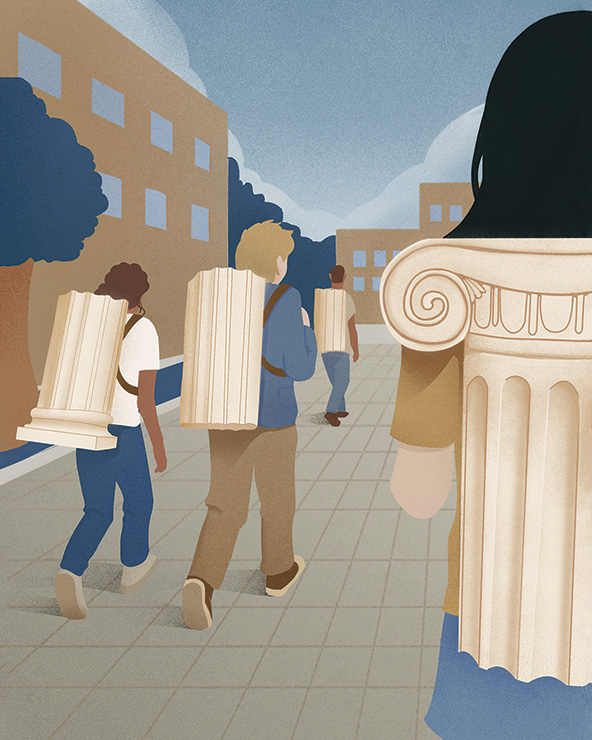
 (Illustration by Elia Sampo)
In the 2024 election, as in every US election going back decades, tens of millions of Americans, including more than 10 million young people, were not registered to vote and therefore were unable to cast a ballot.
Voter registration is an administrative process to create a list of voters who are eligible to participate in elections. In the United States, many otherwise-eligible voters are left out because they are not registered. The exclusionary impact is greatest for groups that are most marginalized, including those who are not white, have low incomes, and/or do not go to college, drive, or speak English as their primary language, and young people.
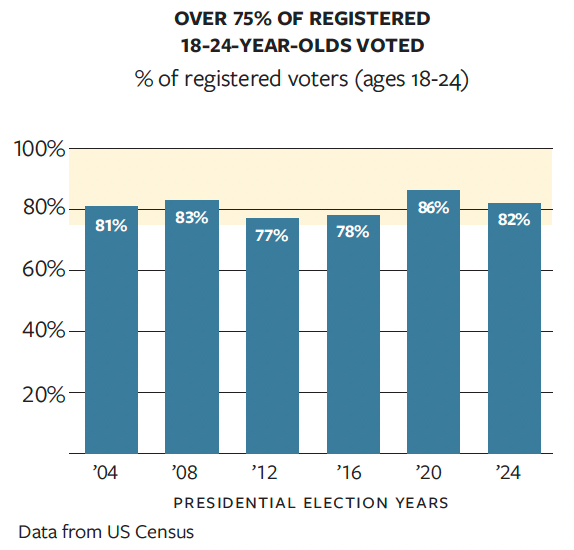
Many people assume that young people turn out to vote at low rates, even when they are registered. But that is not the case, at least in major national elections. According to US Census data, more than 75 percent of registered youth turned out in every presidential election going back to 2004. In 2020, 86 percent of registered youth turned out, and in 2024, 82 percent of registered youth turned out.
One of the greatest obstacles to voter turnout in general, and youth turnout in particular, is registration. In both 2020 and 2024, according to the US Census, less than 75 percent of US adult citizens were registered to vote. That meant more than 60 million people were not registered. More than 10 million of those unregistered were young people between the ages of 18 and 24. While 18- to 24-year-olds make up less than 12 percent of the adult citizen population, they comprise a much higher rate—17 percent—of those who are unregistered.
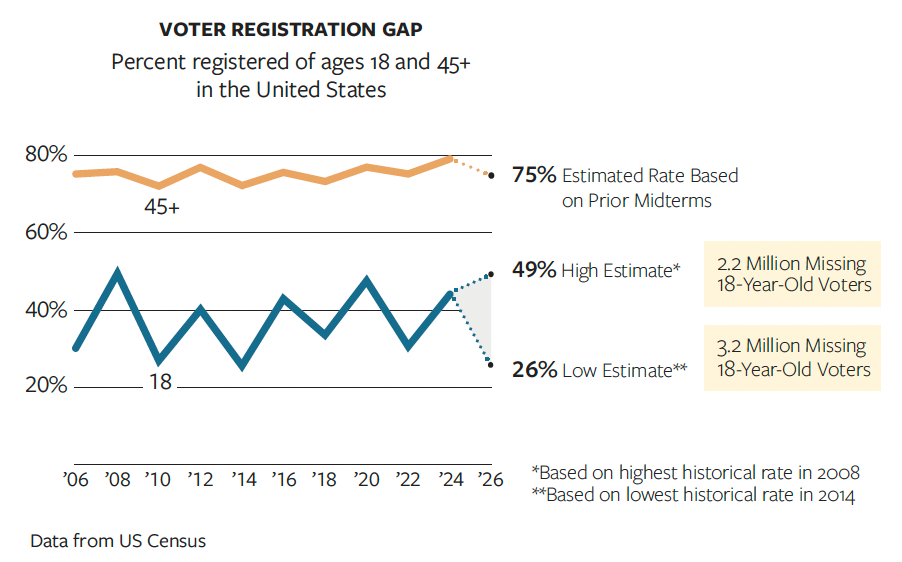
Young people go unregistered at even higher rates in midterm elections than in presidential election years. On average in this century, less than 30 percent of 18-year-olds have been registered during midterms. In 2022, the most recent midterm election, only 30.6 percent of 18-year-olds were registered. Compare that number with approximately 75 percent of voters age 45 and above. Given that four million people turn 18 every year, that meant about 2.8 million 18-year-olds were not registered to vote in that important election.
When we added in the 19-year-olds, more than five million of the youngest voters were unregistered. To put those numbers in perspective, half of US states have smaller populations than the number of unregistered 18- and 19-year-olds in 2022.
The gap is not an accident. It’s built into our current systems and institutions, which in most states simply do not have a goal of, and are not designed to achieve, universal registration for all Americans as they reach voting age. But policy interventions, as well as the establishment of social and cultural traditions with the help of civil society, can help turn this problem around. Absent real and sustained effort, however, low youth registration and low youth turnout are likely to persist.
It’s a problem for many reasons. Among them is the challenge that when young people are not registered, they are not in the voter file. That means many candidates and campaigns—especially those at the state and local levels with real budget constraints—do not have the resources to reach them, hear their concerns, and present plans to address them. That disconnect breeds cynicism and a vicious cycle because young people feel, correctly, that politicians are not speaking to them or confronting the issues most important to them.
Let’s face it: Our current systems for voter registration are failing the youngest voters. The critical missing link—and perhaps the only realistic method to achieve universal voter registration—is making voter registration part of every American’s high school experience. Nearly all teens are in high school when they reach the age at which they can register, and high school students have the interest and capacity to be agents in their own engagement.
High schools represent an educational and efficient opportunity to reach everyone before they graduate. Other benefits include efficiency, reliability, and trust, since schools have existing schedules for enrollment and educational activities, adults on-site who have meaningful, in-person relationships with students and who can help them through the registration process, and opportunities for student leadership and peer-to-peer engagement that are critical to motivating participation. And while many people assume that this is already happening—perhaps because they or their kids had a great advanced-placement government teacher who took matters into their own hands—we are in fact nowhere close to this ideal.
The DMV Exclusion
Instead of using high schools to help everyone register as they become eligible and helping students overcome barriers to participation like state ID laws, the United States relies on state departments of motor vehicles (DMVs) as the primary voter registration and ID agencies in most states. Many people assume that DMV registration on its own, or in combination with online voter registration, is adequate. The numbers and the reality of how these systems operate show that they are not solving the problem on their own.
The explanations are not that complicated. Millions of young people—a full 40 percent of 18-year-olds, based on Federal Highway Administration and Census data—do not get driver’s licenses. Less than half of 17-year-olds are licensed. Some DMV systems are poorly designed, even for the youth who do get licenses, often discouraging registration, rather than making it seamless.
In California, for example, DMV registration is supposed to be automatic, but the system misses people who interact with the DMV before age 16, and the user experience is so confusing, nearly half of teens who are eligible to preregister instead opt out. The number exceeds 100,000 every year. The result is low registration and preregistration rates for the youngest voters.
In New York, less than 40 percent of the state’s 18-year-olds get driver’s licenses. Young people in New York City, where people drive the least, are vastly under registered compared with their peers in other parts of the state.
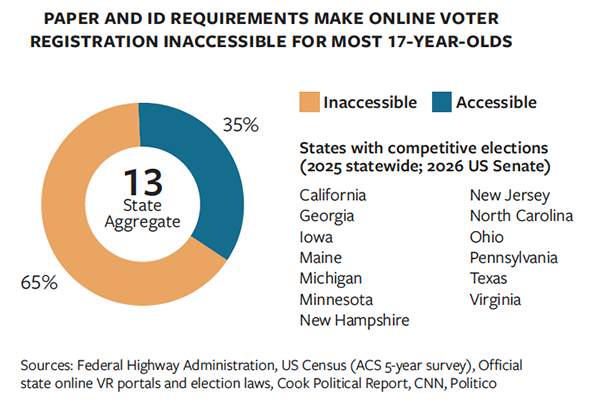
Online voter registration systems do not solve the problem. Although these systems at their best provide a simple process for registering, most require a driver’s license or state ID in order to complete an online registration. These systems do not bridge the gap for young people who do not drive, a disproportionate number of whom live in cities, come from low-income families, and are not white. In addition, seven states have no online voter registration systems.
Digital media campaigns and platforms that connect audiences to online voter registration can help to facilitate and encourage many voter registration transactions. But they cannot overcome the inherent limitations and biases of state laws and online voter registration systems within which they operate.
All of these factors feed into the decades-long trend. Were our current systems doing a decent job, we simply would not be seeing midterm registration rates at 30 percent for 18-year-olds.
High School Registration as Systemic Change
If we look at registration rates closely, what we see are short bursts of registration, prior to elections, that do not make up for the enormous shortfall in normal times. In New York, we see that, with the exception of nine weeks over the past three and a half years—weeks leading to either the midterms or the presidential election—the number of 18-year-olds who have become registered is lower by thousands than the number who turned 18.
Of course, we should always strive to be efficient, reduce friction, make administrative matters as easy as possible, and build on the attention that elections generate. However, automation and last-minute mobilization are clearly falling short. Instead, we should take meaningful steps to engage young people in understanding why it is important to vote and how to prepare to do so, including by registering to vote, and we should help involve them in solving the problem.
High school voter registration has the capacity to achieve population-level impact for the country as a whole, a path to universal voter registration, and a larger, more representative electorate. Registration must be recurring, rather than reactive. The effort is about more than a table in the lunchroom or some forms in an office. High school voter registration is systemic change.
Like any other systemic change, it faces challenges. For the most part, the relevant systems (high schools and school districts) and populations (high school teens, their teachers, and their families) have no training in the relevant laws and mechanics. Teens are just starting to step into adulthood and have different needs than older voters, including the need for guidance in accessing and filling out government forms.
Working with these institutions and populations is outside the expertise of most democracy organizations. Likewise, working with elections officials and voter registration laws and processes is outside the expertise of most education organizations. And expertise in in-person organizing is beyond the scope of most digital providers.
Reversing decades of inattention will not be solved by a single intervention or the stroke of a pen. The problem calls for genuine political innovation—which Johanna Mair, Josefa Kindt, and Sébastien Mena define as a “citizen-led practice of diagnosing problems in the political system and collectively working toward solutions with the objective of strengthening and revitalizing democracy.”1 Nothing is likely to change unless we make it change and involve young people in the process.
The Solution
Remarkably, a solution that would solve the entire problem of low youth registration rates is simple to imagine yet far from reality: Everyone gets registered to vote before they graduate from high school.
 (Illustration by Elia Sampo)
That should be the norm. But it’s not where we are. Today, the policy landscape is complex and lacking in robust coordination to accomplish what should be the routine task of universal voter registration. No single intervention will turn this problem around, but solutions that include empowering high school students to be agents of change can begin right now and will make policy reforms easier to accomplish and more durable—they will reflect student interests, and policy adaptations will reinforce practices that have already begun on the ground.
The Civics Center, the organization I founded in 2018, focuses on such solutions, providing students (and their faculty advisors) with free tools and training, and encouraging them to hold festive, recurring, nonpartisan voter registration events in school. This framework encourages true democratic practices and civic engagement in high schools; project-based learning activities open the door to conversations about democracy while achieving real-world impact, not just simulated experiences.2
Such practices can operate within and help to reform the larger policy arena. The effort depends first on an understanding of the challenges and opportunities presented by US law, which is distinct from electoral law in other democracies. Most significantly, in the United States, individuals must take the initiative to register to vote. In practice, this means that the default for young people coming of age is that they are disenfranchised.
By contrast, some democracies, such as South Korea and Germany, make registration of eligible voters automatic. In Germany, for instance, the state maintains a civil registry of all citizens and relies on that to register eligible individuals to vote automatically. In Australia, Canada, and other democracies, registration is heavily assisted by the state.3 In Australia, for example, a federal agency proactively gathers information about citizens from federal, state, and local sources and establishes and maintains a national voter roll; when a citizen is eligible to vote, the agency places them on the voter roll and contacts the citizen to confirm their placement.
What are the federal, state, and local policy changes needed in the United States to attain the goal of universal registration for everyone eligible as they come of age to life, and how practical are those changes today? Let us consider each level of government in turn.
Federal Pathways
Three federal bills proposed in the 118th Congress (2023-2025), the Freedom to Vote Act, the Youth Voting Rights Act, and the High School Voter Empowerment Act of 2024, would have gone a long way toward helping overcome the barriers to youth voter registration. Together, these bills, among other reforms to make registration and voting easier, would have made preregistration at age 16 the law of the land and designated high schools as voter registration agencies under the National Voter Registration Act.
None of them passed. In fact, since 1971, when the 26th Amendment guaranteeing the right to vote at age 18, went into effect, Congress has enacted no legislation to enforce the amendment beyond simply authorizing the attorney general of the United States to bring suit to address constitutional violations.
The 119th Congress has convened, and a new president is in office. None of these laws has a realistic chance of passing now. Instead, we have seen the current administration revoke prior directions to federal agencies to promote voter registration. The majority in Congress is pushing the misnamed SAVE Act (“Safeguard American Voter Eligibility Act”), which would make it significantly harder for young people to register to vote by requiring a narrow list of ID documents in order to register.
The political reality is plain: Young people and those who support the full realization of their right to vote simply do not have the power today to win meaningful federal action to enforce the 26th Amendment.
State Pathways
However, since the United States has a federalist system, it allows different levers for change at the state and local levels. While a nationwide solution is currently unavailable, we can push for meaningful change regionally and locally, improving things bit by bit, adapting to different contexts and diverse communities, and making a comprehensive solution more likely in the future. This is how the civil rights movement gathered steam, how marriage equality came to be, how marijuana legalization and many other aspects of criminal justice reform are happening. It is also how pro-democracy efforts like ranked-choice voting and same-day voter registration are happening.4 It can happen for universal high school voter registration as well.
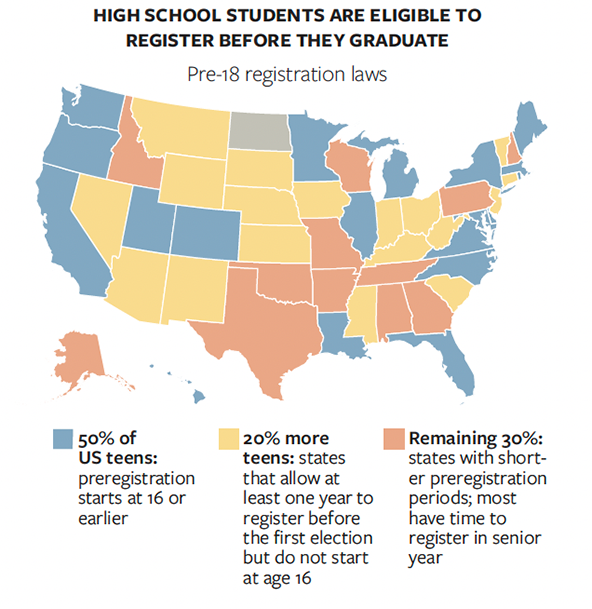
Numerous opportunities to enact and enforce state laws and policies to achieve universal high school voter registration exist. First, we should try to make preregistration starting no later than age 16 the norm in all states. Currently, more than 50 percent of US teens live in states where they can preregister to vote beginning at age 16 or earlier. Such laws exist in 19 states and the District of Columbia. Many other states allow at least one year before a first election in which young people can register or preregister to vote.
Second, we can turn high schools into voter registration agencies under the National Voter Registration Act (NVRA)—the 1993 federal law that designated state DMVs as voter registration agencies in all but a handful of US states. An earlier version of the bill would have made public schools voter registration agencies as well. That earlier bill passed in the House but died in the Senate. Had the law passed as originally drafted, we would likely have tens of millions of more registered voters today.5
Nevertheless, states are required to offer voter registration at agencies in addition to DMVs, and schools are expressly included as permissible agencies through which states can satisfy this requirement. No federal action is needed for schools to become voter registration agencies. In some cases, state legislative action would be necessary to make the designation. In others, an executive order or administrative designation would suffice.6
Several states today already have laws expressly designating high schools as voter registration agencies.7 Many more have meaningful, if more limited, provisions requiring or encouraging high schools to promote voter registration. Examples include laws requiring high schools to distribute voter registration forms and information about registration as part of basic instruction in civics.
Too often, however, even where such laws do exist, states do not implement or enforce them effectively, and low registration rates persist as a result. The most effective policies will include not just a mandate or an authorization but funding for training, monitoring, assessment, and enforcement. (I return to this point with examples in the next section.)
Third, we should require high schools to provide IDs that satisfy state voter ID requirements. Many states now require identification in order to cast a ballot. Voter ID laws create enormous barriers for young voters. Often the laws specify that the ID must be unexpired. Often high school IDs are not on the list of approved IDs, or, if they are, they expire upon graduation so that they cannot be used in the November election after high school seniors graduate.
High school ID systems and state ID laws should be aligned so that high school IDs satisfy any ID requirements to register or to vote, and such that they remain valid at least through the first general election after a student graduates. Polling by the University of Maryland suggests broad and bipartisan support for schools taking on this role.
In states that require proof of residence in order to register to vote, high school documents should satisfy proof of residence requirements, just as utility bills, paychecks, and leases typically do. High schools should affirmatively provide documentation to students to assist them in proving residency.
Fourth, we should boost civics education in high school. The greater the complexity of voter registration laws, the more urgent civics education is to help students successfully navigate these laws’ requirements as part of their readiness for adult life.
Many states lack robust civics education requirements. Others have them but do not include voter registration. All states should adopt and implement standards that reinforce voter registration as part of a robust, experiential, knowledge- and project-based civics education.
Finally, we should make registration and voting easier for all, including young people. States that do not yet offer online voter registration should begin offering it, and those that have it should make their online voter registration systems secure and accessible for those who do not have a state ID. Pennsylvania, New York, and Michigan, for example, have such systems or are in the process of creating them. States should also modernize their DMV systems to provide Secure Automatic Voter Registration (SAVR).8 States that do not currently offer same-day voter registration, as well as a range of options for casting a ballot, should update their laws to simplify registration and voting.
Strengthening Implementation
While the above legislative changes would go a long way toward expanding voter registration access to youth, we need not wait for new legislation to start making improvements. Many laws and policies that exist today would, if actually implemented, monitored, and enforced, make an enormous difference.
For example, California requires schools to designate a person responsible for distributing voter registration forms. In fact, this rarely happens.9
In 1975, California enacted a law that required the Secretary of State to promulgate rules to encourage voter registration outreach. The secretary issued regulations in 1977 ordering counties to create outreach plans, including a provision for cost reimbursement (2 Cal. Code Regs. §§ 20000-20006). The legislature hasn’t funded this outreach since at least the 1980s, and the provision for cost reimbursement was repealed in 1986. The non-implementation of this law has left more than seven million eligible Californians unregistered. California’s statewide preregistration rate remains stuck below 15 percent.
Texas mandates that high schools have personnel who can serve as deputy registrars and distribute voter registration forms. In fact, this rarely happens.
As the Texas Tribune reported in 2024, the results of lax implementation are plain to see: “According to the US Census Bureau, 39.6 percent of Texans ages 18 to 24 were registered to vote in November 2022. And that was the biggest decline in voter registration for any age group compared [with] the previous midterm election in 2018.” The math comes out to more than 1.6 million young Texans who are otherwise eligible but not registered to vote.
New York requires school boards to have policies to promote voter registration and preregistration. In fact, even though many school boards have adopted such policies, the preregistration rate remains at just 20 percent as of October 2024, and enormous disparities exist between upstate and downstate counties. In four of the five boroughs comprising New York City, where few people drive, the preregistration rate is under 10 percent. Again, this is a massive disenfranchisement of the youngest voters, due to lack of implementation of existing law.
Voluntary Efforts
Not only can state and local officials do more to implement policies already in place, but they can take more initiative to improve registration and participation. At the state level, governors, secretaries of state, superintendents of public instruction, and state legislators all have a meaningful role to play. Governors, for example, can make support for high school voter registration an important criterion for relevant appointments and can issue executive orders to require implementation measures that can be accomplished without further legislation. They can include funds for implementation and follow-up in their budgets.
Secretaries of state and supervisors of public instruction can provide guidance documents for high schools and districts on how to implement voter registration and preregistration efforts consistent with curricular and election law requirements and can update systems under their control to better address the needs of high school students. Creating systems for online voter registration that do not depend on registrants’ first obtaining a state ID is one example.
Ultimately, the local level is often the fastest and most effective way to get new initiatives off the ground. School boards can enact policies requiring robust implementation of high school voter registration. School district superintendents and their delegates typically have the power to require schools under their supervision to implement voter registration efforts. Such administrative authority can derive from a variety of sources, including board or state-law policies expressly requiring voter registration efforts or pursuant to more general board or state-law policies concerning civic participation or civics education. Actions can include providing professional development opportunities for educators, election-related and voter registration information to families, and compensation structures that reward educator “voter champions” who take on added responsibilities in the way some teachers also take on sports coaching duties. These efforts can build on state-level social studies frameworks and curricula that include preparing students for citizenship and participation in a democratic society among their objectives.
School administrators, in turn, can provide the support needed at the school level. Examples include guaranteeing time and space for registration drives, accepting volunteer work on a drive as fulfillment of public-service hours, promoting connections with the wider community to facilitate candidate forums or visits from state and local election officials, promoting assemblies or other convenings to teach about voter registration, and providing announcements on school websites and other communications. They can also encourage families to support students in registering to vote, including reminders to bring any needed documents to school to facilitate their registration. As the governmental institution closest to the students, schools and their leaders are in the best position to ensure that voter registration becomes a high school tradition and that students, educators, and families are all involved.
What’s more, educators can ensure that students receive quality, nonpartisan civics instruction in how and why to register to vote and support student leaders in running drives. And parents, as trusted messengers to their teens, can help them access the documents and information they need to register and give them the confidence that they will be ready to vote.
Finally, the students themselves are central. They can learn about why voter registration is important, be ambassadors for democracy for their own school communities, and motivate cohorts at other schools, whether on their phones or with their friends, to do the same. They can also reach parents, extended family, and community members who are not registered.
Students have constitutional and other federally protected rights. The first amendment protects freedom of speech, including student speech. The federal Equal Access Act prohibits public high schools from discriminating against student groups based on the expression of ideas when the school receives federal funds and allows one or more noncurricular student groups to meet.
Whether public officials lead the way or not, school communities have it in their power to become effective agents of voter registration and democratic participation.
Voter Registration Drives
In fact, my ideal vision for beginning to solve this problem is grounded in grassroots action, by students, with adult support in high school. When high school voter registration is working as it should, every high school across the country will hold voter registration drives or provide other meaningful voter registration opportunities twice per year, so that by the time students graduate they will have been offered the opportunity eight times to register to vote. (There is an analogue here to the “Rule of Seven” in marketing, according to which most customers won’t engage in a transaction without encountering an encouraging message seven times.) Repetition builds familiarity and trust. But most high schools today make no effort to offer students repeated exposure to the opportunity to register.
Ideally, drives are supported by teachers and administrators but led by students themselves and treated as a sanctioned student activity. The effort is like that of student newspapers or other student efforts designed to expose teens to adult concerns and to build leadership skills for meaningful participation. The drives should be festive school-wide events, complete with decorations, outlets for student creativity, and a celebratory feel. Schools will support each drive via the communication channels through which they regularly engage their student and parent bodies and will set aside times and spaces for this activity. They can also designate a particular date on which voter registration happens in all homerooms, in advisories, or at school-wide events.
Springtime rite-of-passage events, such as graduations and other annual celebrations and traditions, should have voter registration elements (if not at the actual events, then at related locations, such as where students pick up their caps and gowns).
The important thing is that these efforts turn into perennial student activities and are not limited to election years. They should also be points of pride and offer friendly competition similar to rivalries in sports. Once voter registration becomes an ingrained tradition, each school will be able to see how it compares to other schools and can aim for as close to 100 percent participation as possible. In some states, this will make the school and its students eligible for statewide recognitions that honor their achievement.
Drives increase voter registration and have a peer-to-peer leadership component that allows students to appreciate the mechanics of registering, how voting is part of a public conversation, how they have the power to make a difference, and why everyone should vote. Therefore, the drives don’t just boost voter registration numbers but also develop youth leadership capacity and an appreciation for democratic ideals. The experience of encouraging and enabling their peers to vote sets up students to be leaders in other capacities, and to find confidence and self-efficacy. It also can put them on a long-term path of public service that leads them to organizing or even someday running for office.
Ultimately, a system in which young people can register to vote without the need for extensive time, resources, and organizing devoted to what ought to be a straightforward administrative task may work best in terms of cost and attaining high rates of registration. Today, however, we are far from achieving anything close to automatic high school voter registration. Rather, drives are the most practical way to begin making progress toward a culture of voter registration, starting now.
The Role of the Social Sector
Putting young people at the center of the registration effort does not mean that the social sector does not also play a crucial role. Civil society and philanthropy are critical to creating a resilient and welcoming foundation for the effort. Civil-society organizations can educate their networks, host events, sponsor legislation and policy reform, and convene stakeholders to align on community-wide goals and impact.
We at The Civics Center sponsor campaigns to generate awareness and build momentum and engagement, and we have created innovative data solutions to measure and track changes over time. We also work with partner organizations and school districts that have close ties to students and educators. Like a sports league that creates the structures through which teams compete, we provide the architecture through which others can integrate the effort into their communities and through which they can adapt and improve over time.
Funding such efforts fulfills priorities for many donors and donor organizations, including supporting education, civics, leadership development, and community building, and building power among those served. The work is also efficient and scalable. Because the effort builds local capacity through education and organizing, the work becomes woven into the fabric of high school communities. From there, it grows organically and, consequently, the need for outside investment decreases over time. Supporting structures and communities that can incubate their own solutions makes the outcomes more durable.10
Different types of funders will find different aspects of the work more suitable to their priorities. Venture philanthropy, for example, can play a critical role in creating organizational capacity for research, development, testing, strategy, leadership development, and planning that can launch the field to the prominence it deserves. The effort needs significant expertise in the areas of data, communication and messaging systems, policy development and advancement, impact priorities and measurement, operations, and market and product design to diversify sources of income and promote resilience and scale.
Foundations—especially community foundations—and individual donors with long-term goals are ideally situated to be catalysts. They can support efforts to engage state and local community groups and public officials, validate the importance of the work as part of the civic mission of schools, tailor efforts to specific community needs, and ensure continuity and integration over time. Foundations can also bring together organizations with complementary programs, skills, and networks and encourage collaborations that generate collective impact.
In closing, I suggest the following principles to guide all funders interested in supporting the cause:
High schools operate on their own calendar. | Funding cycles that are aligned with school calendars will be more successful than those focused on the election cycle. Students graduate from high school every year, and spring is when the greatest numbers of young people are old enough to register to vote. Voter registration efforts geared only to the fall of even-numbered years are unlikely to gain the trust of schools or to achieve the greatest impact. Especially at the early stages, the most effective funding will be in the form of consistent, multiyear grants.
No single method will be effective on its own. | Building the field of high school voter registration requires an interdisciplinary approach. Legislation takes time and requires implementation to achieve results. Digital and on-the-ground organizing can achieve better results together than either can on its own. Philanthropy can help to create pathways that promote cooperation among those with different skills and resources, including the integration of digital and face-to-face efforts, advocacy, education, and grassroots organizing.
Measure what matters, and fund experimenters. | Making voter registration part of high school life is new in the United States. It needs experimentation and measurement. Philanthropy can play a critical role in funding this research and should take into account the unique circumstances facing the field. Program success for high school voter registration programs depends on a range of factors. Best practices for general audiences or for college students may not translate to a high school setting.
The problem of low rates of youth voter registration is solvable. The mechanisms exist. They all have precedents and firm grounding in our nation’s history and traditions. Whether our communities decide to take action and welcome all young voters into our democracy depends ultimately on us.
Read more stories by Laura W. Brill.