


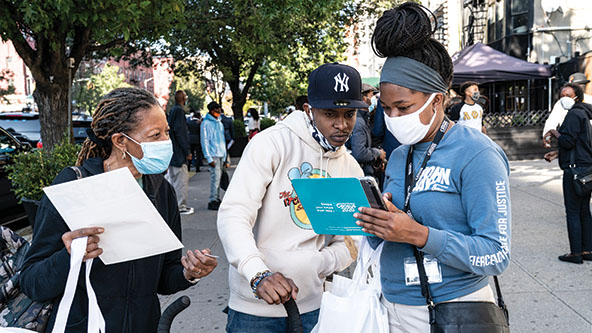
 Census 2020 employees help New Yorkers fill out census forms at Sylvia’s Restaurant in Harlem, New York City, during the 2020 Census drive. (Photo by Lev Radin/Pacific Press/LightRocket via Getty Images)
Few things affect every sector of society. The decennial census is one of them.
The census is the foundation of our democracy. Its original and primary purpose, mandated by the US Constitution, is to apportion electoral representation of the US House of Representatives among the states based on population; that allocation determines each state’s number of votes in the electoral college. Over time, governments, nonprofits, and the private sector have relied on census data for myriad purposes, including determining the distribution of at least $1.5 trillion annually in federal funds to states and localities, conducting research, policymaking, implementing and enforcing civil rights laws, and developing infrastructure, among other public directives.
Every nation that conducts a census uses those data to understand the size, composition, and characteristics of the population. Historically, countries relied on the census for taxation and military conscription. The United States broke with this tradition by linking the census to political representation, thereby turning the census into a tool for empowering the people. Some nations, such as Germany and Spain, use statistical sampling and other strategies to achieve their counts. The United States, however, must follow the language of its founding document, which requires an “actual enumeration” to distribute political representation.
Everyone has a stake in a fair and accurate census. However, certain populations have been historically undercounted, including Black and Latino people; Native Americans living on reservations; young children; immigrants; low-income households; and certain Asian populations that share the characteristics of other undercounted populations, such as low income, but are aggregated under one category.
This historical, documented undercounting of racially marginalized populations and overcounting of white populations spurred an unprecedented mobilization of actors across civil society, including foundations and nonprofit organizations, to promote a fair and accurate 2020 census. When we joined this effort, we did not realize that our actions might have saved it from catastrophe.
This article’s authors have collectively worked on the past four censuses, each of which was mired in controversy. Extensive litigation and legislative attempts almost excluded undocumented immigrants from the 1990 census. The 2000 census was overshadowed by the bitterly partisan fight about whether to adjust the data to make them more accurate. The 2010 census occurred during the Great Recession, at a time when hundreds of families were losing their homes in the mortgage crisis. But these challenges paled in comparison with those of the 2020 census. Despite the unprecedented mobilization, the accuracy of the 2020 count remains highly suspect and, in some respects, worse than the 2010 count.
No one could have anticipated the twists and turns of the 2020 count, as the US Census Bureau faced inadequate preparations, political obstruction, a global pandemic, natural disasters, and severe weather events that displaced populations and hampered operations. Despite these challenges, funders joined with nonprofits, state and local governments, businesses, and others in a determined effort to protect the census in what one funder called a “philanthropic tour de force.” Our 2020 census effort involved strategies we used for the first time, fast pivots to address unanticipated challenges, and trust among diverse partners. The lessons we learned are important in preparing for the 2030 census and also might help us in approaching other challenges requiring large, cross-sector collaborations.
A History of Who Counts
Racism and discrimination are enshrined in the US census. The Great Compromise between northern and southern states during the Constitutional Convention in 1787 produced a federal constitution that mandated the exclusion of US residents from the census based on race. The US Constitution stated that enslaved people should be counted as three-fifths of a person and that American Indians should not be counted at all. The Civil War and abolition of slavery subsequently expanded constitutional rights (the Thirteenth, Fourteenth, and Fifteenth Amendments) for all US citizens, and a series of changes in anti-Indian policies and progress in relationships with tribal nations now requires that American Indians also be counted. The Fourteenth Amendment specifically changed the math used to apportion the US House of Representatives to require that the whole number of all persons be counted for this purpose. Despite this law, unequal enumerations based on race and other factors continued in practice to this day.
The Census Bureau conducts the decennial census using methods that also favor counting populations that are wealthier and have stable housing. Overcounted populations include people who own more than one house and have multiple addresses, and college students living on or near campus who should be counted at that residence but who are often included by their parents at their home address. Because these factors are associated with wealth and privilege, overcounts tend to consist largely of non-Hispanic whites and wealthier households, which magnify racial inequities in census data. The Census Bureau’s evaluation data of the 2020 census revealed that these undercounts and overcounts were worse in 2020 than in the 2010 census. The overcount of non-Hispanic whites roughly doubled between 2010 and 2020, while a threefold increase in undercounts of Latinos and young children occurred.
The legacy of racism resides at the core of the persistent challenges in accurately counting African Americans, Latinos, Native Americans, and other racially marginalized populations. These populations have higher rates of poverty, are more likely to be renters and move frequently, and have a distrust of government based on historical discrimination. These factors make these populations more difficult to count than those that are wealthy, homeowning, and civically engaged.
The inaccuracy of census data and the disproportionate errors in the counts of racial, ethnic, and low-income groups exacerbate inequalities, including the unequal distribution of political representation in congressional reapportionment and redistricting. These errors also lead to the unfair distribution of federal funds determined in part by census data, as well as by errors in provision of services and policymaking, and undermine the enforcement of civil rights laws intended to protect the very groups being undercounted.
A contributing factor to errors in census data is the method used to conduct the decennial count, which has remained nearly unchanged since the 1970s. The Census Bureau prepares a master address list, sends a questionnaire to every mailing address on that list, actively petitions the public to complete the census, and then sends enumerators to follow up with nonresponsive households. The bureau approaches the tallying of the US population by counting households, asking one person in a household to fill out the form based on who was in that household on April 1. It does not mail the questionnaire to post-office boxes, making it more difficult to reach rural households, those living on tribal lands, and others without a street address.
In 2020, households were allowed to complete the census online—in addition to the paper form and phone survey options—for the first time. This new option became the preferred method to answer the census, although it raised concerns about the digital divide, as some households lack internet access, as well as digital literacy to take advantage of this option.
The Census Bureau relies heavily on public cooperation to complete the count. While the bureau began the use of a paid media campaign in 2000 to encourage households to complete the form, it depends on community leaders and organizations—those considered “trusted voices”—for effective outreach. Research has indicated that those who are considered the most trusted by hard-to-count populations are local community and faith leaders, teachers, and health-care providers.
2020’s Challenges
The unparalleled interferences in and disruptions to the 2020 census affected three areas: 1) the lack of funding, planning, and preparation by the federal government; 2) political interference by US President Donald J. Trump’s administration and the bureau’s parent agency, the US Department of Commerce; and 3) natural disasters and the COVID-19 pandemic.
The US Congress consistently underfunded the Census Bureau in the years leading to the 2020 decennial. As a result, the bureau was forced to scale back critical tests and preparations. As early as 2016, Census Bureau staff reported that they were pausing these activities. For example, in the years ending in 8, the Census Bureau usually stages a dress rehearsal, simulating the operations and environments as the final opportunity to adjust its enumeration plans. However, without adequate funding, the Census Bureau was forced to cancel the rehearsal at two of the three planned sites. Only the urban site in Providence, Rhode Island, was retained, while the other two, covering rural areas that included an American Indian reservation and a military base, were dropped. The limited funding also forced the Census Bureau to reduce the scope of its evaluation of the urban site; it employed no message testing, paid advertising, or Census Bureau-funded community mobilization efforts. Consequently, the bureau was unprepared to respond to how the public would react to these strategies in the actual census.
The 2020 census also faced unprecedented interference by a presidential administration determined to use it to advance partisan goals, specifically by undermining the enumeration of immigrants. In early 2019, US Secretary of Commerce Wilbur Ross ordered the Census Bureau to add a question to the census asking for the citizenship status of every member in each household. The Census Bureau extensively tests every potential new question to understand how it affects response rates, and it discovered that a citizenship question significantly decreased response rates from households with immigrant family members who worried about the government’s potential use of the information. As early as 2017, the bureau was already facing increased difficulty in having immigrants respond to other surveys that included a citizenship inquiry, such as the American Community Survey, because the hostility from the Trump administration toward immigrants had increased their fear of government contact. Adding a citizenship question to the 2020 census on the eve of the enumeration process—without testing how it would affect response rates—would significantly affect the bureau’s ability to count households with immigrant members. The matter was immediately challenged in six lawsuits by more than two dozen state and local governments, advocacy organizations, and individuals in various federal courts. In 2019, the challenge made its way to the US Supreme Court, which ruled against the administration.
President Trump subsequently issued an executive order in July 2019 requiring the Census Bureau to create a roster of citizens and noncitizens using other sources, including data from US Citizenship and Immigration Services and the Social Security Administration. The order justified this new database by claiming that it helped states to draw legislative district lines “based on the population of voter-eligible citizens,” thereby altering the practice of drawing districts based on total population, which includes noncitizens and children. This order was challenged in court by the Mexican American Legal Defense and Educational Fund and by Asian Americans Advancing Justice | AAJC. The complaint highlighted the fact, obtained through litigation on adding a citizenship question, that the Trump administration wanted to gather these data to give Republicans and non-Hispanic white people an advantage in the 2021 redistricting process. The courts never ruled on this case, but the Census Bureau staff argued that they could not implement the order because they had concerns about the database’s integrity. Although the database was never made public, widespread media coverage of the executive order created a higher level of distrust in the census among immigrants and other households of color.1
Trump intervened again in July 2020 with a presidential memo to the US commerce secretary calling on the US Department of Commerce to exclude undocumented immigrants from the population numbers used to apportion congressional representatives. This proposed a major policy shift to determine apportionment as the census was being conducted, raising even more suspicion among certain communities about the safety of participating in the census.
These actions marked a striking departure from the Census Bureau’s insulation from political influence. Several other actions, in fact, such as the White House’s deployment of political appointees to monitor and influence census operations, further politicized the census. The career staff resisted these intrusions by raising concerns about undermining the integrity of census operations, the impracticality of carrying out data collection on undocumented immigrants, and the burden of distracting bureau staff from completing the census by complying with directives that had partisan objectives.
A series of natural disasters also challenged the enumeration process. Puerto Rico was still recovering from 2017’s Hurricane Maria when a series of earthquakes hit it in December 2019, making it impossible to mail forms to home addresses. In late summer 2020, the continental United States was struck by hurricanes in the Southeast and deadly wildfires in the West. Hundreds of households were displaced, and the count in those areas had to be paused.
The COVID-19 pandemic then forced the Census Bureau to suspend many of its field operations beginning in March 2020, just weeks before its official launch on April 1. The bureau was not able to drop off forms to households without street addresses and was not able to do door-to-door follow-ups until much later than originally planned. For months, personal contact—statistically the most effective approach to counting reluctant households—was impossible. Reaching these households was a daunting task because of the health crisis and economic devastation. In addition, hundreds of workers whom the bureau had hired for the enumeration resigned for fear of exposure to the virus. The bureau then had to scramble to recruit more workers and do most of their training online.
Some populations were more affected than others. Some reservations closed their borders because of the coronavirus, which meant census forms did not reach residents. Furthermore, from the beginning of the operation, the bureau did not hire enough workers from reservations to help with the count and could not get the forms processed in time. Enumeration in nursing homes—among the worst hit by the coronavirus—was nearly impossible. Colleges and universities ceased operations in mid-March and sent their students home, upending the planned count of college students. And the already challenging task of counting unhoused individuals—scheduled for April—was pushed to October, just weeks before the deadline.
Once counting operations did resume, they became a race against time. The more time elapsed between Census Day, on April 1, and when visits to nonresponsive households occurred, the more likely it was that those households’ interviewees could not recall who lived at that address on April 1. The administration’s sudden decision to end the count in October—earlier than its revised COVID-19 plan, set for November—also affected enumeration. The decision confused enumerators, because a lower court kept the November date but then a higher court allowed the earlier ending date. Consequently, 2020 census operations ended in chaos.
The Census Collaborative
A network of thousands of nonprofits teamed up to prepare for the 2020 census and implementation of a robust get-out-the-count (GOTC) outreach effort. This census collaborative was a development of the Democracy Funders Collaborative (DFC), a group of foundations supporting US democracy-related activities, including the census. In January 2015, the DFC asked the Bauman Foundation’s Gary Bass (one of this article’s coauthors) to explore the possibilities of a joint funder effort for the 2020 census. Bass and his foundation team reviewed previous activities that nonprofits and foundations had undertaken during the 2010 decennial census and interviewed dozens of census experts (including article coauthor Arturo Vargas) to produce a memorandum about how such a collaborative would be possible.
Delivered to the DFC in May 2015, the memorandum emphasized the need for funders and stakeholders—primarily the nonprofits prioritizing census issues—to work together to promote a fair and accurate census by engaging historically undercounted populations. The document also provided the core elements of a plan of action that included funding for policy improvements to the census, broadening audience engagement, and supporting a GOTC campaign. The plan was reviewed and refined by the DFC, stakeholders, and a subgroup of funders, which became known as the Democracy Funders Collaborative Census Subgroup. The subgroup became the steering committee for the funder collaborative and met monthly to guide funder strategy and outreach and identify grantmaking priorities.2
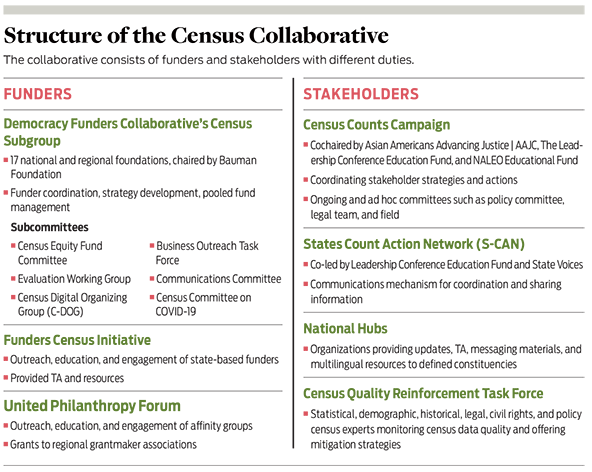
The funders assumed that the campaign would end in 2020 and that, therefore, neither the subgroup nor the campaign would need any special branding. Instead, they would focus on developing interlocking funder and nonprofit structures composed of organizations that could implement the plan of action and would exist long after the census subgroup disbanded. Even as the subgroup worked on refining the plan, the funders began to support structures to educate respective audiences, share census information, and promote action. The subgroup also recognized that if it was to function as a collaborative, funders and stakeholders needed an action plan to serve as the guiding frame for subgroup grantmaking and nonprofit actions.
Funder Structure
Members of the DFC Census Subgroup began monthly meetings in early 2016. To strengthen funder outreach and develop a communications channel, the Census Subgroup supported two philanthropy-serving organizations: the Funders’ Committee for Civic Participation, for their Funders Census Initiative (FCI), and United Philanthropy Forum. Each played a vital role in legitimizing the census through outreach and education, particularly by assisting state-based funders. They also helped to ensure that communications between the Census Subgroup and funders across the country were coordinated and that messages were consistent. Other philanthropy-serving organizations contributed to the creation of a learning community that shared best practices. In addition, Bass periodically distributed census information to a growing list of funders throughout the country, which the two organizations often redistributed through their communications structure.
To leverage what was expected to be limited funding and to encourage funders’ commitment to the plan of action, the Census Subgroup created a pooled fund at New Venture Fund, an institution supporting nonprofit fiscal sponsorships. Funders could also aid organizations directly, but the grantmaking would be counted as part of the collaborative only if the funded activities aligned with the plan. This model allowed funders to join in a manner that fit their funding style. A grant tracker monitored funding and targeted resources where they were most needed. In the early stages, grants made directly to organizations in support of the plan supplied most of the funding. However, in later stages, particularly as Census Day neared, the lion’s share of money came through the pooled fund, to allow for expedited and nimble grantmaking.
The Census Subgroup established committees as needed; some were temporary, others permanent; some were joint funder-nonprofit committees; and others were funder only. For example, a permanent evaluation committee was composed of funders and nonprofits and chaired by Angela Cheng of The JPB Foundation. That committee developed an evaluation plan of the collaborative: Two firms were hired to provide ongoing assessment over three years, as well as a final evaluation in the fourth year; a consultant was hired to develop a case study of the funders’ role; a firm was hired to develop reports describing actions taken in each of the 50 states; and others were funded to undertake case studies and additional evaluation work.
The Census Subgroup and FCI cohosted quarterly meetings for funders and stakeholders beginning in 2016. These convenings grew into larger, daylong events, which representatives from more than 130 stakeholders (including funders, policy and data experts, community organizers, and coalition leaders) joined in person and by video from 2017 through 2020. The independent evaluation of the census collaborative emphasized the importance of these quarterly meetings in building community. The confabs enabled funders and stakeholders to participate in census strategy discussions; share challenges they faced, along with best practices; and learn about new census developments, research, and digital organizing approaches.3
Stakeholder Structure
On the nonprofit side, Asian Americans Advancing Justice | AAJC, The Leadership Conference Education Fund, and NALEO Educational Fund created the Census Counts campaign to engage community, state, and national organizations in a GOTC campaign targeting undercounted populations. Census Counts was crucial to implementing all components of the plan of action: engaging on policy matters, such as the citizenship question, encouraging new players to participate, and being the “hub of hubs” for the outreach plan to encourage the hardest-to-reach to complete the census. Census Counts coordinated action across national organizations and kept stakeholders apprised of the litigation, federal advocacy efforts, and updates that influenced the GOTC campaign. It also launched a website that became the go-to source on the census, including information on the citizenship question, research, tool kits, and social media resources.
Complementing Census Counts was the States Count Action Network (S-CAN), co-led by The Leadership Conference Education Fund and State Voices, a network of state coalitions fighting for multiracial political power. S-CAN became an important communications mechanism to share information from Census Counts and others with census stakeholders. Many of the state partners had their own coalitions to distribute information and shared local information with the national partners through S-CAN. The communication structure funders and stakeholders established allowed census information to rapidly reach target audiences across the country with a consistent message.
For the GOTC campaign, the funders supported a structure of national hubs that worked to educate and build the census capacity of state and local organizations. These centers represented different undercounted populations and offered census resources to their respective constituency and multilingual community-specific campaigns, such as Make Black Count, Indian Country Counts, Count All Kids, and Queer the Census. They also provided training, tool kits, technical assistance, messaging, and coordination to the campaign’s network.
The funder and stakeholder structures were not siloed. Significant cooperation and coordination facilitated communications between funders and stakeholders and between national and state organizations. This teamwork was particularly important when the COVID-19 pandemic hit. The collaboration between funders and stakeholders made it easier to pivot to digital strategies and for funders and stakeholders to quickly share what was and was not working. These structures also provided a way to share information about how the Census Bureau was implementing the count. And the coordination among the Census Subgroup, Census Counts, and FCI meant that messaging to different audiences was consistent.
Leaders of Census Counts and the Census Subgroup met regularly for many months. This meeting schedule helped build strong trust between funders and stakeholders, which provided not only opportunities to identify emerging issues but also ways to resolve issues that made the initiative more effective overall. These structures made translating the collaborative’s vision into action easier.
A Flexible Plan
Despite careful forethought, the action plan needed dramatic changes as the 2020 census shifted. For example, the initial grantmaking plans could not account for the Trump administration’s interventions or the global pandemic. Funders therefore had to be nimble in terms of both shifting what to fund and allowing grantees to use funds flexibly.
The 2015 action plan envisioned funding for census policy improvements ending or shrinking significantly as GOTC efforts ramped up. However, because of the Trump administration’s actions, funding for policy work increased, driven largely by the addition of the citizenship question and congressional underfunding of the census. Because the citizenship question increased distrust of the government and added uncertainty over whether some would avoid filling out the census, GOTC work began earlier than originally planned. Expanding the policy work and starting the GOTC phase earlier put greater stress on the census collaborative to raise the needed funding and to meet the increased work demands.
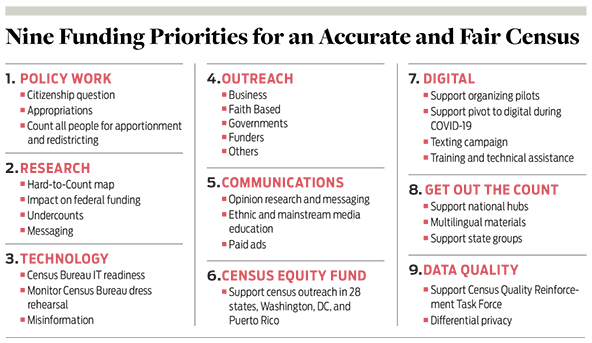
The collaborative’s overall action plan devoted funding to nine priorities to ensure a fair and accurate count. Implementing the action plan started with funding a handful of national organizations with census expertise to monitor Census Bureau actions and advocating for changes that would improve the count for those historically undercounted. The funders also supported two research projects: a “Hard to Count” interactive map to identify communities at greatest risk of being undercounted, and research on how the census influences the distribution of roughly $1.5 trillion in federal funds for each state. Information from each project was used by nonprofits, the news media, and elected officials around the country.
Much of the policy work shifted to efforts to stop the citizenship question, which required additional funding for research, communication strategies, and litigation. For example, one case study described how the collaborative approached efforts to oppose the addition of the question.4 Another high-priority policy issue for the collaborative was congressional underfunding of the census. Another case study examined how stakeholders successfully advocated for increased federal appropriations.5 Additional policy issues affecting the count of people of color emerged. For example, the Census Bureau’s decision to prioritize use of the internet to complete the census raised accessibility concerns, which required the bureau to provide financial support to organizations to track its internet plan and to call for changes to accommodate those without online access or digital literacy.
A critical component of the action plan was to engage and fund groups that were previously uninvolved in census issues but that could reach historically undercounted populations. These groups included faith-based entities, organizations providing social services, and those assisting immigrants and formerly incarcerated individuals. In most cases, these organizations emphasized outreach to families with young children—another undercounted population. This effort expanded the range of groups engaged in the census and formed relationships that continue today.
As the census collaborative transitioned to the GOTC phase, an essential part in shaping the outreach campaign was early messaging research within undercounted communities, which incorporated in-language focus groups and surveys. The national hub organizations primarily led this work. Additionally, nonprofits and funders in several states tailored the national messaging research to specific audiences.
The funders were concerned about inaccurate counts occurring in states with limited philanthropic presence and meager-to-nonexistent state government funding yet large, hard-to-reach populations. Although they did not envision it in the original action plan, the funders created a Census Equity Fund (CEF) to support nonprofit coalitions to conduct GOTC efforts in those states. CEF also provided a vehicle for coordination between national and state funders, sharing information on stakeholder coalitions and strategies for maximizing outreach to undercounted populations. By the end of the 2020 count, nonprofits in 28 states, Washington, DC, and Puerto Rico received CEF funding—often matched with state or local funding—which helped to strengthen nonprofit, state-based GOTC efforts.
The pandemic forced the funders to adjust grantmaking strategies to focus on digital outreach. Fortunately, they established a Census Digital Organizing Group (C-DOG), which involved both funders and stakeholders, roughly a year before the pandemic started. It focused initially on training nonprofits to use digital organizing tools and pilot newer digital tools for census outreach. Once the pandemic started, the effort quickly shifted gears to help organizations pivot from in-person to virtual activities, recommending digital grants that the Census Subgroup funded, developing digital tool kits for use in GOTC campaigns, and overseeing two texting campaigns coordinated with state organizations. The largest of the text campaigns distributed 1 to 3 text messages to 9.4 million people in 17 states who were likely to be undercounted.
Prior to the pandemic, stakeholders in each state held events at barbershops, bodegas, libraries, churches, and other community venues to talk about the importance of filling out the census. During the pandemic, nonprofit groups shifted to bus and car tours with megaphones, hosted tele-townhall meetings, convened virtual art and music events to highlight the census, and shared census information at food pantries and other places where people were going for pandemic-related support services. One evaluation product supported by the Census Subgroup included reports on census activities in each state, Puerto Rico, and Washington, DC, to provide a snapshot of the extensive engagement by nonprofits and funders across the country. Even these reports, however, do not fully capture all that happened, or the remarkable energy and creativity nonprofits brought to the task.
The original action plan assumed the census collaborative would end when the Census Bureau finished collecting data. Yet by 2020 there was growing concern about potential inaccuracies in the count, so the funders amended the action plan and supported a new Census Quality Reinforcement (CQR) task force—a group of more than 100 statisticians, demographers, researchers, historians, and civil rights organizations. CQR examined the quality and accuracy of the census data in the context of apportionment, redistricting, and the distribution of federal funds to states.
As of this article’s publication, CQR is working with the Census Bureau to ensure that the most accurate population estimates are used to distribute federal money, especially considering that the bureau has reported undercounts in six states and overcounts in eight. While the bureau did not provide information on who was miscounted in each state, it did report that Hispanics, Blacks, Native Americans living on reservations, and children under the age of five were undercounted nationally. Whites and Asians were overcounted.
Successes and Setbacks
This census initiative raised approximately $120 million—four times the budget projection in the 2015 Bass memo—plus at least another $75 million from funders supporting state-based activities. Remarkably, no single funder contributed more than 10 percent of the total amount raised for the initiative.
Hundreds of funders were involved, providing grants, participating in state and local government census committees (called Complete Count Committees), and advocating for an accurate census. CEOs from 300 foundations signed a letter to the Census Bureau opposing the addition of the citizenship question, and 500 funders and philanthropy-serving organizations signed a letter opposing the Trump administration’s effort to shorten the census data collection phase. This funder engagement was matched by even larger nonprofit participation. Many states and localities had coalitions led by nonprofits help with the GOTC work. Many coalitions engaged in efforts to petition government to adequately fund the census and to stop the addition of the citizenship question.
The collaborative, however, encountered various hurdles. Funders were initially cautious about supporting the census, for several reasons. The fact that the census was not the type of activity with which funders had familiarity created a need for a massive education campaign. Even as their familiarity grew, some funders thought it was too political, some thought it was the government’s responsibility, and others thought that the challenges were too great for philanthropy to solve.
The slow growth in funding created uncertainties for grantees. Without clear commitments on funding by the Census Subgroup, the stakeholders could not plan properly. Some of the grantees complained about a lack of funder transparency. They wanted to know who received grants, why funding was going primarily to national organizations, and how they could apply for grants. Funders attempted to address these concerns by adding a request for proposals for grants to state organizations and providing lists of organizations at the state and national levels that had been funded to help with various roles, including GOTC efforts.
However, these actions still did not resolve the uncertainty about potential funding, especially since the funders themselves did not know if they could raise the necessary funds. But by the end of the campaign, many of these concerns dissipated, as the funders knew how much money they had to spend and felt more comfortable having the nonprofit leaders recommend where funds should be distributed—an issue that some of the nonprofit campaign leaders raised. For example, a special emergency fund for advertising was created and given to the leaders of Census Counts to administer. Future campaigns like this census collaborative should embrace robust transparency to help grantees plan—even if funding uncertainty exists—and get input from stakeholders on how best to deploy resources.
The Trump administration’s politicization of the census had many adverse effects. It undermined this collaborative’s efforts to engage business leaders, conservatives, and Republicans. Although these players had been involved in past census campaigns, they abstained this time, primarily because they did not want to offend the administration. The funders supported an outreach campaign to businesses, which had only modest success—mostly at the local level once the count started. The funders also supported an outreach initiative to conservatives, but it ended within two months because the conservatives leading that effort believed that they could not successfully engage their peers. However, this reticence did not deter the collaborative from supporting outreach efforts.
The collaborative was driven by the principle that all members were equal partners. Traditionally, funders have held greater sway in the relationship with grantee organizations. Not wanting to antagonize foundations and potentially threaten their source of revenue, many nonprofits avoid challenging funders. This collaborative offered an opportunity to level the playing field by ensuring that broad decisions—including those about the plan of action—were decided jointly by funders and stakeholders, that many committees developing grant recommendations included stakeholders, and that an open communications channel existed for leaders of Census Counts and other stakeholders to share feedback with leaders of the Census Subgroup.
The independent evaluation of the census collaborative supported by the Census Subgroup noted that grantees greatly appreciated the funders’ commitment to equality, even though power discrepancies remained. The evaluation process also helped by providing interim reports about various campaign challenges, allowing the funders to address emerging concerns grantees raised. The final evaluation reports, based on surveys and interviews of stakeholders and funders, confirmed that the collaborative was a success.
Many involved described this initiative as unprecedented in bringing together so many funders and nonprofits to carry out the three-part action plan and in elevating the census from what had previously been considered an obscure issue. Participants overwhelmingly expressed support for the collaborative’s focus on reaching historically undercounted populations. More directly, respondents said the collaborative:
- Engaged at the community level trusted voices who had not been involved in past census work and now intended to remain involved.
- Created a variety of interactions among grantees and funders that fostered a learning community, which helped spur funders to provide grants and increase involvement.
- Established a flexible infrastructure with trusted experts so that funders and nonprofits could pivot quickly to meet each challenge.
- Facilitated safe settings for nonprofits and foundations to work together to solve challenges.
- Demonstrated new ways to use digital tools to enhance in-person outreach, organizing, and advocacy.
- Built an infrastructure that is now being used for vaccine awareness, broadband access, redistricting, civic engagement, and other community outreach campaigns requiring local expertise and trusted voices.
Notwithstanding hurdles along the way, the 2020 census collaborative was a success, as measured by those who evaluated the campaign. The collaborative not only built greater knowledge within civil society about the importance of the census but also provides a model for tackling other civic engagement issues.
Lessons for Civil Society
The collaborative’s success extends well beyond the census. It has created new and lasting relationships among funders and stakeholders that bridge national and state nonprofits and funders. For example, in some states, the census infrastructure was used to promote coronavirus vaccinations and issue public-health guidance. In others, funders and nonprofits engaged in the 2020 census campaign have shown interest in addressing digital-divide issues, particularly with new federal funding to deploy broadband internet and provide affordable equipment and training. Most strikingly, the collaborative created new partnerships across civil rights and civic engagement organizations, business groups, faith-based organizations, and service providers.
The Census Bureau will need the philanthropic community—both funders and nonprofits—to participate in these actions. Philanthropy needs to partner with the bureau.
The significant miscounts among historically uncounted populations in the 2020 census are disappointing, yet they might have been much worse without the collaborative’s efforts. Funders and stakeholders can draw several important lessons from this collaborative to prepare for the 2030 census and beyond:
Funder engagement is essential. | Even though foundation engagement on the 2020 Census started in 2015, many operational and research decisions about the census had already been made or nearly made. Funders and stakeholders now understand that the federal government starts planning for the next decennial census upon completion of the current census. Foundations need to support 2030 census efforts now to shape 2030 policy decisions on topics such as the digital divide, advertising to limited-English-proficient communities, counting of incarcerated individuals, and collection of data on race and ethnicity.
The evaluators of the census collaborative found overwhelming interest among nonprofits in continuing work on the census. We also know the significant role that media serving racially marginalized communities plays in reaching undercounted populations. Without foundation support, however, work on the census is not likely to be able to continue, particularly without funding to those who are considered trusted voices in communities across the country. Perhaps the Census Subgroup’s decision to continue its operations beyond 2020 signals that foundations will commit to promoting a fair and accurate census in an ongoing, consistent manner, rather than just once every 10 years.
Based on conversations with funders and stakeholders, the subgroup has already launched the Census Equity Initiative (CEI) to start its 2030 efforts. CEI will focus on crucial census products, such as the American Community Survey and the decennial census, to ensure that they accurately reflect those who are often miscounted. CEI will also continue to support the infrastructure to strengthen communication and action at the state level, including ways of using census data to build awareness of how the census influences funding for community programs.
Nonprofit engagement is essential. | During the evaluation of the collaborative, stakeholders, particularly those not previously involved in the census, pointed out that participating in the effort helped them understand the importance of civic engagement. This sentiment pleased those who crafted the original action plan, since one of their goals was to use the census as a starting point for more civic engagement.
The collaborative also demonstrated the importance of working with a combination of national, state, and community-based nonprofits. In particular, the investment in state and community groups with flexible funding helped build the trust to create and strengthen coalitions across communities of color, as well as relationships among organizations that had rarely worked together. These state and community organizations most often interact with undercounted populations and are imperative to motivating households to fill out the census.
We must continue to nourish and more fully develop this emerging infrastructure of nonprofits interested in the census and other civic engagement. This process will require time, experimentation, and flexible philanthropic funding.
Democracy is at stake. | Possibly the most enduring lesson from the census collaborative is how essential a fair and accurate census is to achieving a true, multiracial democracy. Prior to this initiative, the census was not on the radar for many funders or nonprofits working at the state and national levels. Now, many of them understand how an undercount can distort our democracy for the next decade by altering political representation and power, by misallocating federal funds, and by allowing data-driven decision-making to go wrong.
Collaboratives are powerful. | Building collaboratives can be challenging, exhausting, and costly, but the census initiative demonstrated that the benefits can far exceed the costs. No single funder or nonprofit working alone could have accomplished what was done. By working together, the census collaborative demonstrated new ways of gaining power and moving from a project to a large-scale campaign. Our model successfully promoted fair representation in redistricting, allowing funders to aggregate their grants to work toward the common goal of fair redistricting. We hope that this model will be applicable to other initiatives beyond the census.
Lessons for Government
As the funders of the census collaborative commissioned independent evaluations of the collaborative, they also funded a project to seek input from funders and stakeholders who had worked on the 2020 census to make recommendations for Census 2030 to share with government and specifically the Census Bureau.
The following are 3 of the more than 100 recommendations for the 2030 census, which focus on the need for the Census Bureau to provide support throughout the decade to state and local governments and nonprofits to prepare for the decennial count, implement better ways of counting the hardest to reach, and improve the accuracy of data collection.
Fund partners | One of the biggest needs is for the federal government to create a grant program to fund state and local efforts, including updating local addresses and enhancing complete count efforts, well in advance of the next census. The federal government does not compensate state or local governments for updating addresses—one of the most critical preparations for the census. It also does not fund outreach efforts by state and local governments and the nonprofits that work with them to educate and activate trusted messengers to help hard-to-reach populations understand the importance of the census. While philanthropy and some state and local governments have sought to fill some of the gaps, only the federal government can move at a larger scale and in a sustained manner.
Institutional memory about the census and past engagement are not retained without consistent outreach and relationship building. It would be less expensive and more effective in the long run for the Census Bureau to maintain a robust partnership program—with funding for the partners—at the national and regional levels throughout the decade not only for the decennial census but also to help support its many other surveys, including the American Community Survey. While the Census Bureau has created a new Office of Strategic Alliances, it is tasked with working only with national partners, despite the need to also maintain relationships with state and local partners who are best situated to continue census education.
Improve outreach | The Census Bureau needs to improve language access and support, better target advertising to historically undercounted communities, and deploy new methods for reaching rural communities, unhoused populations, and those living in group quarters. Providing greater language assistance will make it easier and more likely for more people to self-respond from undercounted communities, thereby both saving significant follow-up costs and increasing the accuracy of the data. Moreover, the Census Bureau must ensure that well-intentioned operational changes do not have unintended consequences, like restricting employment applications to online only, cutting the number of local offices, or aggressively trying to push people who want to use the telephone response option to the online option.
In 2020, the bureau provided census materials, telephone assistance, and advertising in English and 12 non-English languages. It also offered video guides in 59 non-English languages, including American Sign Language, that were not well distributed, and hired local partnership staff speaking nearly 50 non-English languages not necessarily matching the local need. We learned that the bureau’s investment was insufficient to effectively reach immigrant and Indigenous communities who have small national populations but who are significant in their state and local communities. This discrepancy shifted the resource burden to state and local government and community-based organizations who had to find the funding to produce their own translated materials and hire bilingual organizers. For example, Census Bureau workers, though they were supposed to use only official bureau materials, employed translated materials created by organizations funded through the philanthropic census collaborative to reach Native Alaskans—who comprise more than 15 percent of the state’s population. Otherwise, these households would not have been counted.
One in five people in the United States over the age of 5 speaks a language other than English as their first language. Many language-minority communities are significant populations at the local and state levels whose undercounts result in government underfunding; loss of congressional, state, legislative, and local government representation; and misinformed planning for public services, such as schools, hospitals, libraries, and public transportation. The Census Bureau needs to increase the number of languages it employs for official forms, telephone assistance, paid advertising, outreach materials, and mobile questionnaire assistance. It also needs to improve bilingual hiring for its outreach staff, based on local, rather than national, population levels.
The bureau should also increase the total share of its advertising budget to target historically undercounted population groups and expand messaging research to look at different ages, genders, and other cross-sections within the undercounted populations. In addition to increasing its investment, the agency needs to refine its messaging research beyond race to include the study of age, sex, and rural versus urban communities. It needs to shift more paid advertising spending from mainstream television and newspapers to radio programs, ethnic media, and social media that target the households at higher risk of being undercounted.
The 2021 Infrastructure Investment and Jobs Act provides $65 billion to address the digital divide, including support for broadband deployment, access, and training. This funding will ideally help to close the digital divide that was one of the barriers to achieving an accurate count in 2020, particularly in rural and tribal communities on reservations. The Census Bureau still needs a strategy that complements its embrace of online options. During the 2020 census, fewer local census offices existed and hiring of enumerators was done online only. These circumstances resulted in census workers who were unfamiliar with rural areas that did not have access to broadband and made hiring workers on reservations difficult once the pandemic locked them down. Fewer local census offices and the turnover of staff impeded local groups’ and philanthropies’ ability to fully leverage their partnerships with the bureau. Staff unfamiliar with local environments sent materials in languages and messages that did not work in those areas.
Even if broadband access improves, the bureau will need to continue supporting households that are more comfortable with print or telephone options. In the 2020 cycle, the bureau decided not to advertise the telephone option in its television and radio ads, which were most likely to reach those who cannot read or were unlikely to read the media in which the bureau placed its printed ads. Moreover, the telephone lines crashed early in the count, particularly those available to non-English-speaking households. This early breakdown of the telephone option caused community-based organizations to stop recommending that people use the phone lines.
Revise the questionnaire | Census data are used in civil rights enforcement, in the disbursement of federal funds, and in identifying disparate needs and effects of government policies. Many communities of color, women, and LGBTQ people remain more likely to face both individual and institutionalized discrimination in health, employment, housing, education, and environmental impact. Accurate data on race, ethnicity, sexual orientation, gender, and communities that are disproportionately incarcerated are critical for government agencies and organizations seeking to identify and address these disparities.
The current decennial census form has nine questions. As the US population continues to diversify, the most challenging questions relate to collecting data on race and ethnicity. For the 2020 census, the Census Bureau recommended several changes to the race and ethnicity questions that would have required revisions to the US Office of Management and Budget (OMB) standards on collecting and publishing race and ethnicity data. Two of these recommendations included combining two race and Hispanic-origin questions into one and adding a Middle Eastern and North African (MENA) identity category. Testing done earlier in the decade indicated that both groups are counted more accurately if these changes are made. One of the fastest-growing and largest racial categories in the 2020 census was “some other race,” because many Hispanics and MENA households do not identify as white. However, the Trump administration’s OMB did not approve these changes.
In analyzing the 2020 census data, the Census Bureau noted that “using a single combined question for race and ethnicity in the decennial census would ultimately yield an even more accurate portrait of how the US population self-identifies, especially for people who self-identify as multiracial or multiethnic.” 6 The fact that “some other race” became the second-largest racial category in the 2020 census shows the urgency of modernizing the race question. An accurate accounting of race and ethnicity is important both for enforcing civil rights laws and for planning and supporting effective outreach programs and other policies. Accordingly, the Census Bureau and OMB should move expeditiously to use a combined question for race and ethnicity that includes a MENA category. Doing so will encourage other governmental and private-sector surveys to make similar changes so that antidiscrimination laws can be effectively enforced and services adequately provided.
In addition, the Census Bureau should incorporate questions regarding sexual orientation and gender identity to ensure the enforcement of antidiscrimination laws and the provision of appropriate services. During the Obama administration, the bureau explored changes to the residence criteria, which counted the residence of people incarcerated at the time of the census as the prison, rather than their home. This approach means that people of color and lower-income people are counted in mostly rural areas, as opposed to their urban homes, and thereby displaces political representation and alters the flow of federal funds.
A growing number of states and localities are mandating that incarcerated people be counted as residing at their home address, rather than at the prison they are being held in, because of the distortions the latter causes for redistricting and resources. More states and localities should make similar changes, but the most comprehensive approach is for the Census Bureau to make a change that applies uniformly across the country.
2030 Work Begins Now
Many census experts believe the 2020 census would have been even less accurate but for an unprecedented collaborative of nonprofits and funders focused on encouraging the participation of historically undercounted people. Even so, the fact that various populations were significantly undercounted elevates the importance of continuing the work as we move forward.
Despite the 2020 inaccuracies, this census highlighted that United States is becoming more diverse and urban. It is the first time that the white population declined, from 63.7 percent in 2010 to 57.8 percent in 2020. Latino and Asian American populations have grown rapidly, and African American and Native American populations continue to increase. But the fact that the country’s democratic institutions, such as voting districts that hinge on census data, do not yet reflect these trends results in political representation that does not look like America.
It is time for action to ensure that the census is fair and accurate. Our democracy depends on it. This starts with improving the data stemming from the 2020 count, so that federal funding allocations reach targeted audiences and so that current and future research that influences policy decisions is based on accurate census data. It requires revisiting other census products, such as the American Community Survey, to make sure it can provide data about the population, including changing demographics, with sufficient accuracy. And it continues by establishing new ways to ensure that the next decennial census counts everyone.
The Census Bureau will need the philanthropic community—both funders and nonprofits—to participate in these actions. Philanthropy needs to partner with the bureau at the same time it urges the government to do a better job. Achieving this objective calls for funders to support nonprofits for research, advocacy, public education, and organizing. Philanthropy, community, and government leaders must work together—starting now.
Read more stories by Arturo Vargas, Gary D. Bass & Karen K. Narasaki.