


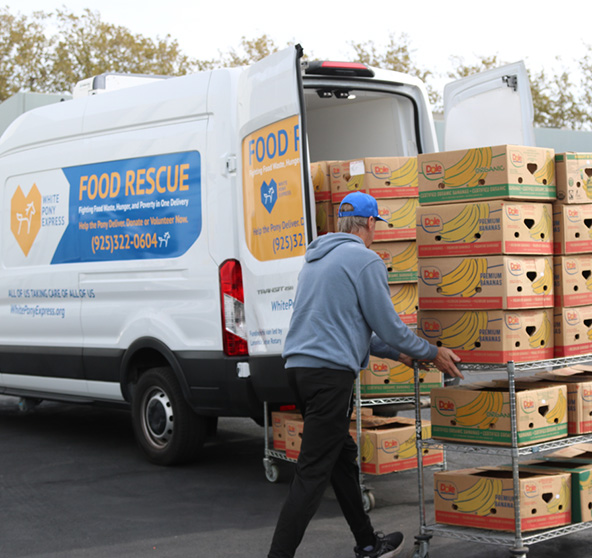
 (Photo courtesy of White Pony Express)
Nonprofits face growing pressure to do more with less: Rising demand, shrinking funding, and increasingly complex social issues often exceed the capacity—and mission—of any single organization. At the same time, because today’s most urgent challenges are interconnected and systemic, effectively addressing hunger, homelessness, education, or health equity requires a level of strategic coordination that few organizations can achieve on their own.
Most nonprofits operate in isolation from each other, for reasons that are easy to understand. Structural incentives such as funding models, branding, and board expectations often reinforce competition over collaboration. As a result, even when their missions overlap, organizations frequently compete for limited funding, volunteers, and visibility, duplicating services in some areas and while leaving needs unmet in others.
Five organizations in Contra Costa County, California, have been developing a new model to align their efforts focused on food insecurity without sacrificing their autonomy as distinct organizations. I would suggest that the example of The Food Security Collaborative offers a replicable blueprint that other social sector leaders can adapt to their local contexts, a model for how—rather than working in isolation—nonprofits can connect their missions, integrate data, share resources, and coordinate services to amplify impact across a shared system.
I call this model an “Impact Collaborative.”
A Scalable Solution for Positive Change
In 2024, The Food Bank of Contra Costa and Solano, White Pony Express, Meals on Wheels Diablo Region, Loaves and Fishes of Contra Costa, and St. Vincent de Paul of Contra Costa County came to a shared realization: Despite years of individual effort to combat hunger, food insecurity remained widespread in their county (or was worsening). Especially when COVID-era relief funds expired, rising inflation, increasing homelessness, widening income inequality, and a growing senior population were all placing increasing pressure on their services, more than any single organization could manage alone.
Instead of continuing to operate independently, the organizations formally aligned under a shared banner: The Food Security Collaborative of Contra Costa County. However, this was not a merger or consolidation, but rather a strategic alliance focused on amplifying collective impact while preserving organizational autonomy.
The Food Security Collaborative model represents a paradigm shift from isolated services to integrated, systems-level collaboration. Unlike formal mergers or rigid coalitions, this model is built on:
- A shared mission without requiring shared governance,
- Autonomy of brand and operations alongside an aligned collective strategy,
- Integrated data tools that drive joint decision-making, and
- Rotating leadership based on organizational capacity and expertise.
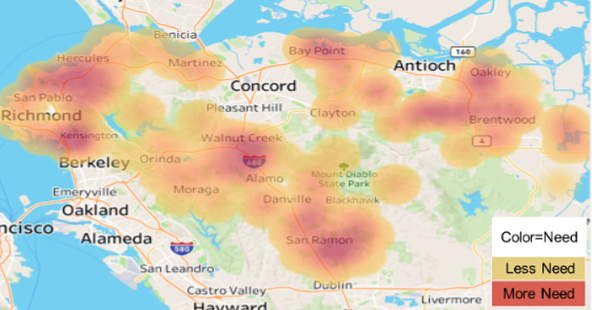
The clearest example of how building a shared, data-informed view of community needs allowed county-wide collaboration was the construction of a food equity “Heat Map,” allowing the collaborative to identify pockets of unmet need across several non-English-speaking neighborhoods, recruit bilingual volunteers, and deploy mobile food pantries to meet it. At the same time, in other areas, they began reducing redundant services so as to redirect resources where they were more urgently needed. Today, data integration and coordinated strategy are embedded in both individual and shared planning processes.
Inside the Food Security Collaborative: Building the Model in Practice
When the leaders of the five nonprofits first gathered to explore synergies and opportunities, they didn’t come with a blueprint. They came with questions. Because each organization had a distinct culture, set of priorities, and funding structure, early meetings were marked by curiosity, and a bit of caution. How would decisions be made? Would collaboration create more work than it saved? If the collaborative received funding, how would it be distributed among its members?
The group began with an initial meeting facilitated by third-party volunteers. Several graduate students from a local university helped document shared goals and lead discussions on the group’s questions. As each organization shared its mission, strengths, and challenges, the group quickly realized that their combined efforts reached nearly every ZIP code in the county, but not in a coordinated way. Meals on Wheels focused on delivering meals to homebound seniors in one part of the county. Loaves and Fishes operated dining rooms for those seeking a hot meal, while St. Vincent de Paul provided emergency pantries for families in crisis. The Food Bank and White Pony Express served nonprofits across the county, yet had limited visibility into how their upstream efforts ultimately reached people on the ground.
The group’s first major challenge, then, involved data. Each organization tracked its own efforts and outputs—pounds of food, number of meals, households served—but the metrics weren’t standardized. The collaborative formed a small working group to align on shared data definitions and create a unified “heat map.” Initially, some partners worried that transparency might expose inefficiencies or raise questions from funders. But once the first version of the map revealed previously unseen service gaps, especially in the more rural Eastern part of the county, the value of data-sharing became undeniable.
Collaboration required patience and openness. Each organization brought its own language, priorities, and ways of making decisions. Over time, the group built trust through regular meetings and transparent dialogue, making decisions by consensus, a process that has fostered mutual respect and shared ownership among the partners.
Funding proved both a hurdle and a breakthrough. At first, partners weren’t sure how joint fundraising would align with their individual campaigns or existing funder relationships. But as the world of philanthropy has been shifting toward collective impact, new opportunities emerged. Through joint proposals, the partners secured funding that none could have accessed alone.
For example, the county had recently passed Measure X, a local half-cent sales tax to support crucial safety-net services and protect vulnerable populations. Jointly applying for a Measure X grant gave the collaborative a leg-up because their approach was seen as more strategic by the county board of supervisors versus a scattershot funding approach. With the Measure X grant, each organization in the alliance saw tangible proof that working together could unlock opportunities none could achieve alone. The funding will support coordinated application of findings from the countywide food security heat map, which had revealed gaps and overlaps in service delivery. What began as a hopeful experiment has suddenly become a funded, data-driven system for change.
Today, the Food Security Collaborative operates with a light but deliberate structure. Bi-monthly meetings maintain alignment and forward momentum. Each partner still runs its own programs, but major service changes are reviewed against the shared heat map. The collaborative has become both a learning community and an operational network.
How to Design an Impact Collaborative
The model built by the Food Security Collaborative reveals design principles that other nonprofit leaders can use to form an effective Impact Collaborative focused on their own unique missions in their respective communities:
- Establish a Common Goal: Organizations working toward a shared outcome—such as food access, housing, or youth development—can maintain their unique identities while uniting around a collective goal. Clarity on the “why” builds trust and creates alignment across similar missions.
- Visualize and Share Data: Integrating data through shared tools like heat maps, dashboards, and centralized reporting systems foster transparency and informed decision-making. When all partners are working from the same data source, trust increases and collaboration becomes more strategic.
- Coordinate Around Community Needs: The collaborative focused on increasing food security, the goal that united each mission. But it also emphasized cultural relevance and multilingual communication across their services, an approach that both increased reach and deepened community trust for individual organizations and the collaborative itself.
- Use External Facilitation: An external facilitator can help mobilize the alliance in its early stages by defining shared goals, clarifying governance, and identifying opportunities for collaboration. In Contra Costa County, this role was filled by local MBA students who guided the process.
- Focus on Collaborative Funding: Instead of competing for limited food security funding as had historically been the case, the collaborative partners prioritized funding opportunities that supported joint initiatives over siloed programs. By co-developing shared proposals with bolder impact metrics, the group demonstrated the value of coordinated action—and has successfully secured funding from several funders beyond what would have otherwise been possible by going it alone.
A Step-by-Step Approach to Collaborative Building
Nonprofits don’t need to start from scratch to adopt this model. Here’s a practical roadmap for building an Impact Collaborative:
- Identify Shared Challenges: Start by gathering trusted peers with aligned missions. Frame the conversation around shared pain points and opportunities for joining forces for greater mission impact.
- Define a Common Goal: Identify one clear, outcome-oriented goal. This becomes the foundation for aligning activities and measuring collective success.
- Map Assets and Gaps: Conduct an inventory of services, geographies, data, and populations served. Look for overlap, unmet needs, and complementary strengths.
- Establish Light Governance: Create clear, flexible processes for decision-making, accountability, and data-sharing. Avoid heavy bureaucracy, but clarify roles and expectations.
- Engage Funders Strategically: Invite funders into the process early to help validate and co-create the model. Emphasize the value of funding collaboration, not just individual programs.
- Measure and Adapt: Select shared success measures. Let the data guide where to focus and adjust strategy.
- Celebrate Wins and Tell the Story: Recognize progress internally and externally. Publicly share stories of collaboration to strengthen momentum and credibility.
Why Impact Collaboratives Matter Now
As traditional nonprofit models hit their limits, the Impact Collaborative approach provides a new blueprint, one that protects organizational independence while powering systemic impact. For funders, it delivers higher returns through coordinated investment. For communities, it increases service access and responsiveness. And for nonprofit leaders, it reframes the challenge from delivering individual programs to scaling collective solutions for elevated mission impact.
Perhaps most importantly, this model represents a cultural shift for nonprofits, away from competition towards cooperation, and from scarcity to scalability. When organizations start co-creating, they unlock outcomes no single group can achieve alone. The challenge for social impact leaders today is not just how to do more with less, but how to do more with greater impact, together.
Read more stories by Soren Kaplan.