


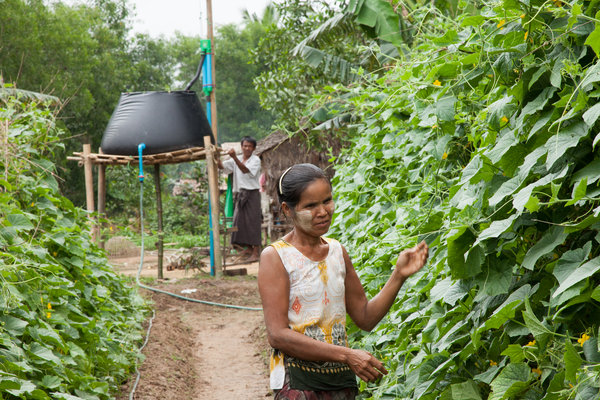
 Customers in the Ayeyarwady Delta region of Myanmar use the Proximity Designs drip irrigation system. (Photograph courtesy of Proximity Designs)
Thein Than grew up on a small farm in Danuphyu Township in the Ayeyarwady Delta, a region of Myanmar (also known as Burma). He had no access to post-elementary schooling in that community. So to continue his education, he moved to Yangon, the country’s largest city. Leaving Danuphyu was a natural step for Than to take. Most residents there struggle to survive by farming small plots of land, and the trip to Yangon—a city of shimmering golden pagodas, a city of opportunity—is only a short bus ride away.
Than, who is now 63, spent eight years working in Yangon. But what he left behind in Danuphyu never left him. Today, he and his family tend a small farm in the township. “That time in the city couldn’t take the farmer out of me,” Than says. As if on cue, he feels a weed with his bare foot and bends down to pull it out. “I love being out here,” he continues. “I enjoy the air, the open sky, the privacy. My sense of self is based on place. Because I can now make a living here, I feel I can be who I am.”
Than is able to make a living as a smallplot farmer in part because the tools of his trade have improved a great deal in recent years. “Here’s how I used to do it,” he explains. With a grimace, he squats down under a bamboo stalk that has a rusted watering bucket on either end of it. When he stands up, his wiry muscles tremble under the weight of the contraption. But he manages to walk up and down rows of turnip and cilantro plants, tilting his body from side to side to give each plant just enough water. He used to fill the buckets and walk these rows 20 times every morning and 20 times every evening. “Not anymore,” he says.
In 2011, Than began using a device called Sin Pauk (“Baby Elephant”), a footpowered water pump made entirely of plastic that costs 15,500 Kyat (about $15). He pairs it with Pyit Taing Taung (“Sturdy Boy”), a 250-gallon tank ($33) that inflates as it fills with water. The pump uses a ropeand- pulley system that makes it easy for Than and his family to operate. Similarly, the tank has a lightweight design—it’s made of PVC-treated canvas and plastic—that allows Than to move it as he irrigates his land.
Together, these items have done more than decrease Than’s workload. They have enabled him to invest time in maximizing the use of his land and in taking his crops to market. As a result, he has been able to double his family’s income over the past five years. “My wife and I have used this extra money to make improvements to our house, but mostly it’s allowed us to cover education expenses for our four children,” he says.
Both products emerged from the workshop of Proximity Designs, a nonprofit social enterprise based in Yangon. (Proximity markets its products under the brand name Yetagon.) Proximity, established in 2004 by the husband-and-wife team of Jim Taylor and Debbie Aung Din, received the Skoll Award for Social Entrepreneurship in 2012. True to its name, the company takes advantage of its nearness to customers in order to develop products that truly meet their needs. Taylor, Aung Din, and their team create enduring relationships with small-plot farmers, and they strive to design farming equipment that is both innovative and affordable. “We never create a product based on a perceived need,” Taylor says. “Every step we take is a result of listening to our customers.”
Since 2004, nearly 150,000 families in nearly 10,000 villages in Myanmar have used Proximity’s products. Over that period, Proximity has sold more than 175,000 items, and the company estimates that use of its products has generated about $300 million in additional income for farmers. More recently, Proximity has begun to offer services as well—services that reflect its deep understanding of the challenges that these customers face.
Design Challenge
Proximity had revenue of $13.7 million in 2015, and it employs more than 400 people. It organizes its business model around a 50-50 balance between earned income and philanthropic funding. That approach allows the company to avoid relying on a single revenue stream. “It’s a sort of checks-andbalances system,” Aung Din says. “When the scales start to tip too much in either direction, we know it’s time to pause and perhaps recalibrate.”
Central to the company’s mission is its dedication to design thinking. Aung Ko Ko, product design co-leader at Proximity, describes that practice as “a merging of modern tech with a mindset of thinking differently and creating purely for social impact.” Ko Ko and his colleagues follow a process that resembles the one used by Western designers in places like the Hasso Plattner Institute of Design (known as the d.school) at Stanford University. They start by interviewing a large cross-section of farmers from various regions of Myanmar. From that set, the Proximity team selects a target group of farmers and works iteratively with that group to develop a prototype design. “This means spending as much time as possible on [customers’] farms so that we can understand the nature of their work,” Taylor explains. For any given product, the entire process typically lasts 18 months to two years.
This approach has led to some important design breakthroughs. The Baby Elephant, for example, departs from the irrigation industry norm by using plastic instead of heavy-duty metal. That choice makes the product lighter, cheaper, and more durable than standard water pumps. Design thinking also enabled Proximity to introduce drip irrigation to Myanmar by developing and marketing an ultra-affordable gravity-fed system. (The system costs about $34.50.)
The use of design thinking in Myanmar comes with challenges, however. For one thing, Myanmar lacks a reliable infrastructure for product development. “There are times when we know our next step, but we have to put production on hold for months because a part is not available in Myanmar and nobody in the country has the tools to make it,” says Nyan Lin Htet, a product designer at Proximity who specializes in solar energy devices. Other challenges reflect deeper social forces. “We constantly work to change some of our country’s cultural norms,” Ko Ko explains. “We respect elders immensely, even if they are only a few years older, and this makes it difficult to create a culture of continuous feedback.” (Design thinking, after all, requires a willingness to question authority.) The Proximity team also “essentially had to introduce the concept of prototyping,” Ko Ko says. “Because there is so much poverty here, product developers have long held that they can go from idea to perfect product without any of the crucial stages in between.”
Full Service
The operational challenges that Proximity confronts mirror the larger development challenges that Myanmar faces. The country is still recovering from a period of military rule that lasted from 1962 until 2011. “Much of the country looks the way it did in the 1950s,” says Chris Milligan, mission director for Burma for the US Agency for International Development (USAID). “The impact of decades of military rule, systemic corruption, and mismanagement has impoverished the majority of the population—notably the 70 percent of the population engaged in agriculture.” Today, Myanmar is pivoting toward democracy, and USAID (which returned to the country in 2012, after withdrawing from it 24 years earlier) is working with organizations such as Proximity to help rebuild the Myanmar economy. (USAID funds part of Proximity’s work.)
Cyclone Nargis, which struck Myanmar in 2008, exacerbated the country’s challenges. The cyclone killed 84,500 people and left 53,800 others missing. It also killed nearly half of the country’s draft animals. Flooding destroyed more than 1.5 million acres of agricultural land and wiped out the livelihoods of thousands of farmers.
In the aftermath of Nargis, members of the Proximity team helped design and implement humanitarian relief efforts that served 250,000 people in the Ayeyarwady Delta. Complicating those efforts was another crisis that occurred during the same period—the spread of the brown plant hopper, a pest that feeds on rice. At one point, the pest destroyed more than 100,000 acres in just four days. Farmers, desperate for a successful crop after the cyclone, turned to local pesticide providers for advice. Acting on that advice, they began to bombard their crops with pesticide, and the stage was set for an environmental catastrophe. The Proximity team helped stave off disaster by offering farmers advice on environmentally sustainable ways to fight the infestation.
For Aung Din, this episode was a wake-up call. “Empathy—our capacity to understand the challenges of our customers—has always been our secret sauce,” she says. “But after Nargis, we realized that farmers didn’t just need great products; they needed great information.” This insight led Aung Din and her colleagues to launch Farm Advisory Services (FAS), a business unit that sends skilled agronomists into all parts of the delta region to offer science-backed advice to farmers on a wide range of challenges. The service is free, and to date more than 35,000 farmers have used it.
The most popular FAS solution is a far cry from the high-tech work that goes into creating Proximity products. “It’s the old saltwater seed-selection method that was perfected in Japan, and it increases crop yield by 10 to 15 percent,” Taylor says. “You can preserve rice seeds by dropping them in saltwater. The unwanted seeds float to the top, and after removing them, you plant only the seeds that sink to the bottom.” Simple though it is, the method requires careful preparation. “How do you know if you’ve mixed enough salt with the water?” Aung Din asks. “You drop a duck egg in. If it floats, you’re good to go. That’s design thinking at its finest.”
Read more stories by Cameron Conaway.