


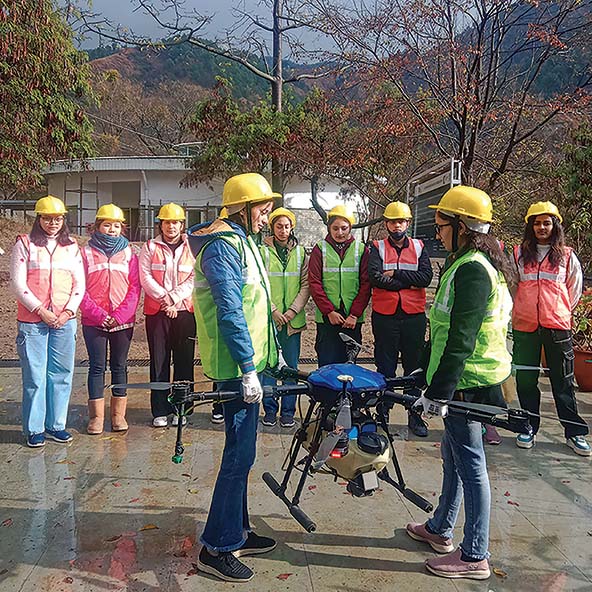
 Drone Didi participants engage in the compass calibration process to ensure accurate drone navigation as part of the training course at IIT Mandi, India. (Photo courtesy of IIT Mandi iHub Team)
When 38-year-old Banita Sharma’s husband developed a health condition recently that left him unable to work, her small pickle business proved insufficient to meet her family’s needs. Few job opportunities exist in her village of Bado Brahmanan, in the northern Indian state of Haryana—especially for women.
“That’s when I heard about a new [program] for women to train as drone pilots,” she says. “It would certify us to run our own drone-rental service, adding another source of income.”
In November 2023, India’s government launched the NAMO Drone Didi (didi is Hindi for “elder sister”) program. Rural women comprise 65 percent of the agricultural workforce, but their work is labor-intensive and poorly paid, with limited ownership of land. The Drone Didi program aims to make them stakeholders in the rural economy through skill development, while also modernizing agriculture through technology and boosting yield and precision farming. The target is to train 15,000 rural women selected from women’s collectives in drone operation for agricultural purposes, mainly to spray fertilizers and pesticides on crops. Hundreds of women have already completed the two-week training program, which qualifies them to purchase a drone at a 50 to 80 percent subsidized cost through a low-interest loan offered by the national agriculture financing facility, with state banks covering the remaining cost.
The government’s ministries are collaborating with educational organizations, fertilizer companies, rural women’s collectives, drone manufacturers, and pilot-training institutes to implement the program nationwide. The government has also allocated 1,261 crores (more than $152 million) over the next two years for the project. The cost of the training is being largely covered by fertilizer companies, who are investing in Drone Didi because it uses fertilizers in crop cultivation.
The Drone Didi training programs are held at drone-training centers in cities across the country. Sharma traveled three hours from her village to attend a two-week residential course in Manesar, a town near the capital of New Delhi. The course was run by the Indian Farmers Fertiliser Cooperative (IFFCO) in partnership with Drone Destination, a remote-vehicle-training organization based in New Delhi.
“We learned air traffic regulations, drone applications, putting a drone together, loading fertilizers, mapping, flight simulation, [and] spraying,” Sharma explains. “I learned how this technology is helpful in reducing water usage, manual labor, and the cost of fertilizers.” An area that would take half to one day to spray manually can be covered in less than 10 minutes with a drone.
Social and gender barriers have made training participants challenging. “Many of [the women] have not been in an organized learning environment for a long time or worked outside the home before,” says Drone Destination CEO Chirag Sharma. “It is a culture shock.”
A project like Drone Didi “serves a higher purpose of democratizing technology and cuts through gender biases by enabling women to venture beyond their homes for educational and employment opportunities,” says Somjit Amrit, CEO of iHub, a technology innovation center at the Indian Institute of Technology, Mandi (IIT Mandi), in the North Indian state of Himachal Pradesh. IIT Mandi is conducting a more expansive 10-week Drone Didi program in partnership with the National Skill Development Corporation. The program is tailored to a wider range of women from both rural and urban areas: It is taught in both Hindi and English and includes modules on entrepreneurship, communication, and leadership.
Shashi Bala, 22, a drone-pilot trainee at IIT Mandi, is the first woman in her family to study and seek work outside her hometown of Kangra. She is eager to break gender barriers with the tools she has been given by the program. “With the drone industry growing rapidly, I am optimistic about building a career in this sector, gaining job experience, and then starting my own venture,” she says.
A partnership ecosystem is gradually being built around the Drone Didi program to support the drone pilots to increase women’s access to financing and work opportunities. Government agencies and training organizations are currently devising loan plans with drone manufacturers and banks to help the pilots buy drones. Drone Destination is working on an app to support the more than 650 women pilots it has trained so far across 13 states to connect them with job opportunities. Physical hubs, too, are under construction to handle drone maintenance.
For many women like Sharma, the program has catalyzed greater social change and fueled even bigger dreams. “I am the first in my village to become a drone pilot,” she says, “so I hope it will set a trend of more jobs for women and change how we are perceived.”
Read more stories by Neha Bhatt.