


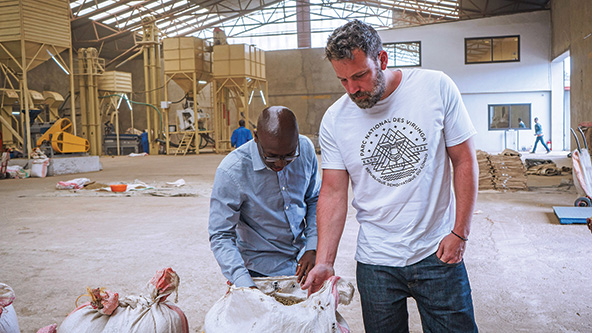
 Eastern Congo Initiative (ECI) cofounder Ben Affleck (right), and former ECI staff member and country director Baraka Kasali, inspect beans at a coffee processing center. (Photo courtesy of ECI)
“I was astonished that so many people could be suffering and dying,” Academy award-winning actor Ben Affleck recalls of first learning about the magnitude of problems affecting the Democratic Republic of the Congo (DRC) in the early 2000s. Since then, the vast central African country’s troubles have continued, as has Affleck’s determination to do something about it.
DRC is experiencing the second largest hunger crisis in the world, after Yemen. Civil conflict displaced approximately five million people between 2017 and 2019. Last year, while the country contended with the COVID-19 pandemic, it was also suffering from its 11th Ebola outbreak; trying to curtail deadly measles and cholera epidemics; and grappling with perennial HIV/AIDS, malaria, and tuberculosis infections.
The scale of the country’s problems stems in part from a war that started in 1996 and has dissipated but never fully ended, producing a death toll in the millions. These many problems are rooted more deeply, however, in a staggering history of colonial brutality that started with the violent reign of Belgium’s King Leopold II at the turn of the 20th century, during which an estimated 10 million Congolese were killed. This set the stage for ongoing exploitation of the country’s mineral wealth, including the world’s largest supply of the black mineral ore coltan—an essential component of electronics.
In 2010, Affleck cofounded the Eastern Congo Initiative (ECI) with Whitney Williams, a businesswoman from a prominent Montana political family, to chip away at these problems. The organization gives grants and technical support to Congolese charities and has disbursed funds to 23 community-based organizations working on everything from child soldier rehabilitation to basic health-care access. The organization also facilitates public-private partnerships, including connecting Congolese coffee and cacao farmers to corporations such as Starbucks, Nespresso, and Theo Chocolate.
ECI also does advocacy, and Affleck has testified in the US Congress multiple times in support of DRC. In 2012, for example, he implored the House Armed Services Committee to influence the United Nations’ role in the fragile country’s stability. In 2014, he testified to the Senate Foreign Relations Committee to ask representatives to pressure DRC’s government to hold free and fair elections, increase US funding for economic development, and engage with then-President Joseph Kabila to reform the security sector. The following year, he persuaded the US Congress to continue aiding the African region when he spoke in a US Senate Committee on Appropriations meeting about ECI’s work to revitalize Congo’s coffee sector.
It’s a scattered portfolio, but Affleck believes that as an outsider with deep pockets, he should have an investment strategy that is broad-based yet locally focused. “Rather than impose a model onto a community that we know little about, have little exposure to, and know almost nobody actually working in, the smaller, community-based organizations were doing much more effective work,” Affleck says. “Countries’ problems have rarely been solved by outsiders interposing themselves and insisting on those countries adopting their models.”
DRC has had more foreign intervention than most countries—the failures of which Williams and Affleck were keen to avoid. The country hosts the world’s largest United Nations peacekeeping mission, and one of the most expensive, which, together with the well-funded aid sector that proliferated during the war, has produced such questionable results that nearly a third of Congolese say that the country would be better off without any foreign aid and half think the peacekeepers should just leave.
“You see these incredible, remarkable, resilient people. … Then you see this humanitarian apparatus that just doesn’t get it—it wasn’t investing in local folks; it was investing in big international NGOs that come and go,” says Williams.
It was clear to Affleck and Williams that the people who would solve DRC’s thorny problems in the long term would be the community leaders who called the country home—and that is exactly who ECI decided to support.
Collaborative Grantmaking
Williams and Affleck first met on an airstrip in neighboring Tanzania in 2006. Affleck was attending an off-the-record learning tour that U2's Bono organized, performing the well-worn Hollywood narrative of turning to Africa to squeeze meaning out of a celebrity success that he felt was increasingly vacuous.
But Affleck’s approach to activism was more than just a publicity stunt. “Rather than being a dilettante and going to Congo and holding someone’s hand in a hospital and taking a picture, I thought I really needed to educate myself,” he explains. “I wasn’t sure that I could be of any help. I was certainly aware that just being a celebrity doesn’t make you a philanthropist, or even useful.”
This attitude led the pair to develop a more collaborative grantmaking approach. Instead of deciding what they wanted to fund, they asked organizations what they needed. This helped Affleck and Williams attract many of their first Congolese partners, including Chouchou Namegabe, a Congolese journalist who cofounded the South Kivu Women’s Media Association, which trains female Congolese journalists to report on women’s rights issues.
“There are a lot of donors who have a lot of money, and they want to come in without knowing what the priority needs of the people they’re working with are,” says Namegabe. “What I really liked about ECI was that we worked like partners to get what we needed. We had a dream of having a radio station for women, and they helped us realize it.”
Another early grantee was the Panzi Foundation, which was established by Congolese gynecologist and pastor Denis Mukwege, who won the Nobel Peace Prize in 2018 for his work providing medical and legal services to survivors of sexual violence.
“The aid model that is often applied in places like DRC is a model that is designed to help in the here and now. It’s almost palliative care; it’s stopgap measures,” says Mvemba Phezo Dizolele, a writer and foreign policy analyst who met Affleck during ECI’s early days and now serves on its board. “It’s not designed to account for the agency of the local populations; it doesn’t take into consideration that they probably know what will work for them and what the solutions are.”
The ability to execute these lofty ideals had a lot to do with the capital and press that Affleck’s celebrity and Williams’ high-profile connections afforded. Early donors to the organization included Cindy McCain, wife of the late Senator John McCain; Microsoft cofounder Paul Allen; and the Howard G. Buffett Foundation, run by its namesake, the son of billionaire investor Warren Buffett.
Strategic Merging
More than a half decade into operations, ECI realized that funding local organizations might not be substantive enough to create lasting change. It was at this time that Affleck considered merging ECI with a local organization to achieve its most ambitious aims.
In 2018, after visiting the community-owned enterprise Asili in the Kabare region, they knew that they had found the organization they were looking for. The water, agriculture, and health service business was created through a partnership by Alight (formerly the American Refugee Committee), the nonprofit design studio IDEO.org, the United States Agency for International Development (USAID), and local residents where Asili planned to operate.
Asili was launched with an initial philanthropic donation that was disbursed by USAID and a group of religious donors called Asili Faith Partners to build clean water pipes and a health clinic. People living inside the surrounding zone pay a small fee each time they access these resources. The payments keep the system sustainable and accessible for those who can’t afford to pay. Today, 150,000 people spread across six zones are paying users of Asili’s water and health clinics.
Asili believes in providing high-quality services and in placing people’s needs first in how these services are designed and delivered. “I firmly believe that a business mentality that looks at people both as owners and customers creates a much more empowering environment than looking at them as beneficiaries,” says Abraham Leno, who was the country director of Alight when it helped to create Asili.
Leno knows this personally. He was 16 when war broke out in his native Sierra Leone and his family had to flee to neighboring Guinea. They spent much of the 1990s in a refugee camp. He remembers food rations being delayed for months at a time and one delivery that arrived infested with bugs, causing a diarrhea outbreak in the camp.
“I think the interpretation is that beggars have no choice, so you should take what we give you, even if it’s not the right thing for you, even if it is not the best thing for you,” Leno observes. “I don’t want to be referred to as a beneficiary ever again in my life, because I know what that did to me.”
Leno believes that Asili can deliver a kind of philanthropy that is self-sustaining and provides world-class services. “The model is revolutionary,” Affleck says. “It reinvents humanitarian aid as start-up capital.”
In August 2020, Asili merged with ECI and installed Leno as ECI’s executive director. While ECI will continue its grantmaking work to other organizations, Affleck says that they’ll reserve most of their energy for Asili. Their plans are to expand water and health-care services to half a million people across 10 zones over the next three years, all of which will be funded by user-fees money. New zones are already being built in the nearby South Kivu region, in the town of Minova, with Nespresso and USAID providing the start-up capital; another two will be built in the town of Uvira, with funding from the Caterpillar Foundation and USAID.
Leno points to the COVID-19 pandemic as proof of the system’s reliability. He says that no pipe has ruptured, nor has service been interrupted, since the pandemic started at the beginning of 2020. Leno and Affleck see the merger as an important moment for a small-scale social enterprise with a big idea in a country not at war, but certainly not at peace.
“How do we transition from protracted humanitarian aid to development?” Leno asks. “It’s this idea of dignity, of valuing the things that we do from the perspective of the person who receives them.”
Read more stories by Abigail Higgins.