


 (Illustration by Harry Campbell)
At the 2013 World Economic Forum in Davos, Switzerland, Tae-Won Chey proposed a bold new idea. The chairman and CEO of SK Group, one of South Korea’s big three conglomerates alongside Samsung and Hyundai Motors, was addressing an impact investment panel on how to revitalize social enterprises.
“Investments should be made based on the actual social value they create, not on their inputs,” Chey said. He suggested the idea of a reward system grounded in measuring the monetary value of social performance. If such a system took hold, social enterprises and the larger market could be incentivized to pursue social impact, with the chase for social returns leading to a virtuous cycle of financial returns to successful social enterprises funding further performance.
Two years later, SK Group led the launch of the Social Progress Credits (SPC) program, the first implementation of a social performance measurement system in South Korea. Over the next nine years, SPC would involve 368 social enterprises that generated, according to SPC’s measures, $294 million in positive social value. SK Group itself paid a total of $45 million in cash incentives to the social enterprises for the social outcomes they generated.
To our knowledge, this effort is the world’s first pay-for-success experiment by a for-profit company. SPC aims to create a system in which social value is defined, recognized, and traded by the market. Since its inception, SPC has represented a bold experiment, with many trials and errors, that has contributed enormously to the development of South Korea’s impact ecosystem. Its story offers valuable lessons and implications for the $2 trillion social enterprise industry, its need for impact measurement, and the challenges of getting it right.
Social Enterprises in South Korea
It is no accident that SPC arose in South Korea. In the United States and Europe, the government plays little or no role in helping social enterprises—organizations that aim to solve social problems, such as poverty, unemployment, disease, and environmental pollution, in a sustainable way through business. Since the early 2000s, the South Korean government, in contrast, has played a pivotal role by passing legislation and implementing policies and programs specifically to support social enterprises through direct funding (e.g., providing subsidy for employment and tax benefits) and indirect funding (e.g., raising a fund of funds for impact investing, offering guarantees for low-interest loans).
In particular, South Korea’s Ministry of Employment and Labor laid the foundation for the development of the Korean impact ecosystem through the Social Enterprise Promotion Act to support the establishment, operation, and growth of social enterprises. Under the law, enacted in 2007, social enterprises that meet specific requirements, such as reinvesting at least two-thirds of their profits for social purposes and giving stakeholders such as workers and service recipients a role in governance, can be certified by the government.
Once certified by the ministry, social enterprises are eligible to receive government benefits such as employment subsidies (40-70 percent of salary for up to five years), tax reduction, and preferential purchasing schemes. By the end of 2007, 55 social enterprises received certification. That number increased nearly 80-fold to 4,222 by the end of 2021, according to the Korea Social Enterprise Promotion Agency, a government agency focusing on certifying and supporting social enterprises. According to a 2022 report by the Korea Ministry of Employment and Labor, certified social enterprises employed 63,034 people, of whom 38,597, or 61.2 percent, belonged to vulnerable groups such as the severely disabled. The total revenue of certified social enterprises is about $5 billion, and the survival rate of certified social enterprises in the five years after certification is 86.4 percent.
Apart from social enterprises, South Korea also has social ventures, companies that seek to solve social problems through innovative business solutions without government subsidies and the regulations that govern certified social enterprises. They have been concentrated in Seoul’s Seongsu neighborhood, the “Brooklyn of Seoul,” since the early 2010s and received critical support from impact investment and acceleration organizations such as Crevisse Partners, D3, Envisioning Partners, HG Initiative, Impact Square, MYSC, Root Impact, and Sopoong.
In 2018, the Ministry of SMEs and Startups announced a plan to support social ventures and began actively backing them by creating an impact fund of funds worth about $80 million and providing credit guarantees. According to the ministry’s 2023 report, the number of social ventures reached 2,184 at the end of 2021, more than doubling from 998 at the end of 2019. Their average revenue is about $2 million, and the average number of employees is 21.2. They tend to have technology-based solutions, with around 60 percent of them having a research and development organization or staff.
Thanks to such active support by the government, South Korea’s ecosystem of social enterprises (hereafter we refer to both “certified social enterprises” and “social ventures” as “social enterprises”) rapidly grew over a short period of time. Such brisk growth, however, urged the question of how well social enterprises addressed targeted social problems and whether their impact could be measured and communicated to justify the financial support coming from taxpayers’ pockets.
Creation of a Virtuous Cycle
Good intentions don’t always lead to good results. The growing focus on measuring realized change in the Korean impact ecosystem is in line with the recent global trend toward greater emphasis on impact measurement and evidence-based accountability. But Korea has been relatively slower to reach a consensus about measuring social performance, perhaps because social enterprises were funded and evaluated by the government based on their business plans and their proclaimed good intentions and objectives, rather than on performance-based impact indicators and associated actual social outcomes.
 SK Group CEO and Chairman Tae-Won Chey (center) commemorates the fifth anniversary of the Center of Social Value Enhancement Studies with its staff in April 2023. (Photo courtesy of CSES)
SK Group crafted the idea of SPC to answer the need for measurement. The company believed that if decisions and investments were based on systematic and quantifiable measurement, resources would be allocated more efficiently, and thus the good work of impactful social enterprises receiving more resources would become more effective and long-lasting. Accordingly, SK Group established SPC as a private-sector-led social performance measurement and cash reward system. The experiment provided an opportunity for the South Korean impact ecosystem to accumulate knowledge on how to measure social performance and to experience firsthand the usefulness of measurement.
SPC was born from the question, “How can we get for-profit companies to stay motivated and engaged in solving social problems?” The basic idea was that all companies, not just social enterprises, will strive to solve more social problems if they are rewarded financially for doing so. If a market-based mechanism is created that rewards companies with market-tradable credits for their contributions to social progress, companies will develop innovative business models that increase both economic and social value. These innovations, in turn, will increase corporate value, improve people’s quality of life, and enhance corporate reputation, which will encourage companies to engage more actively and sustainably in social innovation initiatives, leading to a virtuous cycle of social value creation.
“The Secretariat had to answer three questions: First, is it okay to measure social performance? Second, if it is okay to measure social performance, how can it be measured? Third, why would a large for-profit corporation want to measure social performance?”
SK Group began preparing for SPC in late 2013 to test the feasibility of the idea. At that time, South Korea had no program for supporting social enterprises based on systematic measurement of social performance, and most social enterprises had little experience with such measurement, so the sector lacked awareness of its usefulness and shunned its implementation. Under these circumstances, SK Group’s Corporate Social Responsibility Committee (now the Social Value Committee) took on the role of designing SPC. The committee formed three steering committees with the Korea Social Enterprise Promotion Agency, social entrepreneurs, intermediary support organizations, impact investment institutions, private companies, and academic researchers. Each of these steering committees held discussions on how to measure social performance, recruit participating organizations, and implement rewards. These priorities would become the three core elements of SPC.
In 2014, the SPC Secretariat was tasked with developing a social performance measurement system. In 2018, SK established a separate nonprofit foundation, the Center for Social Value Enhancement Studies (CSES), which has since served as the Secretariat of SPC. The Secretariat organized a series of meetings with social enterprises to develop suitable metrics. In the process, the Secretariat found that participating enterprises had different understandings and attitudes about the definition of social enterprise and the concept of impact. Most social enterprises, it turned out, were concerned about measuring their performance in monetary value.
“The Secretariat had to answer three questions,” says Seong Hoon Park, senior director of CSES, which led the SPC Secretariat since 2014. “First, is it okay to measure social performance, which is abstract and difficult to quantify by its nature? Second, if it is okay to measure social performance, how can it be measured? Third, why would SK, a large for-profit corporation, want to measure the social performance of social enterprises?”
The Secretariat held regular discussions with social enterprises for 18 months, including meetings and workshops. It acknowledged that SPC would be imperfect—it was, after all, a first-of-its-kind endeavor—but emphasized the need to accumulate data to develop more and better measures. The crafting of social performance indicators and measurement formulas was expected to be difficult, especially its direct link to cash compensation.
Together, the Secretariat and participating social enterprises finally reached consensus on a measurement and compensation scheme. First, the parties decided to recognize social performance when a relatively clear market standard (i.e., price) for monetization exists, and otherwise to employ estimates of the realistic market price of goods and services as a proxy. Second, they agreed to be conservative in controversial cases to avoid overestimating social value. Third, social outcomes compensated by other organizations (e.g., related government grants, private donations, etc.) would be excluded, and only the uncompensated residual social value created by social enterprises would be measured (and compensated).
SPC was supposed to spark behavioral change in social enterprises that would lead to bigger social outcomes. But participants worried that the new system would make social enterprises overly dependent on external resources. They were, after all, businesses whose livelihood and sustainability depended on the revenues they generated.
This possibility led to a lengthy back-and-forth among the steering committees’ members about the appropriate size of incentives to both motivate social outcomes and prevent incentive dependency. At the time, social enterprises believed that an influx of external resources of about $40,000-50,000 in cash per company would help motivate social performance. To prevent incentive dependency, some committee members suggested rewarding 3-5 percent of sales, which was the average operating profit margin of SMEs at that time, while others suggested rewarding 20-30 percent of social performance measured.
“Through simulation, the Secretariat estimated that the average social performance would be about $150,000 per company,” Park says. “If 25 percent of the social performance was rewarded as a cash incentive, it would provide an incentive of about $40,000 per company.” Such compensation was expected to provide social enterprises the necessary financial incentive to motivate them to generate social performance but without the undue dependency on external rewards.
A consensus was finally reached to design an incentive structure that would provide 25 percent of the calculated social performance per enterprise as an ex-post cash incentive. Moreover, the rules placed no restrictions on the use of the cash incentive, allowing companies to make their own decisions.
The social enterprises participating in SPC signed a four-year contract that included one year as a practice period to try out measurement for the first time and three years of active measurement, for a total of four annual social performance measurements over four years. In the first year, metrics were agreed upon through practice measurement, and in the following years, incentives were paid in proportion to the social performance measured.
SPC participants also received nonmonetary support. SK Group employees continuously monitored the participating companies and provided services such as legal and patent advice, marketing, and financial accounting. This step, in turn, encouraged social enterprises to improve their management skills.
SPC’s Contributions
For the past 10 years, SPC has contributed immensely to the advancement of the Korean impact ecosystem. Specifically, it has enhanced the sector in six ways.
Increased acceptance and justification of impact measurement | SPC has increased social entrepreneurs’ acceptance of impact measurement and demonstrated its relevance for the sector. As social entrepreneurs participated in the project and went through the measurement and reward process themselves, they were initially more interested in rewards but gradually came to recognize and understand the need for measurement. In the first year or two of SPC, social entrepreneurs still had some concern about measuring social performance in monetary value, but a consensus-based measurement system and metrics tailored to each company’s circumstances helped to increase acceptance.
After nearly a decade of operation, SPC has established measurement standards across the Korean impact ecosystem in a way that has global significance. “The United Kingdom has been trying to measure social performance for a decade since the 2000s, and most of them have failed,” says June-Young Rha, a professor of management at the Catholic University of Korea in Bucheon, who played a critical role in designing SPC in 2014. “No one can deny the value of measuring social outcomes after experiencing its usefulness through SPC.”
SPC has also promoted the importance of measuring social performance more widely. In 2017, the Korea Social Enterprise Promotion Agency developed the Social Value Index (SVI) to help social enterprises measure their social performance, and recently it began using SVI results in decision-making for social enterprise certification and support. Since 2022, the Ministry of SMEs and Startups has been providing a social value self-measurement service based on the Impact Measurement Platform, a global collaborative program for impact management. In the private sector, research institutes and consulting firms have also emerged to measure social performance. This trend is further driven by the societal demand for certified social enterprises and social ventures that have been directly or indirectly supported by tax money to provide empirical evidence of how much they have contributed to the public good by creating social value.
Some of the social enterprises that participated in the project were previously recognized as using best practices. For some of them, measurement showed that their actual social performances were much lower than their reputation or industry buzz.
Enabling results-driven impact communication | SPC has spread evidence-based communication skills for understanding, evaluating, and transmitting social enterprises’ performance throughout the Korean impact ecosystem. Social enterprises with experience in measurement have been able to quantify the social value they generate, which they can use as evidence when communicating with external stakeholders such as investors or funders. For instance, some social enterprises have used the impact reports published based on SPC measurement to demonstrate their actual social performance, which has helped them secure larger investments.
Measurement has also unmasked myths in the sector. Some of the social enterprises that participated in the project were previously recognized as using best practices. For some of them, measurement showed that their actual social performances were much lower than their reputation or industry buzz.
As a result, SPC has helped to reduce the information asymmetry that exists between social enterprises and funders. In particular, SPC’s social performance measurement results have provided a reliable basis for impact investors to consider when evaluating investments in social enterprises.
“Companies participating in SPC can provide quantified information on the extent to which they have solved social problems,” says Sangyeob Han, CEO of Sopoong, one of South Korea’s leading impact investors. “This helps impact investors decide whether to invest and how much. If the social performance measurement formulas and results of companies participating in SPC are systematically and actively shared at the ecosystem level, the transparency, accountability, and efficiency of impact investment decision-making will be greatly improved.”
Impact investors, who previously made their investment decisions based on the good intentions and purpose of social enterprises, can now make data-driven decisions based on their actual financial and social performance according to SPC. This standard enables more informed decisions at the individual investor level, as well as more efficient flow of funds at the system level, which provides an important foundation for revitalizing the Korean impact ecosystem.
Increased capability to create impact | Social enterprises that pursued measurement gained a better understanding of their own social value creation and strengthened their impact management capabilities, which helped them allocate resources better and improve their social performance. According to CSES’ 2023 annual survey of all participating companies, 87 percent of respondents said that the experience of measurement helped them improve their social performance, and 71 percent said it helped them improve their social business models.
Take the example of Chungmil, a social enterprise specializing in food distribution that provides jobs for people with disabilities and the elderly. The company had been in business for 10 years and was looking for a new direction when it began participating in SPC in 2018. “I had weekly discussions with my employees about our mission, values, goals, and what changes we needed to make to become a sustainable social enterprise,” says CEO Chang-Guk Yang.
Chungmil was able to rethink its impact business strategy from the ground up based on social performance measurement and results. According to Yang, joining SPC helped the company reconceive its strategic direction, balancing business growth with its contribution to solving social problems. Thanks to such efforts, Chungmil ranked among the top five companies in terms of incentives received among all SPC participants in 2019.
Flexible funding for greater social impact | Unlike traditional government or philanthropic grants, SPC doesn’t specify or restrict the use of funds. Social enterprises participating in SPC thereby have the autonomy to use the cash incentives according to their needs and strategies.
Participants used SPC incentives for a variety of purposes, CSES’ research shows. For example, in its 2023 survey, 21 percent of the 328 responding companies used SPC incentives for employee salaries, 13 percent for research and development (R&D), and 8 percent for employee bonuses, respectively.
SPC’s flexible funding policy enabled greater social impact. Take, for example, the case of Dongbu Care, which provides support and assistance for infants, children, the elderly, and the disabled, as well as offering jobs for less privileged people such as the disabled and the elderly. In 2015, when Dongbu Care applied for a loan from Mirae Asset, a top-notch financial company with over $600 billion in assets under management, it submitted a report on the incentives it expected to receive as a result of being selected to participate in the SPC program. Specifically, the report showed that it would receive cash payments of at least $40,000 per year for the next three years, which underpinned its ability to repay the loan. As a result, Dongbu Care received a loan of about $400,000, which it could use for investment. Dongbu Care received an incentive of about $130,000 for about $520,000 in social value generated in the first year of participation in SPC, which it used to repay the loan principal and reinvest in the creation of social value. As a result, in the second and third years of participation in SPC, the company was able to generate an improvement in social performance of approximately 200 percent and 400 percent, respectively. In this way, Dongbu Care was able to attract increased funding through SPC incentives and invest it in expanding its services to create greater social value. By 2018, its revenue had doubled to about $5 million in three years after beginning to participate in SPC.
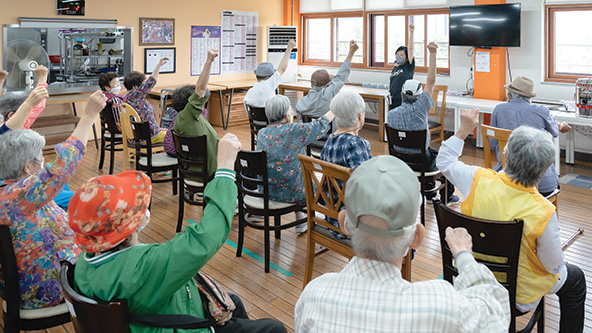 Elderly people participate in a service program provided by Dongbu Care, a social enterprise that has participated in SPC since 2015. (Photo courtesy of CSES)
Dongbu Care didn’t stop there. It sought to help grow the impact ecosystem as a whole. In 2018, IBK Financial Group, one of the top five banks in Korea, launched a new social enterprise fund and offered Dongbu Care a 4 percent loan rate. Dongbu Care counterproposed to pay a 7 percent interest rate, on the condition that IBK offer its loans to other social enterprises at a cheaper rate (i.e., a 3 percent loan rate). In addition, Dongbu Care established the OnMomTouch Cooperative to expand its care business model nationwide and share its know-how through its social franchise system. In other words, Dongbu Care not only expanded the scale of social services using SPC incentives, but also helped other social enterprises with cash financing, coupled with institutional support.
Other companies used the funds to recruit and maintain talent, which is important because South Korean social enterprises suffer a relatively high turnover rate. SPC boosted the retention rates of employees by 2.7 times, reported a study by Joon Han, professor of sociology at Yonsei University, and graduate student Dongil Jang. According to CSES’ 2023 survey, 45 percent of 328 responding companies said that receiving SPC cash incentives helped them recruit talent.
Other social enterprises used SPC incentives to invest in R&D. For example, recycling services company SuperBin received about $700,000 in SPC incentives to develop AI-based technology for collecting and sorting recyclable waste, which helped it to attract about $30 million in cumulative investment by 2022.
“R&D was something we needed to do before, but we couldn’t afford it because it took a lot of time and manpower,” says Mi-Kyun Kim, CEO of Cizion, a social venture devoted to creating a healthy internet culture through IT-based content curation and social media review. “But with the SPC incentives, we finally got to do it.”
Recognition and rewards | By recognizing and rewarding social enterprises for their contributions to solving social problems, SPC has also helped social enterprises gain public trust and empowered and motivated their staff. According to CSES’ 2023 survey, 82 percent of CEOs of SPC-participating companies said that being selected as an SPC helped improve their company’s image and awareness.
Beyond the recognition at the corporate level, SPC has also helped empower social entrepreneurs and motivate the employees of participating social enterprises. “The SPC incentive feels like a kind of award that praises social entrepreneurs for their work,” says Ji-Yeon Jeong, CEO of A Company, a social enterprise that supports young artists with low income by offering jobs, working spaces, events, and learning opportunities. “We reinvested some of the money we received back into the business and gave bonuses to our employees, because they are our assets,” says Soo-Jeong Han, director of Beautiful Coffee, a fair-trade social enterprise that helps coffee farmers in developing countries become self-sufficient.
Building and leveraging impact data and knowledge | Finally, SPC has elevated empirical research on social enterprises by generating data and allowing researchers to analyze it freely, leading to the publication of academic papers and reports on social value.
Before SPC, researchers had little data on social enterprises to analyze, and the field was dominated by normative studies dealing with the justification of government support for social enterprises, according to Sang-Joon Kim, professor of entrepreneurship at Ewha Womans University, in Seoul, South Korea. “However, as various field data have been accumulated with SPC, empirical research on social enterprises through observation, verification, and theorizing has become more active, and it is possible to draw more insightful implications and reliable recommendations based on empirical evidence,” Kim says.
To date, the SPC data released by CSES has been downloaded approximately 12,500 times, and a total of 66 papers have been published using the data. For example, a recent article in Management Science, coauthored by Jae Yong Shin, professor of accounting at Seoul National University, and Sun-Moon Jung, professor of accounting at Dongguk University, found that social enterprises that had received SPC incentives improved their social performance relative to revenue in the following years. The effectiveness of SPC was also found to depend on the combination of organizational culture and the way of using incentives. Specifically, social performance increased when the SPC incentive was paid as employee bonuses in performance-oriented organizations and when used for social reinvestment in value-oriented organizations.
A Big Dream and Three Challenges
SPC has made significant contributions to South Korea’s impact ecosystem. But its ultimate goal was to institutionalize a social-value-based reward system and develop a sustainable impact ecosystem that goes beyond the approach of supporting or investing in individual companies based on their social performance. SPC’s vision was nothing less than a self-sustaining, market-based mechanism through which impact is priced and traded among investors following market principles. It sought to usher in massive systemic change in South Korea’s economy and society at large.
“By providing reasonable and fair compensation for the social value created through such a mechanism, more companies will be incentivized to create social value, while actively solving social problems and reaping financial benefits at the same time,” says Suk-Kwon Na, president of CSES. “As a result, more capital and talent will flow into the impact ecosystem, which will ultimately increase the capacity of society as a whole to solve social problems.”
If CSES’ vision is realized and social value becomes tradable on markets, social enterprises won’t be the only ones working to solve social problems. For-profit companies might follow suit, and the difference between social enterprises and for-profit companies may even become blurred.
To achieve such a bold dream, several limitations and challenges that the SPC experiment has faced must be overcome. Examining these can be useful for improving not only the existing SPC program, but also future pay-for-success programs in other countries or regions.
SPC’s vision was nothing less than a self-sustaining, market-based mechanism through which impact is priced and traded among investors following market principles. It sought to usher in massive systemic change in South Korea’s economy and society at large.
The paradox of measurement | Because SPC provides incentives based on monetized social performance, a paradox of measurement can arise. Qualitative outcomes, which are harder to observe and measure than quantitative outcomes, may not be fully reflected in the monetized social performance results. Take, for example, disability employment: Objective outcomes such as the number of people with disabilities employed and the wages they receive can be easily measured and monetized. On the other hand, qualitative outcomes, such as raising public awareness of the disabled or the emotional well-being of disabled employees, are unlikely to be fully captured by monetary measures. This dynamic may lead social enterprises seeking SPC incentives to choose projects whose results are easier to measure in quantitative terms, which can lead to distortions in their incentive structure.
Some SPC participants showed a tendency to focus on increasing quantitative employment outcomes (e.g., increasing the number of jobs for those less privileged), which are easier to measure and be rewarded. With limited resources and budget constraints, social enterprises may pay less attention to the qualitative aspects of employment (e.g., their job satisfaction and personal growth). While social performance measurement can be an effective tool for communicating impact and calculating incentives, we must be wary about such quantitative proxies becoming ends in themselves.
Reducing the potential for incentive distortions is critical for SPC to work well, and efforts should be made to improve SPC’s recruitment, measurement, and reward systems to ensure that mission-driven social enterprises remain focused on their original mission. In particular, good measurement systems balance the breadth (the number of beneficiaries), depth (the degree of change experienced by beneficiaries), and length (expected duration of solution to be effective) of social outcomes. Measuring the depth and length dimensions well requires understanding the purpose and context of each social enterprise’s work and tailoring metrics accordingly. This is important not only to attract more support and participation from social enterprises, but also to promote a balanced mix of diverse approaches to social change.
Validity and comparability of monetization results | The monetization approach confronts several methodological limitations. Measuring and rewarding the social performance of social enterprises requires finding appropriate financial proxies. However, this is not an easy task. In many cases, social enterprises operate in an area where market mechanisms have failed or underperformed, and thus, market prices or equivalents do not exist at all or are severely distorted by governments or public institutions subsidizing products and services. And even if market prices do exist, they tend to be undervalued, because public or for-profit enterprises are often subsidized by the government to provide products and services below costs. What’s more, positive or negative externalities may not be fully reflected in market prices.
These factors call into question the validity of monetized social performance. “Because we focused on creating a measurement system quickly in the early stage of the program, we did basic work mainly with management scholars and business consultants, and spent most of our time coordinating with key stakeholders such as social entrepreneurs, government officers, and public institutions’ administrators,” says Jun Choi, vice president of SK Hynix and former executive of the SK CSR Committee, who was involved in the initial design of the SPC measurement system. “In the future, it would be good to actively involve more scholars from diverse fields such as economics, accounting, and finance who can think about measurement in a fundamental way.” Building a consensus on social performance measurement based on a theoretically sophisticated foundation, in addition to the experience of SPC operations to date, will help validate monetization.
 CEOs of SPC participating social enterprises hold aloft wooden nameplates while attending the fourth annual SPC Awards in 2019. (Photo courtesy of CSES)
It is also not as straightforward as it seems to compare results measured in monetary terms in different areas of concern. Consider two scenarios: (1) A company employs a disabled person for a year. The social value is assessed at $10,000, based on the difference between the salary the person received and the social security amount she could have received if she didn’t have a job. (2) A company reduces environmental pollution by a certain amount. The social value is assessed at $10,000, based on the price of carbon credits. Should these two scenarios be considered equivalent? This is a critical issue that needs to be resolved in order to improve the compensation system. SPC still operates by having the Secretariat confirm financial proxies and assign monetary value to social performance by considering various factors. However, if social performance can be valued efficiently by market mechanisms, then the problem of deriving appropriate weights and comparability might be resolved.
Barriers to entry for early-stage social enterprises | Early-stage social enterprises face barriers to participation. Since the SPC incentives are paid in proportion to the social performance achieved in the previous year, enterprises must have already achieved a certain level of social performance in order to receive the incentives. Therefore, early-stage social enterprises that have high potential but have not yet achieved much may find it difficult to receive SPC incentives. On the other hand, high-performing social enterprises are more likely to have already secured funding through impact investments or grants from various sources, so they may have less incentive to participate in SPC.
Who, then, should be rewarded through SPC and why? For whom should SPC be designed and institutionalized? While performance-based compensation schemes provide clear benefits, they can suffer a “rich get richer” effect if they do not include a coordinated effort to identify and support promising, early-stage social enterprises. Young enterprises may need encouragement from incentive structures that reward the achievement of predefined level of social performance or other institutional complementarities, such as linking promising social enterprises identified through SPC with angel investments from other organizations.
Incentivizing social performance won’t solve all social problems. For some social problems, input-level monetary support programs may be more effective than performance-based incentives. In addition, monetization-based incentives may cause some companies to focus too much on social problems that are relatively easy to achieve certain performance to be rewarded through SPC, regardless of their original mission. Or the monetization process may result in too many resources being devoted to areas where the financial proxy for solving a particular problem is relatively large, leading to outsize incentives from SPC.
“If the rules of measurement and incentives are poorly designed or insufficient, various side effects can occur,” says the godfather of SPC, SK Group Chairman and CEO Tae-Won Chey. “However, if we spend too much time trying to design a near-perfect mechanism that has no side effects, we may find that the social problem has already become very serious, and it may be too late to intervene to solve it. I think it is more important to accumulate data and gain insights through innovative trials than to be overly afraid of potential side effects. I think SPC is an experiment rather than a near-perfect system, and I hope we can work together to improve our society’s problem-solving capabilities based on the lessons, limitations, and implications of the past 10 years.”
Next Steps
In January 2024, the Rise Ahead Pledge was announced at the World Economic Forum. “Rise,” which stands for “Rallying Private Sector Investments into the Social Economy,” is a commitment to launch new initiatives and strengthen existing programs by 2030 to help achieve the United Nations’ Sustainable Development Goals (SDGs) and address social challenges. The first group of signatories consists of 13 global companies and corporate foundations, including Microsoft, SAP, and IKEA, and in Asia, South Korea’s SK Group and its research institute, CSES. While social innovation has traditionally been implemented by nonprofits, governments, and international organizations, the pledge aims to encourage the private sector to take a more active role in solving social problems.
Who should be rewarded through SPC? While performance-based compensation schemes provide clear benefits, they can suffer a “rich get richer” effect if they do not include a coordinated effort to identify and support promising, early-stage social enterprises.
Here, SK Group and its SPC experiment have led the way, by boosting the social sector and increasing social enterprises’ acceptance of performance measurement. The effort has also fostered the social enterprise ecosystem’s willingness and ability to evaluate, think, and communicate based on performance. In the process, some social enterprises have been motivated to innovate and improve their business strategies and performance through measurement and evaluation.
These transformations are particularly important in the South Korean context, where social enterprises are somewhat dependent on the government. With the experience and knowledge gained through SPC, social enterprises are able to cooperate well with the government, investors, and support organizations on the basis of their actual performance, not just their good intentions and purpose.
The SPC experience and data it has accumulated can provide an important springboard for collaboratively solving complex and intractable social problems by facilitating shared measurement, which is a critical component of collective-impact efforts. Sharing the knowledge gained through SPC data analysis can help cultivate a stronger community to create meaningful collective impact for large-scale systems change.
However, the lack of participation in SPC by other funders has been disappointing. SPC has so far been based on an entrepreneurial experiment by a single conglomerate, SK Group. For the project to become an institutionalized and self-sustaining system, more funders need to be interested and involved.
In recent years, CSES has engaged in various collaborative projects as part of these efforts. It has signed agreements with six local governments in South Korea, including the city of Seoul, to collaborate on a social performance-based compensation system, and it has also launched the first performance-based support program for social enterprises in Japan in collaboration with the Japan Fundraising Association. In addition, based on the experience of previous collaborative projects, it plans to establish a learning network with global leaders in social innovation on the topic of outcome-based financing with the Global Alliance for Social Entrepreneurship of the Schwab Foundation of the World Economic Forum.
Can SPC’s dream of “designing a system through which companies are financially rewarded so that they work harder to solve social problems while making money” be realized? So far, SPC has been an experiment in measuring and rewarding social performance for social enterprises, but the future they envision is a market-based mechanism where social progress is rewarded with tradable credits in the market. If such a mechanism were created and operated seamlessly, it would encourage not only social enterprises but also for-profit companies to become more actively involved in social innovation by leveraging their ample resources and problem-solving capabilities.
“Companies today have a lot of human and financial capital,” Tae-Won Chey says. “If companies can utilize their resources as members of society, and their contributions to society can be properly measured and reflected in their financial statements, resulting in higher firm value, we may see a day when many more companies will compete in good faith to increase their contributions to society.”
Read more stories by Hyun Shin, Gayoung Imm, Myung Eun Jeong, Hyun-Joong Kim & Haeun Kim.