


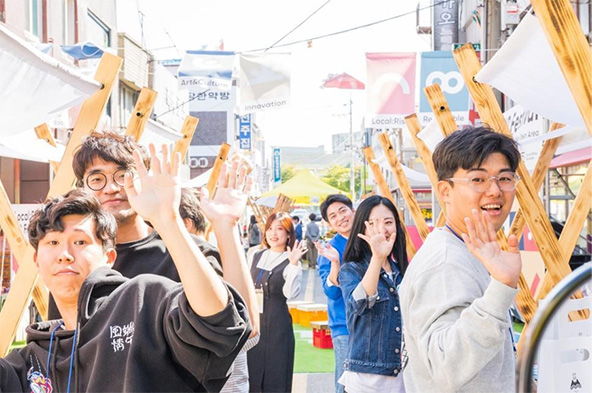
 Young entrepreneurs in front of their booths at Localize Festival 2019. (Photo courtesy of Underdogs)
In the morning hours, when the streets of most cities are at their busiest, Gunsan is quiet. Cars appear only intermittently on the roads, and empty shops with fading signs outnumber the ones that are still open. Restaurants have ample seating even at lunchtime, and vacant houses are becoming more common along the side streets. The massive cranes and port facilities lining the harbor serve mainly as reminders of the city’s past rather than as working infrastructure.
In a city that has lost its sense of motion, speaking about possibility is no easy task. But in 2019, a Korean organization specializing in entrepreneurship education, Underdogs, saw an opportunity to restore Gunsan’s vitality. The idea was to first create an environment where young entrepreneurs could identify local social challenges through their own distinct lenses, and then work to materialize business ideas aimed at solving those problems. Underdogs theorized that this would generate countless experiments, narratives of success and failure, and new relationships and networks—and that the dynamic energy produced through entrepreneurial activity would reanimate the city.
The organization’s Localize Gunsan initiative proved out this theory. In just three years, 17,774 people visited its centralized community and co-working space. Entrepreneurs and local groups worked together to develop a total of 502 Gunsan-related services, and 26 teams opened stores and spaces by activating underused properties.
The mission and structure of these efforts varied widely. One young entrepreneur created Gunsan Sumgim, a seaweed brand, after seeing his father’s locally grown seaweed distributed under other regions’ specialty labels. The Gunsan Bam Cooperative, which launched in response to the lack of cultural life for young people in areas that become even emptier at night, opened a food zone in the center of Gunsan’s tourist district and organized events like World Cup watch parties and outdoor concerts. And Hammer Design, founded by a third-generation carpenter who felt a deep concern over historic buildings falling into abandonment, transformed vacant structures into spaces for Localize Gunsan startup teams.
These and other projects succeeded in infusing Gunsan with new economic and social energy. But developing an effective entrepreneurial ecosystem and finding ways to actively counter community-level and psychological inertia were essential to bringing them to life. Localize Gunsan highlights the power of multi-layered, longer-term support for entrepreneurs, and offers both inspiration and lessons for funders, entrepreneurs, and communities looking to revitalize declining cities.
From Industrial Powerhouse to Structural Decline
Gunsan is a port city located on the west coast of the Korean Peninsula. With the push for heavy and chemical industrialization in the 1970s and 1980s, Korean businesses established large-scale facilities—including the Hyundai Heavy Industries shipyard and Korea GM—in different areas of the city, generating stable jobs in the shipbuilding, automobile, and machinery industries. At its peak, Gunsan’s production output reached 12 trillion won (about $8.9 billion), accounting for 43 percent of total exports from Jeollabuk-do, a province in southwestern Korea. However, in 2018, the withdrawal of two major factories marked the end of Gunsan’s prosperity. Employees and tens of thousands of residents who were connected to local supply chains lost their jobs. Many left the area in search of new jobs, weakening the local economic, educational, and cultural ecosystems.
Other regions of Korea have experienced similar decline due to deindustrialization. Cities that prioritized manufacturing during this era unified around major firms, leaving them with little capacity to diversify and absorb the risk of corporate withdrawal. Today, as a result of lower birthrates, an aging population, and a continued concentration of people in the Seoul metropolitan area, 27 percent of Korea’s regions face 소멸위험지역’, or “the crisis of local extinction,” meaning their ability to function as self-sustaining communities is at risk. Local governments have tried to attract young people through subsidies and an array of policy measures, but these efforts have rarely translated into sustained settlement.
Building an Entrepreneurial Ecosystem
Rather than saying, ‘I’m going to change Gunsan,’” says Underdogs CEO Sangrae Cho, “many people came [to the initiative] saying, ‘I want to try something fun—something different.’” Sangrae explains that applicants for Localize Gunsan were motivated less by “overcoming regional crisis” and more by “trying to reshape their own lives.” For young people exploring possibility, moving to a new city or region can open up space for experimentation. But for them to perceive it as a place of opportunity, the resources and supports that allow for experimentation must come with it.
Founded in 2015, Underdogs has supported the creation of social enterprises and social ventures across a range of social issues. Since its establishment, Underdogs has backed the growth of numerous organizations through incubating and accelerating programs focused on youth and social innovation, as well as region-based entrepreneurship projects developed in collaboration with public and private partners. In particular, it has continually developed and refined practice-centered entrepreneurship education methodologies—moving beyond theory-based instruction—in response to rapidly changing social problems and operating environments.
Underdogs judged that entrepreneurs could reframe the many challenges Gunsan faced as diverse opportunities to test and expand new ideas. It also expected that in a city where youth outmigration was accelerating, young entrepreneurs would be valuable human assets in their own right—and that attracting them to the area could be a win-win strategy for both the place and the entrepreneurs.
To move the idea forward, Underdogs adopted the role of a pacemaker organization, or pacer. The SSIR article “Pacing Entrepreneurs to Success” describes pacers as entrepreneurial support organizations that provide long-term services to enable companies in emerging markets achieve their goals. Surviving in an existing market is difficult enough; achieving goals while building a new market is even harder. Pacers commit to support lasting from one year to a lifetime, including continuous learning opportunities, access to business networks, peer connections, and customized services tailored to demand.
In the Korean context, Underdogs supports young entrepreneurs who are pioneering the “emerging markets” of deindustrialized cities to achieve regional revitalization. In Gunsan, it aimed to create an ecosystem where entrepreneurs could push beyond local constraints—an environment where the work of funders, entrepreneurs, and community members complemented one another and created conditions in which entrepreneurs could persist.
Underdogs’ collaboration with SK Innovation E&S, one of Korea’s leading conglomerate affiliates, played a major role in ensuring that Localize Gunsan was compelling to young entrepreneurs. As part of its social contribution efforts, the company provided stable investment backed by corporate capital to Localize Gunsan, and offered participants comprehensive and realistic supports, including housing and workspace, business funding, and entrepreneurship education. It also connected entrepreneurs to Social Value Connect, South Korea’s largest platform for sharing and scaling social value, and the SK Happiness Foundation, and supported market access so that businesses could expand beyond the local area to the national level.
Above all, SK Innovation E&S upheld the principles of “support, but do not interfere” and a three-year commitment. This simplified decision-making processes and enabled Underdogs’ distinctive speed and intensity to fully manifest. Rather than demanding immediate results, it encouraged entrepreneurs to set key performance indicators related to sustainable growth. It also supported an annual Localize Festival, a celebration and platform led by Localize Gunsan entrepreneurs in partnership with local small business owners, where entrepreneurs could test ideas in real community settings, build and renew local relationships, and reflect on how their roles in the local ecosystem were evolving. This annual rhythm reinforced entrepreneurs’ sense of ownership and accountability to place, normalized iteration and adjustment over time, and aligned with the program’s longer-term commitment to growth over immediate results—ultimately creating conditions in which entrepreneurial capability could deepen and mature. In these ways, SK Innovation E&S combined private-sector agility with corporate capital and networks to create a field of play where entrepreneurs could build capability and grow.
Meanwhile, Local Friendly, one of the teams of entrepreneurs participating in Localize Gunsan, began connecting entrepreneurs with the local community. Led by Sujin Kim, an entrepreneur with a background as a Young Women's Christian Association activist, Local Friendly hosted convivial shared meals—such as tteokbokki (simmered rice cake) and samgyetang (ginseng chicken soup) parties—and oversaw Do It Together, an urban regeneration-style project in which local youth and entrepreneurs came together to renovate vacant buildings. The team’s nonprofit-activist identity was evident throughout their work—so much so that other entrepreneurs would ask, “Why are you working so hard on something that doesn’t make money?” The hospitality and connections the group cultivated helped Localize Gunsan’s entrepreneurs cohere to a tightly bonded youth community that ran together within the ecosystem and energized one another.
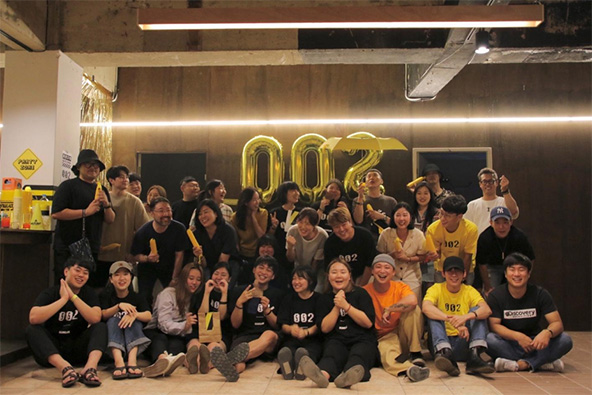 Local Friendly (formerly Ylab Company), Localize Gunsan’s startup team, held an opening ceremony to celebrate the completion of the space. (Photo courtesy of Underdogs)
The contributions of local coach Kwon-neung Cho and Professor Zoo-sun Yoon of Chungnam National University’s Department of Architecture were also important. As a Gunsan-born entrepreneur, Cho played a role in helping entrepreneurs experience the city’s appeal, build closer relationships with the local community, and settle in more securely. He also provided practical advice and support for starting and operating businesses in the region, helping entrepreneurs reduce trial and error along the way. Meanwhile, Professor Yoon introduced domestic and international cases to Underdogs and the entrepreneurs, and interpreted the distinctive characteristics and significance of Localize Gunsan in theoretical terms, strengthening confidence in the project’s overall direction.
Finally, the Gunsan city government provided support so that Localize Gunsan’s entrepreneurs could go the extra mile. Entrepreneurs who registered as Gunsan residents became eligible for city-operated programs such as the Startup Hope Nurturing Project, which provided subsidies to young entrepreneurs, and the Youth Stay Program, which offered near-free, one-room studios in which to live. Notably, the design of Youth Stay Program emerged when the city was exploring support options and a young entrepreneur conveyed entrepreneurs’ housing struggles, demonstrating how a public institution can identify needs through youth voices and translate them into policy.
Breaking Through Inertia
This ecosystem of sustained support laid the groundwork for Localize Gunsan. But for entrepreneurs to generate regional innovation in Gunsan, they had to overcome multiple layers of inertia. At the community level, inertia included a declining local economy and stagnant mood, increasing youth outmigration, and wariness toward outsiders. At the individual level, entrepreneurs faced psychological inertia—fear of failure and a desire to maintain stability—as well as cognitive inertia, or overconfidence in existing knowledge and learned patterns of thinking.
To break through these barriers and generate dynamism, Underdogs developed a practice-centered, entrepreneurship education approach called “act-preneurship” that prioritizes four practices: immersion, peer learning, action, and adaptability. Below is a closer look at each of these in action.
1. Design for immersion. Entrepreneurship is creative work, and creation demands immersion and focus. Designing well for it requires both the “hardware” of physical space to initiate immersion and the “software” of relationships— interactions, culture, and emotional bonds—to sustain it.
Before Localize Gunsan formally launched, Underdogs leased a three-story building to serve as a gravitational center that made immersion possible. It designed the first floor to accommodate a café and a space for coaching and education for entrepreneurs, and designated the second floor as a coworking space where entrepreneurs could work at any time day or night. A shared kitchen on the third floor allowed participants to cook and eat together, and the rooftop was well-suited for parties. Underdogs also secured nearby guesthouse lodging so that Localize Gunsan entrepreneurs coming from outside the city had a place to live. This meant that, rather than experiencing work as something separate from life, participants could develop a sense of coherence between what they did and how they lived. Routines, relationships, and ways of thinking could begin to revolve around the work they were engaged in, and in turn, those lived experiences could continuously inform and reshape the work itself. Underdogs CEO Junghun Kim explains: “At first, there were a lot of complaints. But we believed that for an entrepreneurial community to form, above all else, it was essential to spend an absolute amount of time together.”
 Localize Town, Localize Gunsan’s co-working space for young entrepreneurs, continues to be a foundation of the community. (Photo courtesy of Underdogs)
Underdogs also stationed an operator, or community host, at the building to closely observe entrepreneurs and provide tangible and intangible supports, such as connecting them to mentors and procuring relocation funding for participants who needed to move due to space constraints. In the first year, one of the operators, Seul-ki Lee, noticed that working, eating, and sleeping in such close proximity effectively fueled entrepreneurs’ immersion and creativity, but that their stamina and energy declined overall. In response, she organized a club initiative to help participants take mental breaks and regain momentum through rest and play. Lee reflects, “Since we were starting a new life in a new place, I realized we needed to support not only entrepreneurship itself, but also the overall conditions that made it possible to live well in Gunsan.”
2. Build capacity through peer learning. Population decline in deindustrialized cities naturally weakens local talent, information, resources, and networks, and local-government revitalization programs often restrict eligibility to residents. Well-designed peer learning efforts can bring the strength and diversity needed to produce creative and effective local solutions. Building the right environment and structure can increase the frequency of contact and density of relationships, and the right composition of peer groups can improve the depth of learning and the quality of growth.
During the recruitment process, Underdogs created entrepreneurial teams composed of entrepreneurs with projects in different stages of development, with different areas of focus, and from different regions. Teams included new entrepreneurs and existing founders, split into incubating and accelerating tracks. Startup projects ranged from game content for tourists, travel magazines, and video production, to cat-friendly villages, food-truck cooperatives, and community hotels. By region, 11 teams were from Gunsan and 15 were from outside.
These teams shared helpful ideas and feedback formally and informally throughout the program, and their diversity fueled growth. For example, entrepreneurs born and raised in Gunsan engaged with entrepreneurs who had accumulated experiences in the metropolis of Seoul. While the Gunsan-born entrepreneurs lacked the experience and career background of their Seoul counterparts, they connected Seoul-based entrepreneurs with local networks and shared insights only locals would know.
“We saw outcomes because the social mix worked,” Kim says. “Regardless of individual success or failure, peer learning occurred as people watched and learned how others actually made things happen.” An entrepreneur who opened a photo studio through Localize Gunsan recalls: “If the other entrepreneurs hadn’t been there, I don’t think I would have rented a space and opened a studio on my own. As a consumer, I was used to only seeing finished products and services. Watching other teams go through the startup process made me realize, ‘This is how it works. Everyone starts like this. You have to build it piece by piece.’”
Underdogs also encouraged collaboration between teams. It assigned different teams to plan collaborations with others, and grouped together teams facing similar problems. These efforts to actively connect teams in different ways deepened the entrepreneurs’ understanding of one another and of each other’s business ideas, and opened up new possibilities. For example, the design-focused Blue Mustard Studio collaborated with Mangchi Design, an enterprise specializing in remodeling idle spaces, to renovate abandoned houses in the city center. One entrepreneur, who collaborated with another startup team, explains, “Because we knew where and how the other team was running their business, we could pinpoint exactly where synergy with our own business might emerge.”
3. Promoting action, not words. Creating new dynamism in a city that has lost its vitality can give rise to tension and conflict between entrepreneurs and the local community. “When we first came to Gunsan,” recalls Underdogs Partner Daeun Park, “the local community looked at us with suspicion. … And there were major concerns that we might overlap with existing entrepreneurs in the area.” Building trust and ensuring that different community members see each other not as competitors but as partners requires that entrepreneurs actively and continuously connect with residents, merchants, and other entrepreneurs.
To clearly signal from the outset that Localize Gunsan would collaborate rather than compete with local small businesses, for example, Underdogs excluded applicants hoping to enter the food and beverage sector, since most of Gunsan’s existing businesses operated in that space. Instead, it selected Gunsan-based entrepreneurs and teams whose business models could coexist with and benefit the local community. In addition, as part of orientation, entrepreneurs walked around Wolmyeong-dong, the area where the centralized community and co-working space was located, greeting residents and handing out rainbow-colored rice cakes. They also created and shared specific “living rules,” including smiling and greeting residents first, making one Gunsan acquaintance per day, and communicating kindly with neighbors.
Through consistent efforts to expand points of contact, relationships with residents began to change. One entrepreneur describes how actively engaging with community members throughout the entire entrepreneurial process can change mindsets on both sides: “When I talk with local residents, I listen carefully and respond strongly. That attitude helps me even when I work elsewhere. It’s like I’ve become sly—but also more seasoned and flexible. Even the convenience store owner, who’s now a regular in my life, used to say, ‘Why are you here? Just go to Seoul.’ Now, when I stay in Gunsan during holidays, he takes care of me and says, ‘Gunsan is a good place to live.’”
Underdogs’ emphasis on action accelerated the speed of trust-building in the community and, in turn, the development of the entrepreneurs’ work. Rather than sitting in an office polishing proposal language on a laptop, the repeated act of meeting residents, stakeholders, and tourists on the street as an essential part of testing and refining ideas helped entrepreneurs grow and made their businesses more sustainable. Cho Kwonyung, a Gunsan-native entrepreneur, describes Underdogs’ action-first coaching as “brutal.” “They treat you like a friend, but when it’s coaching time, they push hard. When entrepreneurs came up with an idea, they’d say, ‘Go test it in the field,’ ‘Bring people and prove it.’ They’d conduct check-ins with entrepreneurs whether it was dawn or midnight.”
With constant prompting from Underdogs, the 26 teams gained a sense of belonging within the community that became a driving force, transforming their work and relationships in Gunsan from short-term projects into a part of life they wished to continue. Consequently, the community itself became a condition enabling sustainability. The entrepreneurs' continued presence and growth, in turn, created a virtuous cycle that further solidified the community.
4. Respond adaptively in crisis. The most effective strategy for preparing for an uncertain future is not sophisticated forecasting or perfect planning, but the embodied ability to sense change and adapt quickly. Just as K-pop artists endure intense training to build capability before they debut, a high-intensity coaching process strengthens entrepreneurs’ capacity to adapt. And since survival requires evolution, adaptive capacity is an essential competency for getting through crises that will continue to come.
Following its first, 13-week education program, and in line with its action-oriented style, Underdogs launched the Localize Festival—and event where entrepreneurs showcased their projects across the city and received real-time feedback from experts, residents, business partners, and tourists. The festival produced measurable outcomes—sales, visitor counts, media mentions—but it also created an unmeasured one: striking scenes that reversed the extinction anxiety hanging over Gunsan’s empty streets. Throughout the festival, communities inside and outside the region saw Gunsan’s young entrepreneurs as a force for revitalization.
However, the program’s second year brought a variable no one anticipated: the COVID-19 pandemic. For entrepreneurs who had worked largely through offline stores under the banner of revitalization, everything came to a halt. Movement between regions was restricted, and tourist foot traffic disappeared. The Underdogs coaching approach—verify results through execution, then revise and refine—no longer worked.
Shrinking revenue and an unpredictable outlook threatened the sustainability of the entrepreneurs’ new businesses. Yet at the same time, the flexibility and local understanding they had built through continuous, field-based learning proved their value. Some entrepreneurs shifted their business focus toward residents. For example, Wolmyeong Studio, which had taken concept photos for tourists, learned that Gunsan residents traveled to cities such as Jeonju, roughly 30 miles away, to take ID photos. In response, it began offering ID-photo services for local residents. Underdogs meanwhile converted the Localize Festival to an online format, showcasing projects in new ways. For example, the team selling Gunsan’s specialty seaweed shipped seaweed to people participating in the Localize Gunsan Festival online in advance and taught them how to grill it via live broadcast.
Underdogs also collaborated with entrepreneurs in Gunsan, Gangneung, and Jeju to introduce their local brands to residents in Seoul. And to help entrepreneurs persist through the crisis, Underdogs commissioned them to produce promotional programs—magazines, tours, and workshops—that publicized the Localize Gunsan project.
Sustaining Change
By establishing itself as a pacemaker organization and adopting these four practices, Underdogs succeeded in infusing the region with energy and innovation through Localize Gunsan. All 26 startup teams incubated and accelerated through Localize Gunsan completed the program.
In 2022, the formal education program of Localize Gunsan—which had supported and nurtured young entrepreneurs in the city for three years—came to an end. The intensive support and structured training of its early phase are no longer in place, but the relationships formed and the choices made through the project continue to shape the future.
“I decided to stay in Gunsan,” says Lee. “I’m renting the building we used during Localize Gunsan and trying to make something work there. I guess that makes me an entrepreneur now. Living in Gunsan, rather than Seoul, just feels a bit more interesting and enjoyable—and I wanted to keep going here.”
The inertia surrounding regional decline remains complex and deeply entrenched. Localize Gunsan proved effective in generating concentrated change over a short period of time through an act-preneurship strategy centered on external resources and a community of young entrepreneurs. Yet sustaining this momentum requires an integrated and organic support ecosystem that can be maintained over time. While the fact that a community of entrepreneurs—who have internalized a culture of action—has chosen to remain in Gunsan and continue experimenting is a significant outcome, it also leaves important questions unanswered.
What do entrepreneurs need to sustain their projects? How might the role of pacemaker organizations evolve? And how can cities build and continuously support a balanced support ecosystem rooted in local human resources, including residents, community groups, educational institutions, local businesses, and civil society organizations? Cities and regions like Gunsan now need to find ways to not simply maintain their speed of recovery, but to set a new pace for expanding local vitality.
A version of this story was originally published by SSIR Korea.
Read more stories by Jihye Ahn, Dion Park & Hongrae Jung.