


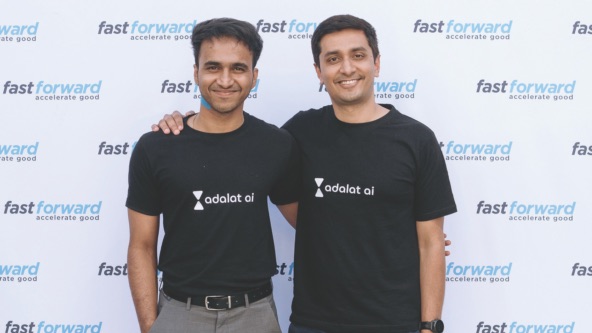
 Adalat AI cofounders Arghya Bhattacharya (left) and Utkarsh Saxena at Fast Forward’s demo day in May 2024. (Photo courtesy of Adalat AI)
India’s judicial system is tremendously overburdened. More than 50 million cases are pending in courts today, with each case potentially taking more than a decade to resolve. A 2023 study on India’s Supreme Court calculated that the average time for a case to go through the system is 13.5 years.
Utkarsh Saxena first encountered India’s frustratingly slow legal system upon practicing law after graduating from Harvard Law School in 2014. As an idealistic young lawyer, he found himself spending more time in court-record rooms digging for documents than preparing for cross-examinations. “That’s when I realized the problem wasn’t just at the front end of the legal system,” he says. “A systemic structural solution is required to help courts build state capacity.”
Believing that technology could facilitate court proceedings and processes, he launched Adalat AI (Court AI), a legal tech nonprofit designed to address social injustices caused by judicial delays, in January 2024.
Though the problem is multifaceted, Saxena pinpointed that the shortage of skilled stenographers significantly impeded the pace of court proceedings. In rural areas that lack stenographers, court judges are even tasked with the job. From this observation, Saxena had the idea for an AI tool that functioned as a voice-transcription assistant designed to handle Indian accents, dialects, languages, and legal jargon to assist court judges and stenographers. Saxena initially built the software—also called Adalat AI—as a speech-to-text solution in the summer of 2023. But after gathering judges’ feedback during a pilot in the state of Karnataka in January 2024, he determined that the software needed to become an “end-to-end tool kit” that integrated every aspect of the courtroom-workflow process. He hired tech engineer Arghya Bhattacharya as both cofounder and chief technology officer to redevelop the software last spring.
“We wanted to create a user experience tailored to the Indian judicial system, where technology adoption rates can vary widely,” Bhattacharya explains. “For example, many courtroom leaders are older and less comfortable with new tech. Or one state may want an advanced product that wouldn’t work in another region. A lot of our work involves talking to stakeholders and finding a common ground that works for everyone.” The software contains high-quality security with full encryption, addressing a major concern for the judges who tested the product to assess the confidentiality of court proceedings. It also comes with user-level encryptions to allow other court staff members to log in to the dashboard with their own unique security key.
In a courtroom, Adalat AI’s tech comes to life the moment the day’s proceedings begin. Once a judge logs in to the dashboard with their unique ID, they use a case-flow management system to track every case and transcribe oral arguments, daily orders, evidence, and final judgments. “Everything spoken into the microphones is transcribed in real time, appearing on the screen as official court records,” Saxena says. “What used to take 5 to 10 minutes now happens in seconds.”
Adalat AI’s principal financial supporters are MIT Solve, Mulago Rainer Arnhold Fellowship, Echoing Green, Fast Forward, and The/Nudge Institute, with additional funding from foundations, accelerators, and law firms. As a nonprofit organization, Adalat AI runs at an operating cost of $238,508 to $357,762 (Rs 2 to 3 crore) per year and offers its software free to Indian courts.
Judges have expressed interest in using the product outside the courtroom as well, such as in arbitration. Among its many advantages, it requires little training, is easy to install and operate, and can be used remotely. “A major choke point is the time it takes to deliver a court order or judgment,” says Gautam Patel, a former justice at the High Court of Bombay. “Adalat AI is a significant breakthrough to address the bottleneck in the judicial system—minimizing delay and maximizing accuracy.”
Currently, Adalat AI is employed in eight states. An app is also in development, which would enable judges to use their mobile phone for dictation. Adalat AI expanded to Ghana last November, and the nonprofit has launched pilots in other countries that face similar judicial challenges, such as Nigeria, Kenya, and Bangladesh.
Read more stories by Neha Bhatt.