


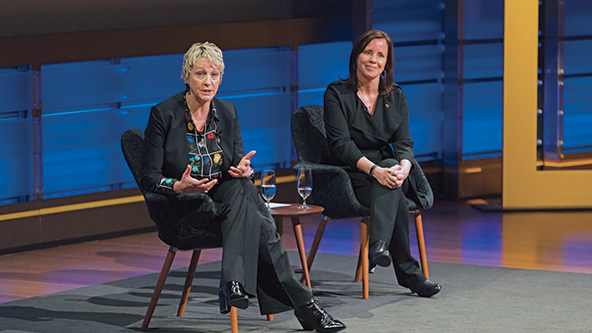
 National Geographic Society CEO Jill Tiefenthaler (left) and Chair of the Board of Trustees Jean Case share the stage. (Photo by Mark Thiessen)
In April 2014, Susan Goldberg became the first female editor in chief in the history of National Geographic, a magazine that has published continuously since its launch in the late 19th century to become the gold standard for journalism that marries scientific curiosity and human interest.
Exactly four years later, Goldberg marked a second break with the magazine’s long history. In the magazine’s April 2018 issue, “Black and White,” she publicly acknowledged the publication’s legacy of racism in terms of how it depicted people of color—both within the United States and abroad. Whether through the choice of subjects, the selection of photography, or story assignments, the magazine reproduced a racial hierarchy: Year after year, white people were at the top, with brown and black people relegated to the bottom tier.
“Until the 1970s National Geographic all but ignored people of color who lived in the United States, rarely acknowledging them beyond laborers or domestic workers,” Goldberg wrote in her editor’s letter that accompanied the issue. Two fraternal twin sisters, one white and one black, graced the cover. “Meanwhile it pictured ‘natives’ elsewhere as exotics, famously and frequently unclothed, happy hunters, noble savages—every type of cliché.”
These two events marked a stark departure from its origin 130 years prior, when, on a freezing cold January night in 1888, a group of 33 white men gathered together in Washington, DC, to jointly explore, understand, and master the globe as leaders of an expansive nation. Though the men came from disparate professional backgrounds—academics, business leaders, cartographers, geographers, government officials, inventors—and different generations, from 20- to 60-somethings, they shared a passion for nature, science, and exploration. Before adjourning for the evening, their pocket watches tucked inside their vests and waistcoats, the nearly three dozen men became founders. They banded together to form not only a new organization, but one that would outlast them: the National Geographic Society.
The group’s mission—“to illuminate and protect the wonder of our world”—persists, though the form has continued to shapeshift and evolve, whether through its printed magazine, its cable TV channel, or its nearly 190 million Instagram followers (and counting). While the National Geographic of today is synonymous with striking imagery, it certainly didn’t start out that way. When Gilbert H. Grosvenor, one of the early editors and a pioneer of photojournalism, decided to include 74 wildlife photographs by naturalist and US Rep. George Shiras, one board member resigned in protest, believing that their inclusion cheapened the magazine. Nevertheless, he persisted, believing that the Society should dare to cover “the world and all that is in it.”
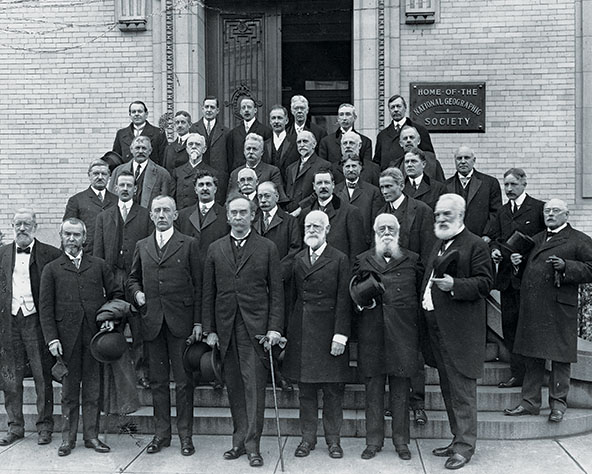 In 1913, members of the National Geographic Society, including editor Gilbert Grosvenor (circled), gather for a dinner event. (Photo courtesy of the National Geographic Society)
Grosvenor’s preference for the increased use of photography (a partiality he shared with Alexander Graham Bell, the Society’s second president) to accompany the magazine’s fact-based storytelling shaped its editorial direction in the years and decades to come, reaching its culmination with its lucrative for-profit media partnership with Disney. But ending up in such an enviable position, financial and otherwise, wasn’t always a sure bet. The organization, like the flora and fauna it covers, has adapted to its changing environment. While the essential mission of the nonprofit organization has stayed firmly intact, the National Geographic Society has experienced its fair share of growing pains—pivoting at critical junctures to become the enduring and thriving global institution that it is today.
As evidenced by its recent reckoning around not only its coverage of race and gender but also its struggle to make the internal workings of the organization more closely resemble the diversity of the population at large, there’s still plenty of work to be done.
New Leadership
Years before the magazine turned its attention to race, the inner workings of the organization were undergoing a subtle, albeit seismic, shift that went well beyond Goldberg’s historic hiring.
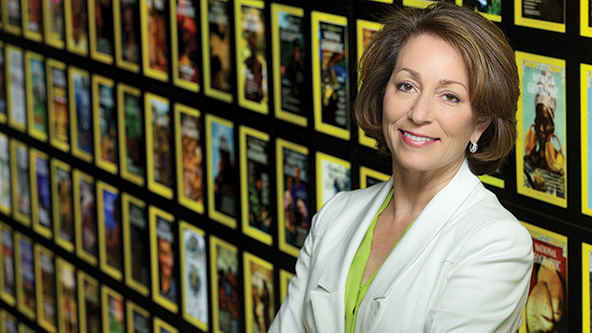 In 2014, Susan Goldberg became the first female editor-in-chief of National Geographic in the magazine’s history. (Photo by Mark Thiessen)
“National Geographic is like many organizations in that they either evolve and change over time, or they die,” says Kaitlin Yarnall, the National Geographic Society’s chief storytelling officer. Yarnall, who began her career at the organization as a cartographer in 2005, now runs a team that focuses on various forms of storytelling, whether through film, journalism, photography, or other mediums.
Sixteen years ago, when Yarnall first joined the staff, she often sat in meetings where she was the only woman in the room. “It honestly barely registered for me because it was so normal,” she says. Slowly, however, things have started to shift. One massive sea change occurred in 2016, when Jean Case became the National Geographic Society’s first female chair of the board of trustees. The 22-member board currently includes 14 men and 8 women, with 36 percent of C-suite executives now Black, Indigenous, and people of color.
“Just as cultures evolve and adapt through time, so has the National Geographic Society in its 133 years,” Case wrote in an internal letter to the Society’s members in February 2021. While the document applauded an array of firsts, it also reminded the community that while the organization had helped shepherd in a new dawn of exploration and innovation, it, like so many institutions, has more work to do to ensure a more “inclusive and equitable future, and to further illuminate the wonder of our world through diverse perspectives.”
Behind the scenes, Case’s leadership had provided a much-needed catalyst for change, particularly in the hiring of Jill Tiefenthaler, who in 2020 became the nonprofit’s first female CEO.
When Tiefenthaler received a call, in fall 2019, from a headhunter about the CEO position opening up at the National Geographic Society, she was 54 and had been the president of Colorado College for nearly a decade. “My immediate thought was that I’m not a scientist or an explorer,” Tiefenthaler says. “I’m just a boring economist.”
Her mind immediately raced back to her childhood in rural northwest Iowa. Inside the one-room schoolhouse was a library, and inside the library were always copies of National Geographic with its iconic yellow border, arresting photographs, and dog-eared, glossy pages. “As a farm girl growing up in Iowa, it was a window to a world,” she says.
After she had spent her entire career in higher education, the eventual job offer also came with a well-timed perk: a compelling opportunity to think about remaking a historic institution with not only a globally recognized brand at its disposal but also bipartisan political backing. Or, as Tiefenthaler puts it: “My conservative Iowa father loves National Geographic as much as my 22-year-old daughter.”
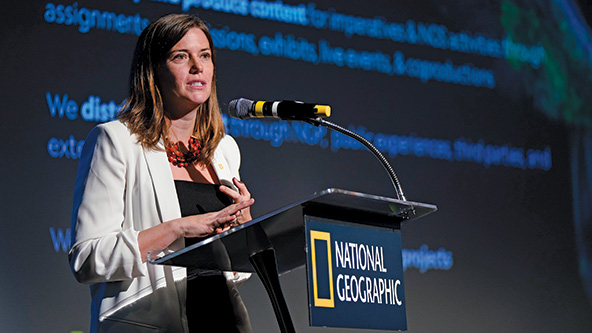 National Geographic Society Chief Storytelling Officer Kaitlin Yarnall speaks at the 2019 Explorers Festival. (Photo by Leigh Vogel)
Though she was initially fearful of leaving her students and what she describes as “the life of the mind” behind, her new colleagues offered a fresh change. The learning curve has reminded her of graduate school. She dove in headfirst, with the audacious goal of creating the nonprofit’s first board-approved strategic plan.
The internal work continued with Shannon P. Bartlett, who recently joined the executive leadership team as the nonprofit’s first-ever chief diversity, equity, and inclusion officer. “I really can say without any hesitation that diversity, equity, and inclusion are key to everything we do,” Yarnall says. “Not only is it a through line in our strategic plan; it’s a leitmotif that runs through everything and that’s baked into everything we want to do going forward.”
Baron Pineda, a professor of anthropology at Oberlin College and specialist in human rights and Indigenous peoples, is encouraged by what he sees. “National Geographic has played an important role despite their faults—particularly in showing readers that there’s a world beyond the United States,” says Pineda, who not only read National Geographic as a child, but whose family still subscribes to the magazine. In recent years, he’s been impressed to see how the magazine has pivoted to cover pressing social issues. Looking ahead, he’ll be curious to see whether the yellow-bordered magazine that arrives in his mailbox every month indeed reflects the changing demographics of its board and staff.
New Business Model
In terms of organizational history, January 2001—and the launch of National Geographic, the cable television channel—was not only a potentially risky moment but a bellwether in terms of where the company would head in the first decades of the 21st century.
The organization had entered the world of television a bit too late, with the Travel Channel, the History Channel, and the Discovery Channel already in existence. For decades, though the Society had funded award-winning documentaries on public television, the more conservative-leaning board didn’t want to lower its standards and enter the cable television space.
“By then, it was very expensive to get in,” says Renee Braden, who oversees the Society’s research library and archival collections. “We should have gotten in while it was still cheap. We were kicking ourselves.”
Flash-forward to November 2015, when the organization marked the beginning of an especially transformative chapter: their partnership with 21st Century Fox, which The Walt Disney Company acquired in 2019. A new joint venture, National Geographic Partners, reorganized what had formerly been the National Geographic Society’s publishing operations and media properties—and consolidated the magazine, television channels, and digital and social media platforms under one streamlined, for-profit roof. (Internally, staffers use NGS and NGP for shorthand.) Disney later proved to be an ideal match, not only sharing the Society’s passion for storytelling, inspiration, and innovation, but possessing an altogether different set of tools with which to navigate the world of business.
“I can’t imagine what we would have been like financially if we didn’t have that partnership,” Yarnall says. Little did they know, as print consumers shifted their attention online, the print revenue model, predicated on a steady stream of advertising dollars, soon imploded. (From 165 subscribers in 1888 and 988 in 1894 to an all-time peak of 11 million in the late 1980s, yearly subscribers now hover around 2 million.)
Disney’s business expertise, global footprint, and direct-to-consumer offerings like Disney+ have helped expand the Society’s impact by reaching a broader, multigenerational audience. Owning a diverse set of media assets has helped, particularly as cable revenue, the National Geographic Channel included, continues to decline.
Ultimately, the joint venture did two strategic things for the National Geographic Society: It allowed their media business to become part of a much larger—and far more scalable—media conglomerate. And most importantly for the folks who work at the nonprofit, it helped shore up their financial future. They not only acquired an expanded endowment (the deal injected $725 million) and a steady revenue stream, but they also became a minority owner of a media company (a 27 percent, 73 percent split) that had, along with deep pockets, the added benefit of unprecedented amplification and reach.
The partnership also had the intended consequence of giving them mission clarity. “We were always a nonprofit with a mandate to run a media company,” Yarnall says. “But now we’re a nonprofit in partnership with a larger media company.” Rather than spending precious time building and maintaining a magazine subscriber base, she and her team are now free to focus on the business of funding and amplifying the voices and issues that the world might not otherwise know about. “It’s been clarifying,” she says. “It’s extremely hard to do both.”
Yarnall’s colleague Braden is a self-described lifer. She’s been with the organization in various capacities since 1987. Every so often, when it came time for her to start thinking about moving on and working somewhere else, her phone would ring and she would be seduced back into staying on staff. “Everyone who works here feels very passionate about the Society,” Braden says. “People feel very connected to it.” In the bookcases behind her are the yellow spines of every single issue of National Geographic from 1888 to the present. Another relic, a banner that reads “National Geographic for the E.R.A.,” hangs nearby.
At times, Braden has compared the joint venture to a big-sister-little-sister relationship. “There’s definitely some sibling rivalry, and we had to get used to how we were going to work together, with different reporting lines and organizational structures,” she says. “On bad days, it’s overly bureaucratic. But on good days, it seems to fire on all cylinders.” So far, Braden is enthusiastic about the organization’s bold leap into the future.
John Wihbey, a professor of journalism at Northeastern University, sees the National Geographic Society as occupying a fairly enviable position, particularly when contrasted with other media nonprofits. He cites the BBC, NPR, and PBS as possible comparisons.
“They have an absolutely gold-plated brand with a high degree of trust,” Wihbey says. He notes that it would be difficult, if not impossible, for advertising dollars to buy the National Geographic Society’s level of visual and name recognition. “They were essentially born on third base because of not only the brand’s power, but its legacy.”
And while some naysayers might consider their partnership with Disney as having sold out, Wihbey views it as a strategic move—both in terms of its bottom line and also in terms of securing its identity as a 501(c)(3) while not sullying the nonprofit brand with the tawdriness of a commercial media company.
“I just hope that the National Geographic Society doesn’t lose their North Star as they feel more corporate pressure,” he says. “If 73 percent of you is owned by Disney, with all of its power and its clout, it will be increasingly difficult to push back when core values are infringed upon or challenged because the corporate bottom line dictates editorial direction.”
New Strategy
As CEO, Tiefenthaler is in the enviable position of not having to worry nearly as much as a traditional nonprofit leader about the constant problem of cash flow. Due to the joint venture between the National Geographic Society and The Walt Disney Company, the former has an endowment of $1.4 billion and an annual operating budget of about $200 million. Still, a branding challenge is that most of the world doesn’t yet know the difference between the .org side of the partnership (which is run by NGS) and the .com slice of the pie (which is run by NGP).
The Society had an endowment of about $250 million at the time of the expanded joint venture, which, as a result of the $725 million deal, grew to nearly $1 billion. Tiefenthaler is now tasked with making the most of the unique and enviable partnership between the nonprofit and for-profit (and the 27 cents of every dollar that go back into the former’s coffer). One of her main tasks is to create a culture of philanthropy and appeal to donors by emphasizing that every philanthropic dollar—100 percent of donations—funds various programs, rather than paying for overhead or salaries. Nevertheless, Tiefenthaler is always on the lookout for new income-generating opportunities: “Nonprofits that don’t have revenue goals can become a little sleepy.”
When Tiefenthaler first joined Colorado College, she began her tenure by embarking on a first-of-its-kind, campus-wide listening tour. Once she started running the National Geographic Society, rather than assuming that, based on prior professional experiences, she knew best, she did a somewhat revolutionary thing for the newly hired CEO: She sat back, listened, and took careful notes. Prior to Tiefenthaler’s arrival, a long lineage of white men not only had occupied her position but a generation ago would have taken their meals in the executive dining room alongside their white male colleagues.
In short order, though the global pandemic would soon disrupt the day-to-day functioning of the nonprofit in ways too numerous to count, it created a newfound silver lining in terms of efficiency once the workday shifted from in person to online. Within six months, Tiefenthaler had met via Zoom with three-quarters of the approximately 400-person staff, plus donors, Explorers, partners, and trustees.
“But strategic planning is easy,” Tiefenthaler cautions. “It’s the implementation that’s the hard part.” In June 2021, the organization released a 68-page strategic plan called NG Next. The public document outlines a “five-year plan that strengthens our foundation, builds on our momentum, embeds diversity, equity, and inclusion into every aspect of our work, and sets a clear vision for the future to drive significant impact.”
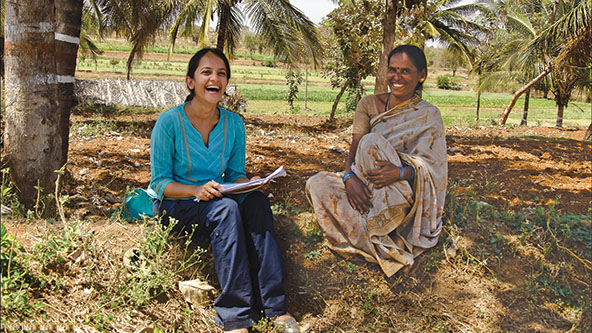 Krithi Karanth (left), a National Geographic Explorer, runs the Centre for Wildlife Studies in Bengaluru, India. (Photo courtesy of the National Geographic Society)
New Explorers
The strategic plan focuses on one of the most important programs that the Society funds, its Explorers. “By 2030, the National Geographic Society will be known globally for its bold and impactful Explorer-led programs that spark curiosity in hundreds of millions of people, inspiring them to learn about, care for, and protect our world,” the plan’s vision statement reads. The Explorers program, like the organization itself, has undergone a transformation to achieve greater equity.
“The most obvious expression of what we do is where we put our money,” Yarnall says. As of 2021, the nonprofit reached gender parity among its Explorers—the scientists, educators, conservationists, and storytellers that the National Geographic Society funds throughout the world. According to Yarnall, non-Americans count for 60 percent of the Explorers, and more than half of the storytellers they fund hail from the Global South.
Krithi Karanth is one such Explorer. Based in Bangalore, India, Karanth is a conservationist scientist and adjunct faculty member at Duke University and India’s National Centre for Biological Sciences. In 2011, when Karanth applied for her first National Geographic Society grant, she expected to be rejected. (Currently, the acceptance rate hovers around 10 percent.) Instead, she received an email saying that they would like to speak with her. The team wanted to know whether she’d be up for the special honor of being their 10,000th grantee. Karanth enthusiastically answered in the affirmative.
“They have an uncanny ability to find extraordinarily innovative and deeply passionate people,” she says. In October, the Society and Karanth marked a decade—10 grants over 10 years—of working together. “They grow with you,” she says.
She recalls that the National Geographic Society had a pretty terrible website back when she applied. It took dozens of clicks before she could even locate the online application form. She had recently moved back to India and walked away from her American life, where she had lived between the ages of 18 and 31. She is now 42. While the United States had given her the best education and training imaginable, she felt that she could do far more in India in terms of impact than if she remained cloistered within the confines of elite universities. (After graduating from the University of Florida, she received a master’s degree in 2003 from Yale and a PhD in 2008 from Duke University.) Ironically, she had lived 20 minutes away by Metro train from the National Geographic campus for years. But it took her moving back home, and halfway around the world, for her to finally connect.
The newly unveiled strategic plan highlights the continued emphasis on its Explorers. (“Grantee” used to be the name that the organization applied to anyone who received a grant.) Since the program’s inception, Explorers now hover around 6,000, with many receiving multiple grants over multiple years. When Karanth first joined the program, she was the only Asian Explorer, as far as she could discern. In the days before the COVID-19 pandemic, she fondly recalled separate Explorers Festivals in Asia, where grantees across the continent not only connected and formed friendships but shared their successes and failures. “The power is in the people that you fund,” she says.
Karanth runs the Centre for Wildlife Studies, an Indian NGO founded in 1984 that focuses on wildlife education, conservation, and research. The program has allowed her to achieve both short-term and long-term goals. Earlier in her career, a one-year grant might have made the most sense, particularly when she was just starting out. But now, a three-to-five-year grant allows for greater impact.
Over the years, her grants have ranged from $10,000 to $150,000. Karanth currently has a large grant to build curriculum and content for 200,000 middle-school-aged children at 3,500 schools, materials that they translate from English into six Indian languages and that cater to both urban students who have access to the internet and to rural children who lack connectivity.
In 2012, she launched a conservation education program, connecting children around the country who live near wildlife parks. She also has worked directly with human-wildlife conflict, helping to resolve an issue where elephants were harming crops or injuring people. Karanth and her team helped develop an early acoustic warning system, based on elephant sounds. When nightfall came and a potentially violent herd lurked nearby, residents were urged to stay in the safety of their homes.
But the arrival of COVID-19 brought an unprecedented set of challenges. When we spoke in August 2021, schools throughout the country were still shuttered, with estimates of 250 million children still out of school. The pandemic has required that she pause some of her work as a conservationist and focus, for a time, on more urgent matters. In particular, she worries most for the rural areas, where schools have been closed for nearly two years—and where girls, in particular, may never have the opportunity to return to the classroom.
In September 2020, when the second wave of the pandemic became particularly acute, Karanth helped organize 4,000 vaccinated frontline workers. “While everyone was talking about it in big cities, no one had any idea of what was happening in rural India,” she says. In the absence of government relief, her wildlife NGO shifted to becoming a health-care provider. In rural regions, the country’s health-care infrastructure relies on primary health centers spread out across nearly three dozen regions. They’re often the first stop before seeking treatment at a hospital. But when Karanth and her team discovered that they were woefully unprepared to meet the demand, she promptly shifted her focus and started organizing the delivery of personal protective equipment, thermometers, and hand sanitizer to more than 100 health centers.
New Relief
Karanth was hardly alone in adapting to the challenges of the pandemic.
Since March 2020, when the COVID-19 lockdown forced everyone to work from home and become acquainted with Slack, Yarnall and her 30-person team has struggled to figure out how to support their storytellers. On March 27, 2020, the Society launched an Emergency Fund for Journalists, which supplied microgrants ranging between $1,000 and $8,000. The grants became an essential tool for freelance reporters who couldn’t travel because of COVID-19 but who wanted to tell stories based in their communities.
“Stories can change the world,” says Yarnall, who noted that the National Geographic Society is one of the largest funders of independent storytellers. “On my wish list is that the rest of the world knew that.”
Thousands of applicants soon poured in. All told, the National Geographic Society funded more than 300 projects in 70 countries. One haunting photograph taken by Joshua Irwandi, of a dead body swaddled in layers of plastic wrap and awaiting a body bag inside an Indonesian hospital, not only went viral but was a 2021 finalist for the Pulitzer Prize.
The only catch for the participating journalist is that National Geographic has the right of first refusal. If they pass, the journalist is then free to take his or her content (whether a photograph, radio piece, or newspaper or magazine story) elsewhere. In return, all they ask for is a one-line credit: “Made possible with funds from the National Geographic Society.” Ultimately, some of the COVID-funded coverage appeared in The Washington Post, The New Yorker, and Rolling Stone, among other venues.
New Workplace
In normal, nonpandemic times, Society staff work at the National Geographic headquarters, which sits on a nearly 900,000-square-foot campus only a few blocks north of the White House, spread across three buildings that house NGS, NGP, and the National Geographic Museum. Its grandeur and location mark its historical significance.
But many new hires have yet to set foot on its grounds, due to the persistence of the COVID-19 pandemic. “The Delta variant has been like a gut punch,” Tiefenthaler says. When we spoke in August, the DC-based staff had planned to return to the office shortly after Labor Day. But those plans (including a two-day in-person staffwide retreat) were put on hold.
Leading a nonprofit during a pandemic has taught the new CEO the importance of two essential things: space and grace. “I’ve never lived through a time when people needed more empathy, more support, more compassion,” she says.
In the hope of retaining talent—and women employees in particular (it’s been estimated that more than two million American women left the workforce during the pandemic)—Tiefenthaler has instituted several changes to the structure and order of the virtual workday. Zoom meetings aren’t scheduled before 9 a.m. or after 4 p.m., with the hours between 11 a.m. and 1 p.m. designated as a no-meeting time. And while the staff currently plans to return to the office in January 2022, the workweek at the nonprofit will likely look quite a bit different in the months and years to come.
Workers in the 21st century crave flexibility and freedom. Gone, it seems, are the days when employees sat tethered to their cubicles for eight solid hours at a stretch. Looking ahead, Tiefenthaler envisions a work culture where employees might spend three consecutive days a week in the office, with two days spent working remotely—and Fridays devoid of meetings altogether. The organization also plans to offer its workers total flexibility in terms of when and where they work during the months of July and August.
An innovative workplace celebrates experimentation and encourages resilience. According to Tiefenthaler, one of the biggest pandemic takeaways has been that employees don’t need their bosses hovering over them, micromanaging their every move. And while community-building exercises and spontaneous brainstorming conversations (to say nothing of mentoring new colleagues) can be more challenging in the absence of real-time, in-person interactions, Zoom has proven to be a great equalizer: No one sits at the head of the table, and everyone occupies the same amount of space.
Last summer, during the half-dozen conversations I had with various staff members, one theme became resoundingly clear. While the National Geographic Society was known for pushing boundaries on the exploratory side of things (think: funding Explorers who scaled Mounts Everest and Kilimanjaro), the work climate was remarkably conservative. It turned out that the Washingtonian institution had a deeply ingrained paternalistic culture.
“There was a general lack of risk-taking,” Tiefenthaler observes. Employees often looked to the C-suite executives for answers rather than first problem-solving among themselves. Besides a general aversion to risk, many employees expressed a fear of somehow damaging the iconic brand. “In terms of moving forward, our brand is both our greatest asset and also our greatest barrier,” she says.
“Over the years, if you look back at various issues, you’ll see that at some points it’s ahead of American public opinion, sometimes it’s in lockstep, and sometimes it’s behind,” says Renee Braden. “The Society goes through periods of evolution and revolution in cycles.”
The Next Century
When looking to the future of the organization, the staff was unusually reflective.
As an economist, Tiefenthaler spends a good chunk of her time thinking a lot about not only their business model, but the Society’s legacy. “When I’m gone, I want people to see that we’ve set the Society up for another 133 years in a good financial position,” she says. “My hope is that by 2030, people know us not only for the magazine of their youth and our social media posts, but for helping to fund our Explorers—or trying to become Explorers themselves.”
When Braden looks to the coming years, she feels optimistic. “We’re being led by two women for the first time in our history, with the magazine led by Susan Goldberg,” she says. “Throughout the Society’s history, women have not only opened doors, but kicked the doors off their hinges.”
While the nonprofit invests a great deal of time and money in the education space, Braden’s personal mission is to work on helping children foster a lifelong love of learning. As work from home continues, Braden not only misses the National Geographic Society’s vibrant work culture but is counting down the days until she can again walk past a hallway full of screaming kids: “There’s nothing better than a field trip.”
Transporting herself back 133 years, Kaitlin Yarnall likes to think that the founders, while “narratively convenient to portray as old white men,” were actually the innovators and entrepreneurs of their time. Henry Mitchell, one of the cofounders, in addition to being an oceanographer and hydrographer, was also an early supporter of the suffragette movement.
“The founders would be damn proud of us,” she says. “One, we still exist. Two, we own the building. And third, we didn’t sell out.”
Read more stories by Amanda M. Fairbanks.