


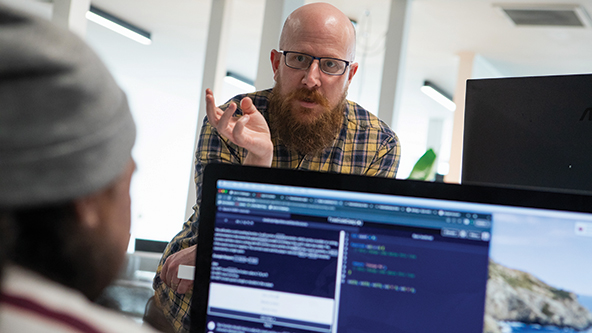
 Take2’s former learning facilitator Dylan Wiggill talks with a Take2 student. (Photo courtesy of Take2)
New Zealand’s prisoner rehabilitation system is broken. The country’s incarceration rate of 173 people per 100,000 is higher than in many other high-income economies. For example, neighboring Australia is at 158 per 100,000, and Norway, which has a population size comparable to New Zealand’s, is at 52. Recidivism rates are also high: Nearly 57 percent of those released from prison are reconvicted within two years, and 36 percent are reincarcerated two years after their release. Research shows that employment reduces recidivism, but formerly incarcerated people experience significant barriers to employment, including the requirement to report any criminal conviction on their job applications, which automatically disqualifies their candidacy for employment.
Cameron Smith witnessed the difficulty of placing formerly incarcerated people into jobs when he worked as a recruitment consultant at the firm Michael Page in Auckland, New Zealand, in 2013. “They’re looking to get their life back on track, but whether their mistake was a month ago, a year ago, or 10 years ago, we as a society put a lot of barriers in front of them,” he says.
When Smith took a managing position at an Auckland-based impact-investment firm a few years later, he noticed that there were myriad job opportunities in the tech sector but a talent shortage and lack of diversity. From this observation, he wondered if he could bridge those gaps with a talent pool of people hoping for a second chance at life.
This query inspired Smith’s founding of Take2 in 2019. A social enterprise, Take2 offers people in prisons a 9- to 12-month training program where they learn web development skills and social skills such as teamwork and communication. Take2 has partnered with New Zealand’s leading tech companies like RUSH and Datacom to facilitate program graduates’ employment upon their release. Partnerships are a strategic decision, Smith explains, because they add credibility to the program. “There’s also a lot of structure, training, and support in place with a larger organization, which is an ideal landing spot for our graduates coming into the workforce,” he says. The partnerships are mutually beneficial because partners hire Take2’s graduates to fill their shortage of tech talent, which boost their diversity and inclusion efforts, as more than half of those incarcerated in New Zealand are Māori or Pacific Islander.
Training and Thriving
Take2’s program involves two phases: The job training program during incarceration is followed by two years of support upon a graduate’s release and reentry into society. Training consists of lessons in coding and other web development technologies in addition to technical workshops and motivational talks from employment partners.
“Bringing the employment partners into the prison classroom and [students] hearing ‘We appreciate where you’ve come from and you’ve made a mistake, but that won’t hold you back from having a career at our organization or the tech sector’ is really powerful for the students,” Smith explains.
Another essential part of the program is the life-skills curriculum. Dylan Wiggill, a former Take2 learning facilitator who codesigned the course, developed an approach that teaches students about self-regulation techniques such as mindfulness and meditation, as well as team-based skills—including collaboration, resilience, and adopting a growth mindset—to help them navigate the workplace.
“It’s inspiring to walk into a prison environment each day and see a group of men that are so focused on trying to achieve these great outcomes for themselves—so much so that back in their residence, they’re running study groups together outside of class hours,” Wiggill says. “It makes my life feel like it has a greater purpose.”
Take2 will prevent reincarceration in New Zealand and chart a new course toward a better rehabilitation system.
Take2’s yearlong pilot began in October 2020 at the Auckland South Corrections Facility with 10 participants, 3 of whom were hired by Take2’s partner companies upon their release. One of the graduates, who asked to remain anonymous, now works as a quality-assurance tester at Datacom. “The things I learned in the Take2 program help me in many different parts of my life,” he says. “They make me better at handling different situations and achieving success in both personal and professional areas. The communication skills I learnt during my time with Take2 have helped me form and build positive relationships within my workplace.”
Take2 was launched with Smith’s personal savings and is now entirely funded by philanthropic organizations, including the Spark Foundation, the Simplicity Foundation, and the J. R. McKenzie Trust. Employment partners have also donated laptops and resources for the design and implementation of the program’s IT infrastructure in the prison classroom.
“We have a long-running mantra of bringing in people new to IT that wouldn’t necessarily be in IT,” says Karl Wright, chief information officer at Datacom, one of Take2’s employment partners. “But we’re not doing this because it looks good on our diversity and inclusion report. You have to get serious about actually helping and changing lives. You have to do this because you fundamentally believe that people deserve a second chance.”
 Take2 staff and students pose for a photo after the successful completion of their Demo Day. (Photo courtesy of Take2)
Students who finish the program are offered support reintegrating into society upon release, from assistance with securing government-issued IDs and setting up bank accounts to providing them laptops, phones, and internet access, to career mentorship and personal counseling.
Take2 offers “important support, programs to help change behavior, and chances to learn new skills,” says the Take2 graduate and Datacom employee. “This not only helps them fit back into society well and decreases the chances of them committing more crimes, but it also improves their chances of finding stable employment and leading productive lives.”
Take2 is a 13-person organization consisting of a board of directors, which includes Smith; an advisory board; and five full-time staff. One of Take2’s graduates is now part of its advisory board, which informs the program’s design and suggests improvements. The graduates are also giving back to society. Building on the coding skills they learned in the program, two of Take2’s graduates created Ngā Mihi, an online platform where family members and others can buy preapproved essentials like socks and underwear for people in prisons.
New Pathways
Launching Take2 was difficult, Smith says, because each stakeholder—the funders, employment partners, and a prison—was reluctant to get involved without stakeholder consensus. It took Smith time to build trust and relationships with them. Persuading tech companies, for instance, to hire Take2 graduates was challenging because of the stigma that formerly incarcerated people suffer due to their criminal record. Smith persisted in his effort to dispel this bias, eventually winning their buy-in by asking them to shift their perceptions, be more open, and give Take2 graduates a chance.
During its pilot program, Take2 discovered a flaw in the training program’s design: Some students were unexpectedly released from prison in the middle of their training and thus were unable to complete the program. And when the COVID-19 pandemic hit in 2020, the social enterprise had to find a way to keep its program running amid government shutdowns, which included limited visitor access to prisons. To address both issues, the team built a community hub in Auckland, with classrooms for those who have been released in the middle of the program or those on home detention, serving community sentences, or out on parole to continue their education and complete the program.
Take2 currently has 25 participants—12 in the community hub and 13 at the Auckland South Corrections Facility—with plans to increase that number by bringing its program to prisons across New Zealand. The team is working with the Department of Corrections on expansion plans, including to women’s prisons.
In 2023, Take2 launched Take2 Elevate, which offers businesses services such as website and web application design and construction and software testing and maintenance. The venture expands Take2’s mission to forge employment pathways for formerly incarcerated people by hiring them as apprentices. The revenue earned is used to cover operating costs for both Take2 and Take2 Elevate and for apprentices’ compensation.
Take2 Elevate has a mixed-staffing model of senior industry professionals coaching and training graduates from the Take2 program as part of their apprenticeships, as well as an augmented-staffing model whereby graduates work as contractors at businesses wary about hiring Take2 graduates as full-time employees.
“It’s an easier offering for some employers who may be on the fence to lean in and take that first step,” Smith says. “If it’s not working out, we can bring our graduates back into Elevate and find a more appropriate fit for them.”
Smith hopes that Take2 will prevent reincarceration in New Zealand and chart a course toward a better rehabilitation system. Just as valuable as this systems change is the real-life impact on the lives of formerly incarcerated people.
“Seeing the people we’ve worked with flourishing in the industry and giving back [is] not something that we put a number on,” he says. “When you’re on that journey with them and you see them succeeding, it’s hard for anything else to match.”
Read more stories by Rina Diane Caballar.