


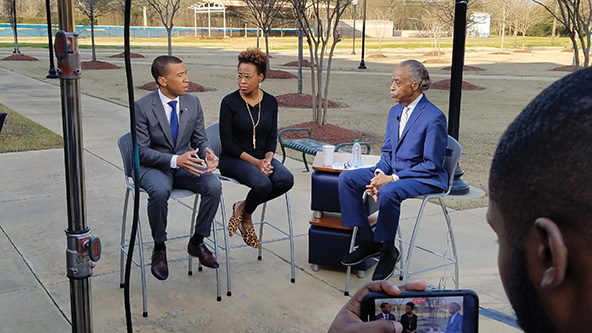
 The 19th’s editor at large, Errin Haines, makes a TV appearance in Selma, Alabama, on March 7, 2020, the anniversary of Bloody Sunday, to discuss the Super Tuesday primaries. (Photo courtesy of Errin Haines)
When Emily Ramshaw was editor in chief at the Texas Tribune in 2019, she had an idea to start a nonprofit, nonpartisan publication that would cover the issues representing the largest demographic of the US electorate—women. She wanted to tell stories about things women cared about and put their voices at the forefront of political conversation. With her colleague Amanda Zamora, then chief audience officer at the Tribune, she cofounded The 19th, a newsroom that helps women be, as Zamora puts it, “equal participants in democracy.”
The 19th is dedicated to in-depth reporting of the issues that matter to women, especially health care, which women prioritize in elections more than men, according to the Gender Watch Project’s 2018 survey.
In the run-up to the 2016 election, “we saw a dearth of the kind of coverage that we feel we want and need in our democracy,” Zamora observes. “[Emily and I] have worked in terrific newsrooms with incredible reporting, whether policy or politics, [but] we want to see a more dedicated focus to the intersection of gender politics and policy. We don’t want our coverage to be the exception; we want it to be the rule.”
The 19th is named in honor of the 19th Amendment, which gave female US citizens the right to vote; the ratification of the amendment celebrated its centennial this past August. Its logo’s asterisk is an acknowledgment, however, that the constitutional right has been mainly accessible to white women—that racist suppression tactics and laws have prohibited women of color from accessing this right.
In its first four months of operation, The 19th fundraised $7 million and amassed 700 founding members, who donated up to $1 million. Members include philanthropic organizations like the Rockefeller Philanthropy Advisors’ Reproductive Health and Women’s Rights Collaborative and the Ford Foundation, and individuals such as documentary filmmaker Abigail Disney and philanthropist and nonprofit cofounder Kathryn Murdoch.
The Ford Foundation became a donor because its commitment to gender equity aligns with The 19th’s mission. “[We have] an ongoing body [of] gender equity work including research and conferences as well as grants to newsrooms, and we were thrilled to hear about the concept for The 19th,” explains Farai Chideya, a program officer at the Ford Foundation.
Around the time of its launch, The 19th’s staff consisted of a team of about a dozen people. Yet, even during the COVID-19 pandemic, they have continued their expansion. Zamora and Ramshaw have hired reporters to cover a range of topics—including women’s health, the economy, and state government and legislatures—in time for the 2020 elections.
The 19th’s editor at large, Errin Haines, knows that many readers aren’t going to be political obsessives like she is and thinks they’ll be better served by comprehensively reported stories that don’t focus on aggressive yet superficial “horse-race politics.” Clickbait is also not welcome. Instead, Haines says, she is aiming for “storytelling that represents women of different races, of different socioeconomic backgrounds, [and] of different geographies.” Her objective is to assign articles that focus on the issues rather than election polls, ones that pose questions such as “How do we define electability, and how much does that have to do with race and gender?” She explains that these types of questions and articles offer “a conversation that centers voters and [will] inform policy.”
With the global pandemic consuming the news cycle, The 19th has pivoted to tell stories about how COVID-19 has affected women—for example, how the virus has been leveraged by politicians to limit reproductive rights. It has also started to document women on the front lines, from those working as health-care providers to those providing education and social services to people in need. Presented in the series “Portraits of a Pandemic,” in partnership with The Philadelphia Inquirer, these articles highlight acts of female leadership, bravery, and ingenuity during the COVID-19 crisis.
The 19th also is examining how the pandemic has affected voting for female, nonbinary, and transgender Americans this election, focusing on voter access and voter suppression.
Whether or not COVID-19 resurges, The 19th vows to be “a destination for all women who want to be civically engaged regardless of their politics,” Haines says. “All of them need to be able to see themselves in what we are talking about, the conversations that we are trying to encourage among the electorate, with women—the majority of the electorate.”
Read more stories by Hilary Weaver.