


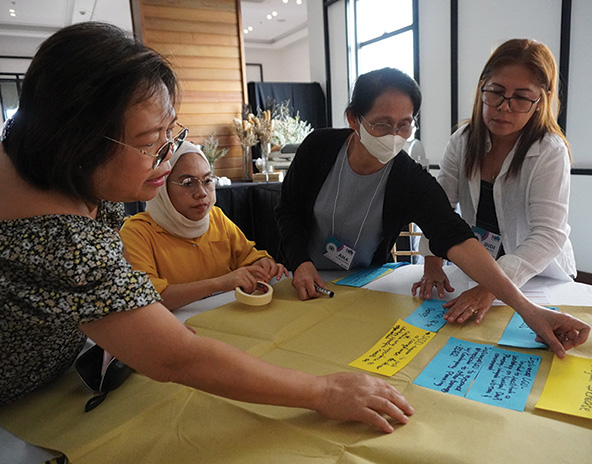
 During the second day of the April 2023 General Assembly of the HPP, women leaders of select HPP member organizations brainstorm ideas. (Photo courtesy of Mary Therese Norbe)
The humanitarian-relief NGO CARE American civic activists Arthur Ringland and Lincoln Clark petitioned 22 US charities to create a nonprofit to send care packages to a Europe devastated by World War II. Since then, CARE has grown into a global organization operating in 109 countries. The NGO carries out its mission to end poverty through programs in areas such as crisis response, food and nutrition, health, and economic development.
In November 2013, Typhoon Haiyan—among the strongest storms ever recorded globally—made landfall in the Philippines, killing more than 7,000 people and destroying more than 1 million homes. CARE, which had worked in the country since 1949, and its local partners—subcontractors who administered CARE’s programs—delivered shelter, food, and financial aid to 318,000 Filipinos. The effort, however, was hindered by the need to fly in overseas staff as the scale of the crisis grew beyond the capacity of CARE and its partners. Consequently, a 2017 internal review revealed that CARE’s Haiyan response fell short of its targets, including delivering food within 72 hours of a disaster. Some deliveries took as long as six days because CARE lacked partners in the Philippines’ most remote and hardest-hit areas.
CARE concluded that it was too dependent upon its own staff and failed to leverage the resources, knowledge, and capacity of local organizations. Although subcontracting with its Philippine partners helped to decentralize some of its work, CARE decided that it needed to build more robust relationships with its partners. CARE’s shift in the Philippines was part of its global strategy to leverage partnerships while promoting the values of trust, equality, and mutual learning. Enduring and effective impact in the Philippines and beyond required CARE to work with its partners as equals, not as subcontractors.
In 2016, this strategic shift spurred the creation of the Philippines Humanitarian Partnership Platform (HPP), an informal alliance of CARE and four Philippine NGOs that manages all of CARE’s emergency-response initiatives in the country. Since 2016, that number has grown to 30 partners, who represent the nation’s more than 7,000 islands.
A Humanitarian Force Multiplier
HPP is neither a standalone organization nor a formal federation competing for resources and staff. Rather, it is a collective of independent organizations united to deliver effective programs by enhancing local expertise and leadership. HPP emphasizes humility and equal partnership, with CARE and other NGOs sharing information and coordinating activities to maximize impact, reduce redundancy, and facilitate complementary humanitarian efforts.
“With HPP, partner organizations are not just taking orders from the larger NGO,” says Jennifer Furigay, a coordinator for the nonprofit Assistance and Cooperation for Community Resilience and Development (ACCORD), whose partnership with CARE predates HPP. No single partner dominates or disproportionately influences the alliance’s overall strategy. CARE’s senior leadership heavily championed the approach to improve relationships not only in the Philippines but worldwide.
“CARE’s leadership was immediately drawn to the power of this network approach,” says CARE’s president and CEO, Michelle Nunn. “Both board and executive leadership saw that this could not only be a more sustainable and cost-effective approach, but also allows for greater impact. As one of our team members said, ‘This is not just how we do our work, but this is who we are.’”
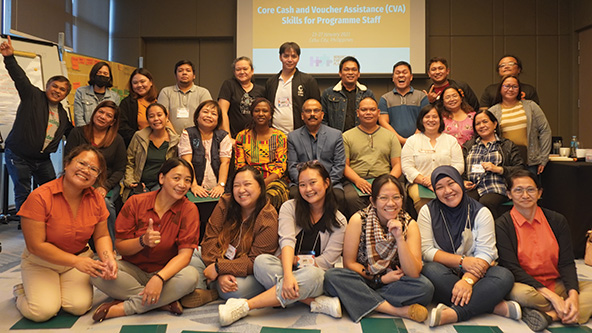 HPP partners participate in a CALP-facilitated training on core cash and voucher (CVA) skills for program staff held in Cebu City in January 2023. (Photo courtesy of CARE Philippines)
HPP convenes committees for finance, procurement, and communications. Members also collaborate on technical training, like disaster-preparedness simulations. It facilitates joint planning, simulations, project design, and implementation among local partners. Private sector partners include Philippine financial-service providers such as Palawan Express and Cebuana Lhuillier, who contribute supply-chain and cash-transfer support during a crisis.
Members see HPP as a humanitarian force multiplier that enables them to plan for and respond to emergencies far more effectively than they ever could alone. HPP maintains an emergency-response surge fund supported by CARE Philippines with a predefined protocol for rapid funding and support to HPP members in need. Partners are preauthorized to conduct assessments and distributions with their own funds, with CARE refunding their expenses up to $2,000 per organization.
Although CARE provides the bulk of the funding for HPP, decisions on how to allocate funds are not determined by CARE’s senior management. Instead, CARE and its partners collaborate on design and delivery of programs and services. CARE USA covers all of HPP’s operating and maintenance costs, but more recently has attracted outside funders like the Tijori Foundation on the strength of HPP’s track record.
“Before HPP, we [acted] alone,” says Jimmy Khayog, HPP member and executive director of the nonprofit Cordillera Disaster Response and Development Services. “Through HPP, we now have resources to provide immediate relief while we are still doing damage assessment. We couldn’t do that before.” Being able to respond on the ground within 24 hours of a disaster has not only saved lives but also boosted fundraising for these local organizations.
With HPP members contributing their local connections, knowledge, and capacity, CARE can concentrate on work it is uniquely equipped to do, such as resource procurement, hosting convenings, and funding professional development for HPP members. CARE also utilizes its global reputation to attract resources for HPP partners, providing trust and accountability for donors unfamiliar with smaller local organizations. Its role confers a degree of trust and accountability for donors seeking to engage a broader network of smaller, local partners.
HPP has strengthened CARE’s funding proposals for work in the Philippines. “Rather than being CARE led, the proposals are instead coming from the communities where the work would happen, by people and organizations who live in those communities,” says Lance Gutierrez, business development manager for CARE Philippines. “The proposals are more accurate because they represent the needs, perspectives, and expertise of those communities.” Delivery of programs and services is also more efficient because fewer resources are wasted on poorly designed programs that lacked local input, and they are more sustainable because local capacity is continually being developed by HPP members.
“The only way CARE can reach our performance targets in the Philippines is by working with our partners in HPP,” says Leigh Fuentes, CARE’s Philippines office partnership coordinator. “Their reputations, their rapport with their communities, and their roots let us reach these communities.”
Care at Scale
As important as HPP is for CARE and its partners, it is an even bigger win for communities in the Philippines that depend on NGOs for lifesaving services. Since 2016, HPP has responded to an average of six disasters annually. After Typhoon Rai struck the country in 2021, Philippines government officials recognized CARE for having the largest humanitarian response of any international organization, second only to the Red Cross—which has nearly 10 times the staff as CARE’s 49 staff in the Philippines. The scale of CARE’s response was possible only because of HPP’s network of partners, who can effectively respond to humanitarian emergencies in each of the Philippines’ 17 regions.
Rather than being CARE led, the proposals instead come from the communities where the work happens.
“We have a network of 30 community-based partners, and we can mobilize nearly 3,500 network staff—more than 70 times CARE’s staff—within hours of a disaster,” says David Gazashvili, the former CARE Philippines country director. “Because the partners work where they live, they’re more aware of local needs, speak local languages, and understand local cultures.”
HPP recently expanded its work beyond humanitarian response into economic development and disaster preparedness. HPP members collaborate with local governments to integrate risk management into development plans. For example, HPP members offer “build-back-better” shelter repair kits that include tools; building materials such as corrugated sheets, specialized nails, hammers, and aluminum screens; and technical guidelines to help communities rebuild after a crisis. This approach enables community self-recovery by offering families the resources and knowledge to rebuild on their own following a disaster rather than having to wait and pay for expensive contractors.
With its success in the Philippines, CARE is already developing similar partnership platforms in Malawi, Nepal, South Sudan, and Niger, with more countries on the horizon. It is not a matter of simply duplicating HPP’s resources or structure, but rather of employing the core principles that paved the way for HPP’s success: trust, humility, and mutual collaboration. HPP demonstrates how networks grounded in these values deliver better and more sustainable outcomes for communities.
Read more stories by Jane Wei-Skillern & Annelie Strath.