


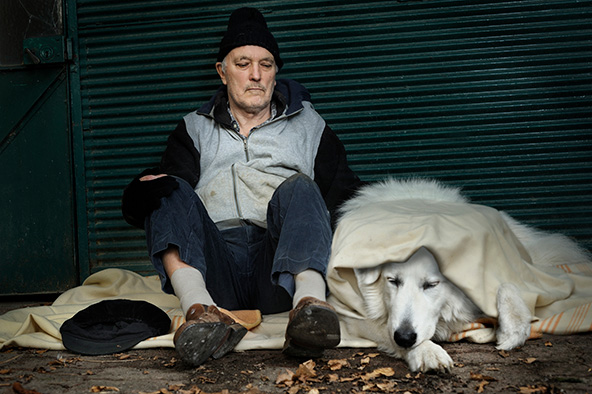
 (Photo by iStock/jeangill)
Cash transfer programs have grown in popularity globally over the past two decades. Pilots for guaranteed income to low-income households have also taken off across the United States, from the California-based Stockton Economic Empowerment Demonstration to the New Jersey-based Newark Movement for Economic Equity.
More recently, cash transfer programs have been adapted to assist people experiencing homelessness. Several programs have launched or are planning to launch within the year, including ones by the Trust Youth Initiative in New York City, the Denver Basic Income Project, and the San Francisco-based nonprofit Miracle Messages.
Cash assistance programs have historically ignored unhoused people because of the suspicion that they would misuse the funds. “Too often, our safety net programs are coming from a place of paternalism where we assume that people don’t know how to make the best decisions about their own life,” explains Jacquelyn Simone, policy director at Coalition for the Homeless in New York City.
Evidence shows that low-income people who receive cash transfers use them for essential items such as housing and food. This includes results from the New Leaf Project, a 2018 cash transfer program for people experiencing homelessness in Vancouver, Canada, run by the nonprofit Foundations for Social Change. Participants who received a lump sum of $7,500 CAD (approximately $5,700 USD in 2018) had greater food security and savings and were able to move into stable housing faster than the control group.
Trusting people to know their own needs is what inspired Miracle Messages founder Kevin Adler to launch a cash transfer program pilot. The nonprofit runs the Miracle Friends program, which connects people experiencing homelessness to volunteers who provide general support and wellness checks in weekly phone calls. In 2021, Miracle Messages distributed $500 per month for 6 months to 12 participants. The nonprofit is expanding to Los Angeles in 2022, where its program will provide $750 a month for a year to at least 50 adults as part of a randomized controlled trial.
Adler notes that half of the participants were able to secure stable housing in large part due to the cash transfers. One of these participants, Ray [surname withheld], lost his job due to health issues and lived on the San Francisco streets for a year before he joined the cash transfer program. Ray’s savings from the program enabled him to move to Topeka, Kansas, and secure permanent housing, soon after which he found a job. The program, which provided him with volunteer support and the freedom to spend the cash on his own terms, boosted his confidence. “They allowed me to make decisions for myself,” he says. “Having someone come up to you and say, ‘I trust you,’ goes a long way.”
Researchers say that several considerations go into designing the pilots. One is whether to offer support services in addition to cash. Miracle Messages expects that cash transfer participants will also continue their weekly check-ins with their volunteers. The Denver Basic Income Project provides a variety of support, including employment assistance, and the Truth Youth Initiative offers counseling, housing navigation, and other services—in both cases, these services are not requisites for receiving the cash.
Other considerations are the amount and frequency of payments. The Denver Basic Income Project plans to test payment structures among 820 participants in 2022. One group will receive an initial lump sum of $6,500 followed by $500 per month for 11 months; a second group will receive $1,000 per month for a year; and a control group will receive $50 per month for a year.
The Trust Youth Initiative, launching in early 2022 with funding from the New York City government and private donors such as the Robin Hood Foundation, is also piloting a cash transfer program. Youth experiencing homelessness will receive $1,100 per month for 2 years. The program also includes a lump sum of $3,000 available to participants, who decide when and how to withdraw it (such as through a bank account or a payment app like PayPal or Venmo). University of Chicago researcher Matthew Morton, who is working on the program’s evaluation, explains that “every aspect of the program’s and the evaluation’s design were tailored based on the feedback of young people [who have experienced homelessness] and what they thought would work for them.” For example, they recommended the addition of a lump sum payment to help with large expenses, such as apartment deposits and furnishings.
Cash transfer programs are not a silver bullet to end homelessness. But the success of pilots like those of Miracle Messages indicate these programs’ potential to assist unhoused people directly and quickly, without barriers.
Read more stories by Stephanie Wykstra.