


 (Illustration by iStock/A-Digit)
Leading a business is hard. Leading a nonprofit is even harder—nonprofit leaders typically have more stakeholders, less control, and fewer resources than their for-profit counterparts. And the headwinds are only growing stronger as charitable donations decline and as government funding faces uncertainty. Despite these challenges, training for nonprofit leaders and board members has not materially changed in the past 25 years. More can be done.
We believe part of the solution lies in nonprofit board fellows programs (NBFPs): experiential learning opportunities, offered typically in business schools, which enable professional graduate students to serve as board members and consultants for local nonprofits while also participating in some form of governance training.
After interviewing program staff, MBA participants, and nonprofit partners across 17 of the top US business schools, we identified a number of lessons we hope will lay new foundations for nonprofit leadership education. This research was carried out while David served as Program Director for the Golub Capital Social Impact Labs and Ben was a Fellow at the Tuck School of Business’ Center for Business, Government and Society (which hosts Tuck’s NBFP).
How Do Nonprofit Board Fellows Programs Work?
NBFPs match local nonprofits with MBA “fellows” who serve as non-voting board members and, in most cases, also deliver a pro bono consulting project. However, individual programs vary significantly across four dimensions:
- Size: The average cohort has 35 fellows, but sizes range from six to 10 in the smallest NBFPs to 80+ in the largest (at University of Chicago’s Booth School of Business).
- Duration: Most NBFPs last around seven to 12 months, but the longest last 18 months.
- Pedagogy: The curricular components of NBFPs vary from required, for-credit classes on nonprofit leadership to optional classes, non-credit training, workshops, and mentoring.
- Institutionality: Students almost always play an important role in recruiting and coordinating activities, but NBFPs have a choice about how much overall program design and partner relationship management is student-run, part-time supported by staff, or led by a dedicated director and faculty sponsor. (More details on these differences are explained here.)
When well-designed and resourced, NBFPs are mutually beneficial. The top three benefits listed by fellows and NBFP alumni are training in governance (both nonprofit-specific and general); exposure to board culture; and the development of transferable skills like effective communication. That said, there are a myriad of additional advantages, including opportunities to become involved in the community, to achieve impact, to grow professional networks, and to build confidence, and the ability to join nonprofit boards earlier.
On their end, nonprofit partners are grateful for the chance to develop emerging leaders and to have capable people deliver fresh perspectives and strategically important work that the organization otherwise lacks the resources to pursue.
“We’ve had phenomenal Board Fellows for as long as I've been doing this,” says Karyn Kirk, the Chief Legal Officer of YMCA—a long-time NBFP partner organization. “And if possible, every year they’re just better and better.”
Among the tail of additional benefits, nonprofits also use NBFPs to fill skills gaps, to become more connected to partner schools’ resources, to identify other nonprofits in the community, and to build a pipeline of board members from a young and diverse pool of future leaders.
What Makes NBFPs Successful?
Across our research, two critical success factors emerged as drivers of successful NBFPs: fellows and nonprofits each investing sufficient time and effort, and that effort being aligned with explicit expectations—especially on the scope of the strategic project. Without these factors, both sides of the relationship may struggle to maintain accountability and to achieve desired outcomes. This points to some best practices that students and nonprofits can follow in order to individually and collectively enhance the impact of NBFPs.
MBA candidates should go into NBFPs with their eyes open. These programs represent a significant time commitment and fellows’ personal growth will be directly related to the energy and proactivity they are able to invest in the nonprofit and its mission. Brian Peckrill is on the National Advisory Board for the network of NBFPs and is executive director of the William G. McGowan Charitable Fund which every year selects 10 MBA candidates from top schools to participate in its prestigious ethical leadership development program, including delivering a pro bono social impact project. He encourages participants to “practice appreciative inquiry. Most leadership development occurs when our fellows get to know their nonprofits and the clients they serve, experience the real challenges these stakeholders face, and are forced to re-examine their assumptions.” Networking early and often, showing up to social and fundraising events as well as committee meetings, and being ready to contribute—all of these enrich fellows’ experiences.
NBFP leaders and the nonprofit executive directors we spoke to agreed another key to unlocking value is for nonprofits to provide fellows with “real” experience (e.g. through structured onboarding and as much exposure as possible). This not only means being quick to connect fellows with committee members and support staff but also being transparent about organizational requirements, stage of maturity, etc., and only participating in NBFPs if the nonprofit is in a position to give fellows meaningful work.
Lessons for NBFP Leaders
Our research also suggests some powerful opportunities for universities to improve and expand the impact of their NBFPs. Below are seven considerations that NBFP leaders should bear in mind.
1. Pick the Right Number of Fellows. Cohort size has two important implications. The first is impact; NBFPs which are too small limit their impact on nonprofits and students, while NBFPs which grow too large without hiring dedicated staff can struggle to effectively manage external relationships (and face an increased chance of partnering with nonprofits who cannot co-invest in the process).
The second is perceived competitiveness. At some schools there are about as many places as interested candidates, while acceptance rates at larger programs can be 50 percent (e.g. University of Michigan’s Ross School of Business), 33 percent (e.g. University of Pennsylvania’s Wharton School), or as low as 25 percent (e.g. Northwestern University’s Kellogg School of Management). This selectivity may deter good candidates from applying, but it also bolsters prestige and the quality of applicants ultimately selected.
2. Manage the Matching Process. While three schools match one fellow to each partner nonprofit, the remainder have tried to balance impact and relationship “manageability” by allowing—or even requiring—multiple fellows to volunteer with the same organization. This has the benefit of bringing different, potentially complementary areas of expertise to the nonprofit and letting fellows share the workload. But it is not without risks; one executive director we spoke to curtailed their partnership with an NBFP in part because having multiple fellows per project decreased individual accountability.
One way to mitigate this risk is to increase NBFP duration, to 15 months for example, and to extend the overlap between outgoing fellows and their replacements. Even without changing program duration, NBFPs should consider matching fellows and partners as early as possible (most likely early spring—even if they do not start working together until after the summer). This can be achieved by providing more explicit guidelines and examples to shorten the timeline for scoping projects.
3. Onboard Effectively. Like students, nonprofits benefit from more structured engagement. NBFPs should invest across the entire program lifecycle: from partner onboarding to student support, community building, and ongoing relationship management. This means engaging with partners to ensure kickoff days and other mandatory events are set up to maximize value, such as by onboarding multiple organizations together in content-varied sessions so that even long-standing partners have the chance to learn. It also means setting up touch points throughout the year and using calls or conferences with past and present nonprofit partners and top-performing fellows to share everything from program-specific feedback to current thinking on social impact.
The result can be long-term partnerships where nonprofits build NBFPs into their annual planning processes and fellows maintain high levels of participation after graduation. For example, Richard Day (Chicago Booth 2020) joined the board of Renaissance Social Services after completing his fellowship with them and Sarah Brayton (Northwestern Kellogg 2016) has served on the San Francisco and national boards of the YMCA and as the chair of an education nonprofit since finishing her fellowship.
4. Choose High-Impact Projects. “Projects are a great way of helping the board activate and elevate key priorities it has identified,” says Holly Buckendahl, CEO of Ronald McDonald House Charities of Chicagoland and Northwest Indiana. Examples of projects are wide-ranging, from conducting research on sustainability to producing new reporting guidelines, and to be most effective, NBFP leaders should help scope projects which marry nonprofit needs with fellows’ personal and professional interests. The websites of Foster, Kellogg, McCombs, Fuqua, Columbia, and Olin business schools all offer helpful inspiration.
As Michael Thatcher, CEO of Charity Navigator observed at a recent conference for nonprofit and corporate leaders, very few of even the largest nonprofits have an R&D budget. When built into the strategic planning process, board fellow projects can be a free way to generate new innovations for the organization.
5. Provide Educational Support. Many fellows we spoke to highlighted the combination of experiential and academic learning as one of the most rewarding parts of their programs. The former makes things “real,” while the latter is vital for building skills and confidence and for translating core concepts into a nonprofit context.
Several of the NBFP leaders we spoke to said that adding a curricular component was the most significant current area of program change. Berkeley Haas provides an instructive example. Following the pandemic, the school redesigned its Bears on Boards program, moving from a required one-credit class to a series of non-credit sessions which allowed the program to broaden access. While this made it easier for first-year students to participate, Haas determined it wasn’t preparing students as effectively as the previous approach, and decided to move back to for-credit teaching in the 2024-25 academic year.
There are other options schools can explore if a new class is not feasible, such as setting up the NBFP as a practicum or giving students the option to receive credit for their fellowship if they submit final project deliverables and personal reflections.
6. Invest Institutional Resources. The first leading business school to establish an NBFP was likely Michigan Ross in 1999. Spurred on by Ross and a handful of other student-led efforts, the nonprofit membership organization Net Impact adopted NBFPs as a signature initiative in the early 2000s, publishing detailed guidelines and templates for setting up NBFPs and sharing practices at its annual conference. Following this effort, 91 of Net Impact’s 300 chapters started up NBFPs at various times, most of which were small (15 fellows on average) and student-led. By the 2014-15 academic year, only 28 of these NBFPs were active, down from a peak of 55, and only a couple of leading business schools (Virginia Darden and UCLA Anderson) have NBFPs still run by the local Net Impact chapter.
There are some advantages to student-led NBFPs, including the significant additional opportunities they provide for students to develop as leaders. However, frequent student turnover and the resulting loss of institutional memory can make it harder to sustain deep nonprofit partnerships. Relying on students for end-to-end program design and delivery likely accounts for the high attrition of NBFPs established by Net Impact chapters and the struggles some schools faced restarting NBFPs post-COVID.
Having dedicated staff to manage nonprofit relationships and oversee the program—and faculty who can provide tailored education and mentorship—not only makes NBFPs more valuable for current students but also provides crucial continuity as those students graduate.
7. Learn From What Works. For any program or organization to remain successful, it must have a mechanism for continuous improvement. This is one of the most significant areas in which NBFPs can improve. While some programs conduct year-end (and occasionally mid-year) surveys of fellows and partners, many don’t measure the returns on the significant time and financial investments they make throughout the year. Longer-term evaluations of NBFP effectiveness have been basically non-existent.
This is beginning to change. For example, the Cornell Johnson Graduate School of Management has started interviewing graduates about the effectiveness of their NBFP, and Chicago Booth tracks fellows who continue serving on boards after graduation. But many schools’ efforts here are geared more towards alumni engagement than program evaluation.
A promising new development is a study by researchers at Northwestern Kellogg comparing the experiences of 800+ NBFP alumni with MBA alumni who did not participate in the program. The study found past fellows were more likely to join nonprofit boards, did so earlier in their careers, were more likely to serve in leadership positions on those boards, and felt better prepared for nonprofit governance than those who had not gone through the NBFP.
Building a National Network of Board Fellows Programs
Golub Capital, a leading private credit manager, had sponsored a NBFP at Northwestern Kellogg since 2021. Based on our research showing NBFPs’ high return on investment, as reported by both students and nonprofits, the firm saw an opportunity to bring together NBFPs from leading business schools into a community of practice that shares insights and learnings from their respective programs.
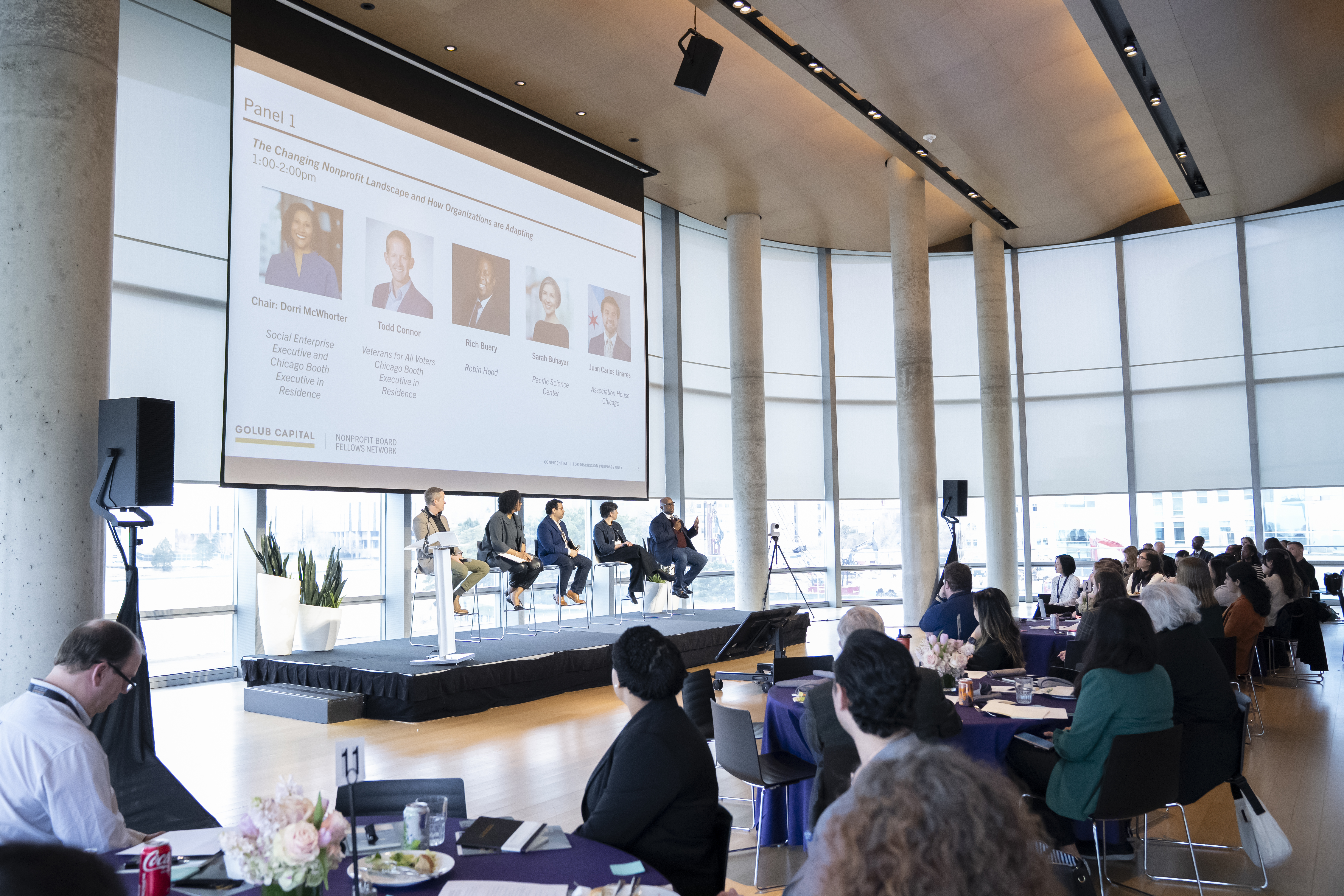 Photo from the inaugural Golub Capital Nonprofit Board Fellows Network Symposium that was hosted by the Kellogg School of Management on April 4-5, 2025. (Courtesy of the authors)
The Golub Capital Nonprofit Board Fellows Network was formed in 2024 through a competitive Request for Proposal (RFP) process that awarded grants to establish or enhance existing NBFPs at: Penn’s Wharton School, Chicago Booth, NYU’s Stern School of Business, Carnegie Mellon’s Tepper School of Business, Yale School of Management, Berkeley Haas, and the existing Golub Capital NBFP at Northwestern Kellogg.
Eight further schools were invited to become affiliates of the network, receiving funding to send five attendees to an annual symposium, gaining access to shared resources, and being invited to take part in a second RFP in early 2025. In this second round, four additional schools—Michigan Ross, Virginia Darden, UCLA Anderson, and UT McCombs—were selected to receive funding starting in the summer of 2025, expanding the Golub Capital Board Fellows Network to 11 members and four affiliates.
The network has four overarching goals:
1. Strengthen Individual Programs. By investing significant funds over a minimum of five years (alongside significant support from each university) and giving NBFPs flexibility on how to allocate those funds, Golub Capital has enabled schools without an NBFP to launch one and is helping existing programs expand the number of students and nonprofits they serve. Golub Capital’s funding enables NBFP leaders in the network to experiment with new ways of enhancing program quality, such as widening recruitment outside full-time MBAs to include other professional graduate students; expanding to other university locations, both inside the US and internationally; providing continuing education for NBFP alumni; and using alumni as mentors for current fellows.
2. Enhance Nonprofit Capabilities. The network will offer free and low-cost professional development opportunities to nonprofit staff; provide students with templates, tools, and mentoring to strengthen the quality of consulting projects; and serve as a conduit for nonprofits to build deeper partnerships with partner universities.
3. Diffuse Innovations and Best Practices. Member and affiliate schools have expressed strong interest in learning from their peers, and Golub Capital is eager to build a thriving community where NBFP teams can share ideas and practices. In support of this, the network recently held its first symposium—where faculty, staff, fellows, and nonprofit partners presented highlights of their work and discussed topics of common interest. This diffusion will continue throughout the year through virtual forums, allowing fellows and nonprofits to meet and share project results.
4. Develop a Talent Pipeline. By 2028, more than 1,000 Golub Capital Board Fellows will be graduating each year. They will combine business skills, a demonstrated commitment to social impact, and an understanding of how mission-driven leadership really works. To amplify the profile and impact of these future leaders, the network will connect alumni within regions and match them to nonprofits that are seeking new associate or full-board members.
Conclusion
Given the rising demand for nonprofit services and the post-COVID push to transform higher education (and to show how universities are enriching the communities in which they’re located), now is a good time to explore ways of growing and enhancing NBFPs.
Prescribing generalized design principles can be difficult, given the wide variety of schools and nonprofits involved in NBFPs, the different geographic and financial contexts in which they operate, and the lack of good data on program outcomes. However, our research suggests there are a variety of ways in which students, nonprofits, and—most importantly—the leaders of nonprofit board fellowship programs can make these programs even more effective, at scale and more sustainably.
We are confident that by strengthening and growing the ecosystem of NBFPs, the students, staff, faculty, and nonprofit partners who are involved will not only drive significant value in the short term but also develop a future generation of leaders better prepared to help nonprofits meet the challenges they face.
Read more stories by David Finegold & Ben Marshall.