


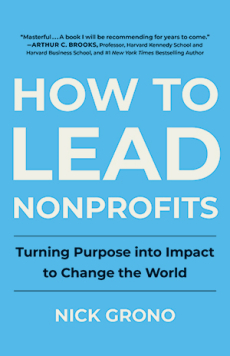
How to Lead Nonprofits: Turning Purpose into Impact to Change the World
Nick Grono
256 pages, Matt Holt, 2024
Whenever I talk to other nonprofit leaders, we invariably end up swapping stories about the myriad challenges we face in running our organizations. Without fail, a few themes emerge. They include: the burden of the relentless fundraising; the often-acrimonious internal debates on important and contentious issues ranging from Gaza to DEI; managing relationships with sometimes fractious boards; the difficulties of effectively measuring impact and linking to strategy; and CEO burnout.
Over time I concluded that if these issues pre-occupied my extended peer group, they probably pre-occupied most nonprofit leaders much of the time. That assumption was proven correct when I started actively reaching out to other leaders around the world. Yet, despite this, there is a dearth of practitioner-focussed books on nonprofit leadership—books that might give current and aspiring leaders comfort they are not alone in facing their challenges and provide them with some practical guidance in dealing with them.
It's for this reason I set out to write How to Lead Nonprofits: Turning Purpose into Impact to Change the World. I interviewed nonprofit leaders on all continents to learn from their expertise. And I drew upon my own leadership experiences—particularly my many missteps—to produce something that would have been helpful to me when I first became a CEO and, hopefully, to my fellow CEOs.
In this excerpt from the introduction, I explain that the role of the leader is to harness the power of their organization’s purpose and use it to shape everything the organization does—internally with its people and externally with its partners—to deliver the greatest possible change. This provides the framework for the book.
My hope is that this book will be a practical resource for nonprofit leaders around the world. I hope, in particular, it helps them lean into the joy that comes from working to change the world for good.—Nick Grono
* * *
On a bleak midwinter’s day in London a decade ago, I became the CEO of a brand-new nonprofit organization. I had landed in England the day before from my home country of Australia and was struggling to adjust to the subzero temperature after the blazing sun of the southern summer. It wasn’t the only change I was adjusting to.
At this early stage it seemed a little grandiose even to call myself CEO, given I was the sole staff member of my nascent organization, the Freedom Fund. We had no office, no board, no strategic plan, and no programs in place. But what I did bring with me was more than ten years of leadership experience of US and international nonprofits, and another decade before that working in corporate law, government, and banking. I also had a deep belief in the power of well-led nonprofits, with motivated teams, to drive outsized change.
In contrast to its modest circumstances, the Freedom Fund’s ambitions were huge: to mobilize the knowledge, capital, and will needed to end modern slavery. Modern slavery is an umbrella term for horrendous crimes such as sex trafficking, forced labor, bonded labor, and forced marriage. It traps fifty million women, men, and children today into lives of violence and extreme exploitation and generates hundreds of billions of dollars in profit every year for its perpetrators. It’s also a crime that touches all of us, as countless everyday products—from mobile phones to cotton T-shirts to processed seafood—are produced with forced labor.
The Fund had one big advantage from the beginning, and that was the backing of three highly regarded philanthropic foundations. Thankfully, they were willing to take a bet on this vision and my leadership by providing generous start-up capital to test whether the Fund could make real progress against its ambitious goals.
So, on that cold, gray January day, I had two priorities. The first was to get the basic operational pieces in place so that I could start hiring staff and setting up programs. This meant I had to prepare an initial budget, find an office, draft a work plan for the first year, ensure board members were appointed, and hold the first board meeting.
The bigger—and, to my mind, more important—priority was to use the first few months to put in place the fundamentals that would give the Freedom Fund the best chance of success over the longer term. I was acutely conscious that the start-up funding gave us the opportunity to be deliberate about our purpose, impact, and culture from the very beginning. I was determined not to waste that gift. I wanted to use all that I had learned from my previous decade in the nonprofit world, and my time before that in the private and government sectors, to position the Freedom Fund for success. I was also determined to draw on the wisdom of the many outstanding leaders I had worked with over the years, and the lessons I had absorbed from other impactful nonprofits over that time.
Fast-forward to the present. Today the Freedom Fund works in twelve countries, including many of those with the highest burden of modern slavery, such as Brazil, Ethiopia, and Myanmar. We have a global team of eighty-five people. We have partnered with, and helped shift power and resources to, some 150 grassroots organizations. Working with those partners, we have helped bring over 31,000 people out of slavery. Our programs have directly touched the lives of 1.5 million people in slavery or at high risk of it. And they have positively changed the systems affecting more than seven million vulnerable people, reducing their risk of being harmed.
Look beyond those numbers and picture the women and girls who are no longer being exploited in brothels or cotton spinning mills or coerced into marriage; men and boys who are no longer being forced to work in dangerous mines, brick kilns, or fishing boats; women, men, and children who have been helped to escape a myriad of other deeply exploitative situations. To fuel this impact, we have raised over $220 million in funding. Our budget has grown at a rate of about 25 percent year over year, and we have managed this while also recording a very high level of staff satisfaction.
Though we are still a young organization, our work is beginning to garner international attention: Harvard Business School is teaching a case study on the Freedom Fund’s strategy and impact. Thought leaders in philanthropy, such as Bridgespan, the Gates Foundation, MacKenzie Scott, and The Philanthropy Workshop, are highlighting the impact of our work. All of this drives our flywheel, enabling us to mobilize more resources and increase our impact.
So how did we get here? The answer is: by focusing relentlessly and with discipline on our purpose and impact. This focus shapes everything the Freedom Fund does. It sets our direction of travel. It helps us build a highly effective organization, enabling us to recruit and retain an outstanding team that shares an inclusive and impact-focused culture. And it ensures we maintain close partnerships with those who have the greatest stake in our success—particularly local communities and courageous grassroots organizations, but also our funders and peer organizations.
What Do Successful Nonprofits Have in Common?
I’ve spent a lot of time studying successful nonprofits to identify their shared attributes. In addition to my two decades working for nonprofits, I’ve also served on seven nonprofit boards to date, which has given me a firsthand perspective on governance. I also have experience of working for business and government: In addition to my early years as a corporate lawyer, I worked at the investment bank Goldman Sachs and later was chief of staff to the Australian attorney general. I spent a number of years providing leadership training to young women and men on a sail-training ship. After some twenty years of leadership, I am increasingly asked to advise and coach other nonprofit leaders, and I’ve learned a lot from these rich discussions.
All of this has shaped my thinking on what great nonprofit leadership is. The starting point is to identify what the most successful nonprofits have in common. Once we identify this, we can explore the leader’s role in building and sustaining these organizations.
Nonprofits come in many forms. They are service-delivery organizations, advocacy organizations, charities, foundations, non-governmental organizations (NGOs), religious organizations, social welfare organizations, and education and arts institutions. There are more than 1.5 million registered nonprofits in the US and millions more globally. Given this diversity, it’s not surprising that many factors contribute to nonprofit success—starting with leadership, but also including staff, culture, the issue being addressed, operational context, funding models, and peers and competitors.
But all highly successful nonprofits put purpose and impact at the very heart of everything they do, and they maintain a disciplined and relentless focus on them. Nonprofits exist to make a positive change in our world. This is their purpose, their reason for existence. Their contribution to that change is their impact. They save lives, protect rights, tackle poverty and hunger, promote the arts, provide education and health services to the world’s least fortunate, and much more. Some nonprofits have more impact than others, and definitions of “positive change” can vary widely, but all have purpose and impact as the golden thread running through all their work.
The power of this approach can best be seen by comparing nonprofits with businesses. Businesses exist to maximize value for their shareholders—that is their principal purpose and how their impact is measured by their shareholders. Successful businesses are defined primarily by their financial returns. Some may have a secondary purpose of doing public good, but financial considerations reign supreme, and that strongly shapes their leadership and differentiates it in important ways from nonprofit leadership. By contrast, the most effective nonprofits start and end with a focus on change—and understanding this is key to understanding nonprofit leadership.
The Role of the Leader
Given this focus on driving change, what is the role of the leader in building and sustaining great nonprofits? Many (particularly business leaders) argue that the key is to lead nonprofits more like businesses, but this entirely misses the point. The simple fact of leading a profit-driven organization does not, of itself, make you a good leader. There are well-led businesses and badly run ones, just like there are great nonprofits and mediocre ones. One of the world’s leading experts on business leadership, Jim Collins, highlighted this by subtitling his study on nonprofit leadership: “why business thinking is not the answer.”
Rather, the role of the leader is to harness the power of purpose and use it to shape everything the organization does—internally with its people and externally with its partners—to deliver the greatest possible change.
The framework I use in this book reflects this approach. It is structured around purpose, people, and partners:
Purpose determines a nonprofit’s direction of travel and destination. It explains why a nonprofit exists and what it hopes to achieve. The first section of this book will explore “purpose” in detail and the way it shapes mission, impact, and strategy, with a chapter on each.
People are central to the success of any organization. The second section of this book looks internally, at the people and dynamics that power a nonprofit. It starts with a chapter on the CEO’s priorities and style. Next comes a chapter on teams—specifically culture and staffing—followed by one on diversity, equity, and inclusion. The section ends with a chapter on another key group of people, namely your board.
Partners are key to amplifying a nonprofit’s impact. Nonprofits have a range of groups with an interest in their success: these are their external stakeholders or, as I prefer to call them, their partners. The book’s final section looks at the role of these partners. It starts with a chapter on the individuals and communities you serve, as these are the principal reason for your organization’s existence. Next come your funders, who provide the financial fuel on which your organization depends. The last chapter is on collaboration and networks.
Why This Book?
In writing this book, I was conscious that there is no shortage of literature on leadership. But almost all of it is about running businesses. And, while much of what is written about profit-driven leadership is relevant to nonprofits, there are fundamental differences between the two types of organizations, which means that business literature and experience will never be sufficient to address the needs of nonprofit leaders. This is why successful business leaders can do poorly in leading nonprofits, and why effective nonprofit leaders can stumble when they try and move to private-sector leadership positions.
Despite these differences or, rather, because of them, I regularly compare business and nonprofit practice throughout this book. The contrast illustrates how different incentives lead to different priorities and outcomes, and better shapes our understanding of nonprofit leadership.