


 (Illustration by Formative)
Sometimes it can be easy to forget that, at its heart, the climate crisis is a health crisis. Headline-grabbing debates around things like electric vehicles and net-zero goals can obscure the driving force behind these initiatives, which is this: As the largest source of human-caused environmental toxins on the planet, the fossil fuel industry is heating the Earth and poisoning its inhabitants, making it harder for billions of people to live long and healthy lives.
In other words, the fight against oil and gas is a fight for our own survival. It is a fight against the pollution that is responsible for so many of our negative health outcomes. Outcomes with severe disparities for communities on the fence line of the oil and gas industry, outcomes that hit harder for children and their mothers, and outcomes that in many ways affect every single one of us. This is becoming more apparent to everyone in the United States as the frequency of life-threatening extreme weather events increases and byproducts of the petrochemical industry build up in our bodies and make us sick.
Right now, the Trump administration is working to dramatically roll back, delay, and water down rules that regulate the toxic pollution from fossil fuel facilities. These moves will give oil and gas producers near carte blanche to spew dangerous chemicals into the environment, endangering the health of all Americans. This deregulation campaign is happening as the US fossil fuel industry is looking to expand its infrastructure and seeking new sources of profit. Funders and advocates must rally around creative and robust community-led solutions that prioritize health protection over corporate gain. Local air monitoring initiatives, proactive health-care education, and public engagement in industrial permitting decisions can empower people to protect themselves and their communities.
The Houston Arrow
Oil and gas operations leak toxic pollutants into the air, soil, and water of their surrounding environments. These include diesel particulate matter, arsenic, and cyanide, just to name a few. Other hazardous chemicals have names that are just a series of numbers and words that often defy pronunciation. You might have never heard of 2,3,7,8-Tetrachlorodibenzo-p-dioxin, but your instinct to keep it out of the lungs of your children would be right on. Some pollutants are so dangerous that even short-term exposure can be fatal. For less potent chemicals, long-term exposure can lead to the development and/or exacerbation of virtually every chronic ailment, including respiratory, circulatory, and endocrine diseases, as well as many cancers. Exposure can also cause reproductive anomalies, mental health declines, and developmental disorders, particularly in children. And evidence is emerging to suggest a link between exposure and negative social conditions, such as crime and the achievement gap.
The harmful health effects of these pollutants are on full display in Houston, Texas, the so-called energy capital of the world. Houston is home to more than 4,500 oil and gas companies and nearly 200 separate oil and gas industrial facilities. According to the county health authority, the Houston zip codes where life expectancies are lowest are those with the majority of oil and gas sources. Houstonians have a name for this phenomenon: The Houston Arrow. On certain maps, data forms the shape of an arrow that points to those places with the most health problems, social challenges, environmental risk, and oil and gas infrastructure. People who live where the arrow points are also more likely to be of color and of lower wealth. The Arrow also points to the neighborhoods in Houston’s outdated wards system that were redlined, where land was valued less, where oil and gas built cheaply and quickly, and where it continues to expand today.
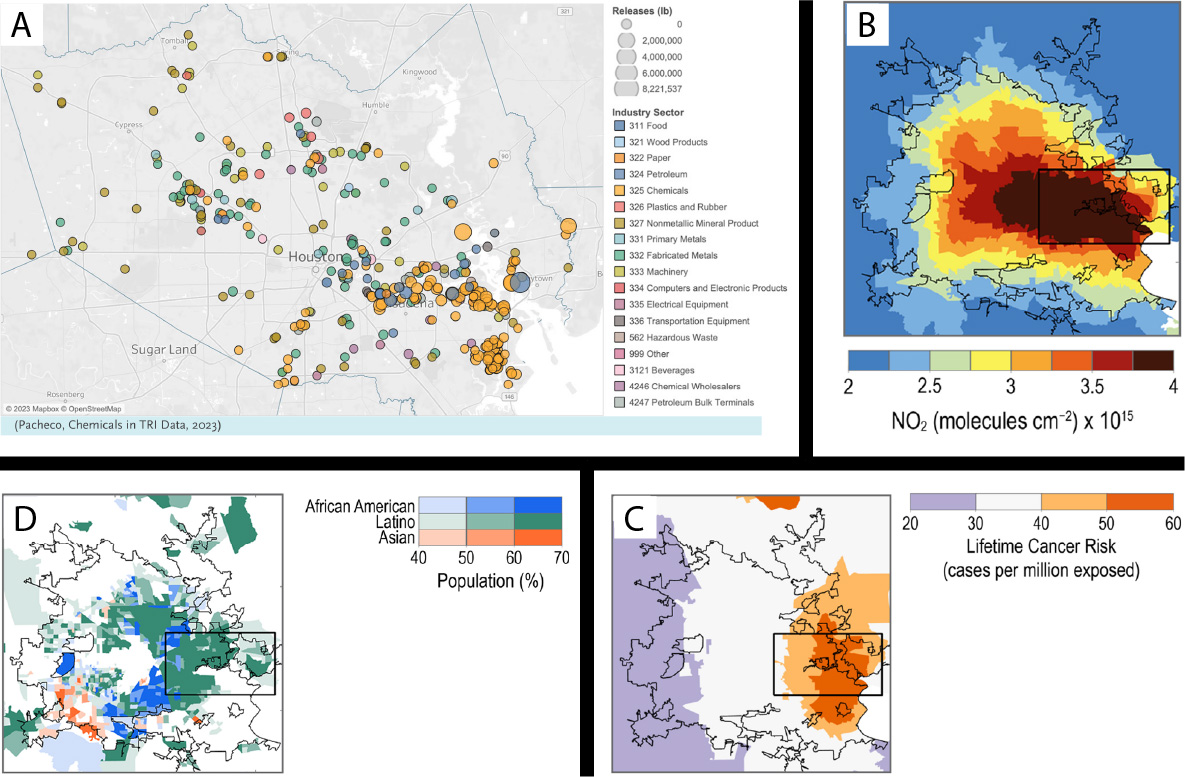
(Click to enlarge) Clockwise, from top left: A) The location of oil and gas industry infrastructure is concentrated in Houston’s Southeast area, which B) also has dramatically higher rates of air pollutants like nitrogen dioxide (NO2). C) This same area has increased lifetime cancer risk, and D) is concentrated in communities with higher populations of people of color and lower wealth.
Sources: Air Alliance Houston, EPA.gov
Houston is a microcosm of the fossil fuel industry’s dominance and resulting devastation in America. But many other communities across our country—Louisiana’s “Cancer Alley”; Gary, Indiana; Refinery Row in Southern California; much of the Ohio River Valley—have essentially been sacrificed to the oil and gas industry’s operations and its profits.
Beyond the Fenceline
You don’t have to live next to an oil refinery to be in danger. The fossil fuel industry’s hazardous products and byproducts will find you, wherever you are, and whether you’re rich, poor, liberal, or conservative.
For example, petrochemicals from the oil and gas industry transit through or near countless rural, urban, and suburban communities across our country, resulting in a massive web of heavy-duty trucking and freight rail routes that put everyone at risk. The 2023 chemical disaster in East Palestine, Ohio, was a stark reminder of this truth. The storage and disposal of petroleum products can further contaminate the environment, especially when industry infrastructure fails, as it has multiple times during extreme weather events.
Or consider our growing plastics problem. Oil and gas companies have long known that society would eventually transition away from fossil fuels toward more sustainable options and have worked hard to develop “plan B” lines of profit, such as plastics. In the last two decades, global plastic production has doubled and is projected to triple again by 2060. The majority of that rise is in single-use products. As a result, microplastics are now everywhere, including inside our bodily organs. Scientists are only just beginning to understand the health implications, with early research suggesting an increased risk of heart attack, stroke, and dementia.
Fighting for a Healthier Future
We’re facing a hard truth: The oil and gas industry has never been more powerful and prolific in its polluting than it is right now. Despite 60 years of environmental health regulations and huge resources poured into supporting the growth of clean energy industries, we have failed to effectively rein in the one industry standing squarely between us and a future in which everyone’s health is protected. Efforts to pass legislation holding the fossil fuel industry accountable for climate disasters and damages have rapidly spread across multiple states and serve as an exciting example of community pushback. But real, robust progress calls for a new era of action driven by local communities.
Strengthening Community Science: People living near oil and gas infrastructure often sense their environments are being polluted, but struggle to prove a source point. Regulatory pollution monitoring lacks both local specificity and regional completeness; and while important for system failure detection, the results of industry monitoring are not typically made public and do not reflect conditions beyond the property line. When members of the public can collect their own environmental data, they are empowered.
In greater Houston, for example, the relatively recent availability of low-cost air quality sensors has allowed people to quantifiably document the toxin levels in their environments and even pinpoint a polluting source. Air Alliance Houston, an environmental justice organization focused on curbing air pollution from oil and gas, operates the region’s largest community air monitor network, with over 60 monitors hosted by local residents. Their online dashboard provides a real-time snapshot of local air quality; and trend data from the dashboard are used in pollution complaints, air permit reviews, and calls to action against facilities. Data from low-cost sensor networks can also be used as proof of fugitive emissions and permit violations, or as evidence for legal actions against specific polluters. This data also enables people to make decisions about exposure to protect their own health. Such innovations in community science have shifted the power of information about the impacts of oil and gas on air quality to those living in harm’s way.
More support is needed to ensure community scientists have the training and capacity-building skills needed to implement their projects with unimpeachable scientific quality. Support is needed to create and provide access to the tools they need to generate, store, and manage the data from these sensors. Support is then also needed to turn that data into the advocacy—community education and organizing, permitting fights, legal action—necessary to improve environmental health conditions for the most heavily impacted communities.
Harnessing Health Care Systems: The field of occupational health has long known that worker safety is directly affected by the oil and gas industry. Now other health workers are beginning to take note: screening programs and providers are increasingly assessing place and proximity to oil and gas as a risk factor for their patients’ health. This is particularly critical for safety-net community clinics such as Federally Qualified Health Centers (FQHCs) that commonly serve individuals living in medically underserved industrial neighborhoods. Community Health Worker (CHW) programs are also responding. By definition, CHWs who are from industrial areas know first-hand how this proximity affects health and what protective measures to take. A new Community Health and Environmental Worker (CHEW) program in Houston, for example, explicitly focuses its patient education work on environmental risk factors in the most climate vulnerable neighborhoods like Houston’s Fifth Ward. Houston’s local March of Dimes chapter recently trained CHWs on chemical disaster preparedness and the impacts of oil and gas on maternal health. The city’s health department has a program to alert school nurses about high air pollution days, so they can prepare to treat asthmatic students. With investment, the opportunities to scale these programs are significant. A coalition in Houston is already incubating new solutions by bringing together the major health care provider groups, clinic and hospital systems, medical and public health schools, and environmental and climate justice organizations.
Supporting Permitting Fights: Historical land devaluation policies such as redlining, covenants, and deeds have resulted in the concentration of oil and gas infrastructure in specific zip codes. Most permitting processes also are not sufficiently informed by polluter history, so even after dangerous leaks, spills, fires, or explosions, permits continue to be renewed and oil and gas operations continue to expand. Communities in the shadow of this cycle are launching coordinated opposition to oil and gas permits and “site fights.” Mass systems, such as Air Alliance Houston’s “AirMail,” have been built to automatically notify people of permit applications in their neighborhoods and opportunities to weigh in on permitting decisions at permit meetings. By raising health and safety concerns about these facilities, community members are slowing down the permitting process and, in some cases, even blocking new oil and gas facilities. At the same time, they are connecting with each other, validating their shared lived experience, and holding oil and gas facilities and regulators accountable to their permits and commitments.
With greater resources, community organizations and their partners can advance and scale this kind of impactful frontline movement-building. Fighting the oil and gas industry and their near limitless resources is some of the toughest advocacy that can be taken on. This work takes intense people resources, time, and consistency over years and even decades—convening neighbors, block-walking, relationship building, forming collaborative coalitions, teaching, training, prepping testimony, etc. Every community-based organization that fights the oil and gas industry needs a cadre of multi-lingual and multi-cultural organizers, as well as legal, scientific, and policy support to make progress. This advocacy requires a huge sustained effort of multiple partners organized around and supporting the efforts of community-based organizations working on the frontlines of the fight.
The oil and gas industry has an inordinate amount of power over the environmental conditions that ultimately determine our health. While some progress has been made over the years to right this wrong, the speed with which many of our most recent victories have been undone at the bidding of the oil and gas industry is breathtaking. For example, supplemental air toxics standards have been the norm for decades, regulating such hazardous processes as petrochemical sterilizing and manufacturing. In 2025, the Trump administration invited oil and gas companies to simply ask for special exemptions to avoid complying with these limits, essentially giving them a “free pass” to pollute. Community-based organizations and advocacies such as the Natural Resources Defense Council fought for decades to force EPA to finalize regulations such as the Hazardous Organic NESHAP (HON). Finalized in April of 2024, the HON rule at long last set the stage to ramp up monitoring at the fenceline of many oil and gas facilities and force reductions of incredibly dangerous chemicals such as ethylene oxide. EPA Administrator Lee Zeldin has already signaled his intent to pull this rule back and President Trump is granting more “free passes” to polluting facilities to simply ignore a statutorily-backed rule already on the books.
As the pollution from the oil and gas industry in its many forms—from greenhouse gases to microplastics, and from particulate matter to PFAS—becomes impossible to avoid, outrage is growing. The drive to protect who and what we love is growing. So is awareness that we all—advocacy, philanthropy, academia—must squarely take on the oil and gas industry to open up a path to a clean, healthy, sustainable, and prosperous future. Philanthropists must strengthen this wave of resistance by directing resources toward efforts that help communities fight for their fundamental right to a healthy and prosperous future and block further oil and gas expansion. Actions taken in the Houston area provide some examples of effective strategies that can be scaled up across the country. It is the time for bold ambitions, and for the sustained scale of support that squarely taking on this industry will require.
The Funder Collaborative on Oil and Gas partners with NRDC, Air Alliance Houston, and other organizations working to protect American communities from the negative health impacts of the oil and gas industry. To learn more or work with us, contact Sarah Brennan at [email protected].
Read more stories by Matthew Tejada & Jen Hadayia.