


 (Illustration by Formative)
Progress on climate change seems closer than ever given advances in clean energy technologies over the last decade. In 2024, renewables provided 93 percent of new electricity capacity worldwide; this explosive growth is only expected to continue. Yet the United States’ wealthy fossil fuel industry is determined to strengthen its grip on the nation’s energy system, aided and abetted by unfair subsidies and regulatory rollbacks. This stranglehold threatens the health, prosperity, and basic dignity of all Americans, and even democracy itself.
Many Americans don’t want this, and they’re putting up a fight. In recent months, people across the political spectrum have blocked the industry’s expansion in their own communities and have held it accountable for local harms. This broad-based and collective resistance has the potential to help repair our civic life. Now more than ever, we should embrace what unites us.

Clean Energy’s Clear Advantage
The push to produce more fossil fuels and dismantle environmental protections is driven by a false narrative that says America’s domestic energy potential has been constrained and therefore needs to be “unleashed.” But the United States has produced more oil and gas than any other country for a decade, and is now producing slightly more than Saudi Arabia and Russia combined. Since 2019, the United States has exported more energy than it imports. Our energy abundance has upended geopolitics and nudged America toward petrostate status. Indeed, as professors Michael L. Ross and Erik Voeten recently noted in Foreign Affairs, “petrostates tend to have more autocratic governments, more belligerent foreign policies, and higher levels of corruption—trends that now apply to the United States.”
The fossil fuel industry aims to use its political power to maintain its position for decades to come, despite clean energy’s clear advantages across a range of metrics.
- Clean energy is better for the health of people and the planet. Renewables do not emit climate-warming pollution and are also much better for public health than fossil fuels, avoiding the toxic byproducts of extracting, processing, transporting, and burning oil and gas for energy. By one estimate, ditching fossil fuels for clean energy alternatives would save roughly 110,000 lives and $1.2 trillion in health costs over the next 25 years. And yet America is moving in the wrong direction, with the current administration promoting the fossil fuel industry, making it harder to build renewables, and either waiving or refusing to enforce regulations that protect people from air and water pollution.
- Clean energy is cheap and reliable. For the last decade, it has been cheaper on average to add electricity by building unsubsidized solar and wind power instead of new fossil fuel power plants. Improvements in battery technology mean unsubsidized wind and solar can now power the grid as reliably and more cheaply than fossil fuel plants in many places, and reliable renewable electricity will only keep getting cheaper. Globally, clean technology is expected to attract almost twice the investment as fossil fuels this year. On the flip side, the cost of building new gas-fired power plants is higher now than it has been in 10 years, and the industry’s export push adds upward pressure to domestic electricity prices.
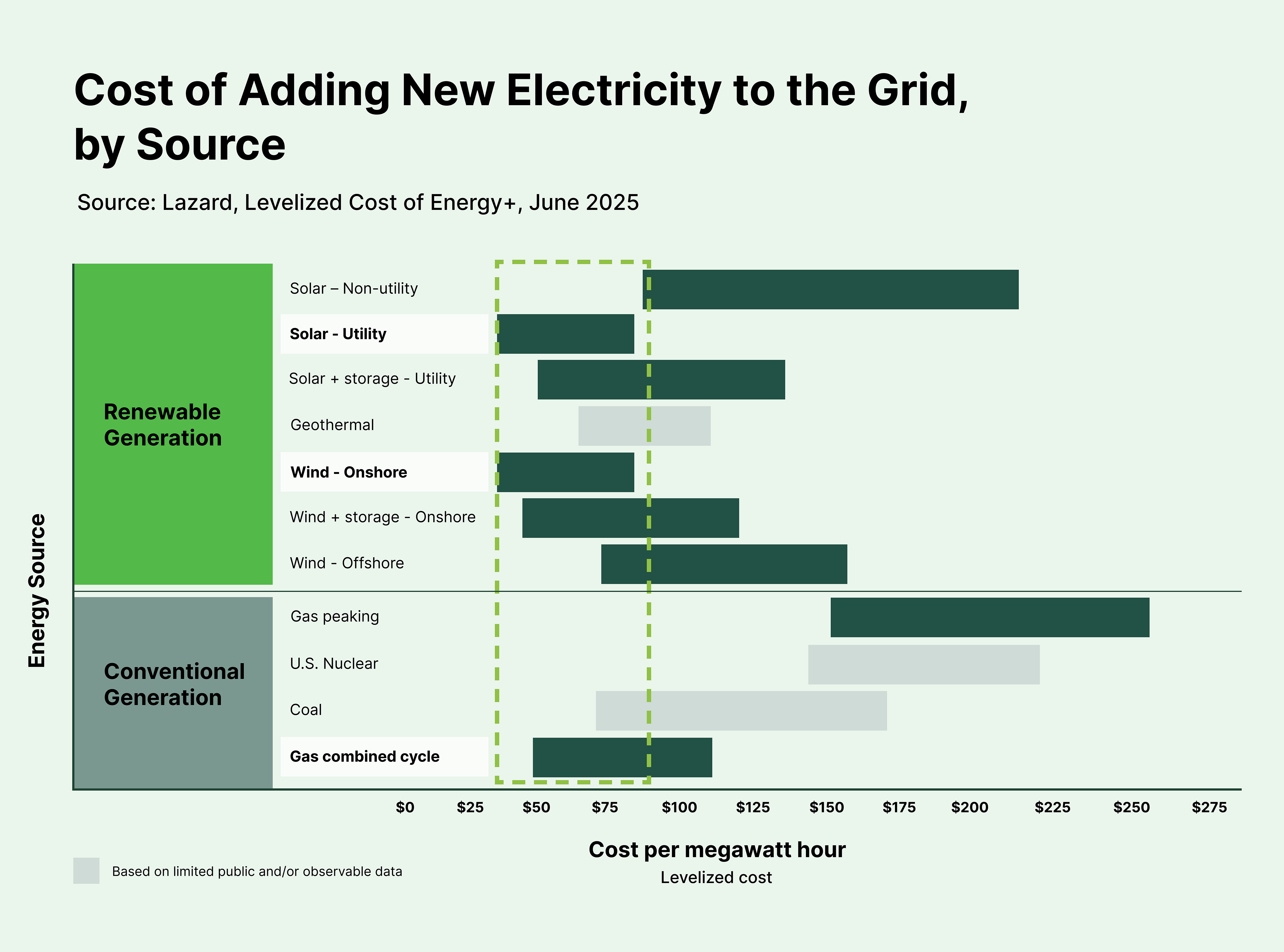 Click to enlarge. Utility-scale solar and onshore wind remain the most cost-effective forms of new-build energy generation on an unsubsidized basis. (Source: Lazard, Levelized Cost of Energy+, June 2025)
- Clean energy is quick to build. The typical construction time for utility-scale solar is 15 months. For wind, it’s as short as 18 months. But for a gas-fired plant, it’s two years (and given the recent gas turbine shortage, likely longer), and for a new coal-fired plant, it’s five years. When fossil fuel-powered electricity plants do get built, it’s thanks to explicit financial handouts like tax breaks or implicit subsidies that protect the industry from competition and disincentivize energy efficiency improvements. It is this unfair advantage that explains why, in spite of all scientific and economic reason, there are now plans to massively expand our nation’s gas pipeline network (with a climate footprint equivalent to up to half our current emissions) to feed new power plants and gas export terminals; build new oil export terminals; fast-track new coal mines; open vast amounts of public land to fossil fuel production; and expand our capacity to manufacture plastics and petrochemicals.
- Clean energy is growing exponentially. Renewables provided more than a quarter of the United States’ electricity over the last year, with that share increasing every year since 2013. Battery storage, which has provided more than a quarter of electricity in the evening in California recently, grew by more than 75 percent over the last year, and is expected to keep expanding rapidly. Demand for oil and gas as fuels, by contrast, is expected to peak around the end of the decade, and despite America’s record-breaking oil and gas production, oilfield employment is on the decline. The clean energy sector is the engine of future job growth, employing more people than fossil fuels worldwide and growing in the United States, where clean energy comprises 40 percent of energy sector employment.
- Clean energy is popular with both left and right. A majority of Americans think the growth of solar and wind should be a higher priority than fossil fuels, and also believe that restrictions on greenhouse gas emissions should be expanded or maintained. Ninety-three percent of Democrats and 73 percent of Republicans want the nation to “be a world leader in developing clean energy.” Meanwhile, polling shows the fossil fuel industry is unpopular. A majority of self-identified MAGA voters in Western states oppose measures to increase oil and gas production on public land, and more than 70 percent oppose the use of eminent domain—which allows the government to force private landowners to hand over their property—to build pipelines. Nationwide, a majority of Republicans support requiring oil and gas corporations to pay for a share of the costs for climate-related damages.
David vs. Goliath
Oil and gas’s dominance over American life can feel like a David vs. Goliath story. Yet despite the odds, recent examples of pushback in red, blue, and purple states show that the Davids have more power than we might think.
South Dakota: On the same day that South Dakota’s voters overwhelmingly supported President Donald Trump in last November’s election, they also passed a law letting communities retain the right to protect their land from proposed pipelines. Then in the spring, the state’s Republican governor Larry Rhoden signed a law limiting the use of eminent domain to secure land for carbon pipeline projects. At the heart of this debate is a pipeline that would transport carbon dioxide from Iowa to Nebraska, where it would be used to increase the productivity of older oil and gas wells. This process, called “enhanced oil recovery,” is subsidized by the federal government.
Pennsylvania: Constraints on the industry in Pennsylvania are a big deal, as the state produces 5 percent of the world’s gas, more than all but four countries: the United States, Russia, Iran, and China. And yet Cecil Township, which voted 60 percent for President Trump, passed a municipal ordinance in November banning oil and gas drilling within 2,500 feet of homes and schools due to the mounting evidence that fracking exposure is linked to deadly disease. The following month, Democratic Governor Josh Shapiro filed suit against the entity, known as PJM, that determines how much consumers pay for electricity in the region. Nearby states joined the suit, which was settled in April and is projected to save consumers $21 billion on utility bills over the next two years. This saga is ongoing, however. In July, a bipartisan group of 10 governors expressed frustration that PJM is still not quickly adding enough new cheap electricity to the grid, and rising electricity bills are hurting consumers. Given its cost advantage and speed to market, clean energy is the solution.
New York and South Carolina: In December, Governor Kathy Hochul of New York signed a law holding the oil and gas industry responsible for $75 billion in damages from planet-warming pollution. Over the last decade, state and municipal leaders around the country have launched similar legal challenges. Many have been led by Democratic politicians, but the Republican mayor of Charleston, South Carolina, has defended a lawsuit over immediate climate risks like flooding. A judge recently dismissed Charleston’s case; it is not yet clear whether the mayor will mount an appeal.
Louisiana: In April, a jury held Chevron responsible for damaging Louisiana’s coast, levying a fine of $745 million. The state’s Republican attorney general, Liz Murrill, has backed this lawsuit and 43 similar pending suits, even though they are contrary to the White House’s agenda of “unleashing America’s domestic energy production.” The combined impact of these suits could be massive. Also in April, the Fifth U.S. Circuit Court of Appeals in New Orleans —not considered a liberal court—ruled that a lawsuit alleging racial discrimination in the pattern of zoning for petrochemical plants in “Cancer Alley” can proceed. This is a procedural victory, but still heartening given recent attacks on environmental justice.
Virginia: This spring, the Pittsylvania County board of supervisors resoundingly rejected a rezoning application for the construction of a 3.5 gigawatt gas-fired plant to power a massive data center, after pushback from residents concerned about their water, air, and land. The project would have been the second largest power plant in the country. The decision delays the project’s start for at least a year, if not indefinitely. Just five months earlier, President Trump won this county with 71 percent of the vote.
Illinois: Over the summer, the state’s Democratic governor, J.B. Pritzker, signed a law with strong bipartisan support banning the storage of carbon dioxide under the Mahomet Aquifer, the main source of drinking water for almost a million people. The industry argues that carbon storage, which is subsidized by federal tax credits, will make oil and gas climate friendly. Illinois is home to the nation’s first storage site permitted by the Environmental Protection Agency, which began leaking last fall. Carbon dioxide leaks can contaminate groundwater and cancel out any potential climate benefit from carbon storage.
Florida and Texas: In June, the Republican governor of Florida, Ron DeSantis, signed into law a ban on drilling in the Apalachicola River basin to protect water and ecosystems; there has also been significant bipartisan opposition to offshore drilling in the Southeast. That same month in Texas, Governor Greg Abbott, also a Republican, signed a new law requiring oil and gas corporations to plug wells that have been inactive for 15 years. This bipartisan legislation is the state’s first legislative step in years to address leaky old wells that pose safety and health hazards. Finally, the Supreme Court ended June by declining to hear two cases that would have limited people’s ability to sue corporations, one involving a $14.25 million judgment against Exxon for violating its Clean Air Act permits at its refinery in Baytown, Texas. Given that fossil fuel corporations seem to have trouble complying with environmental regulations, the Supreme Court may have given a slingshot to the Davids.
It’s no surprise that local initiatives are behind so many of the recent successes pushing back against oil and gas giants. After all, America’s democratic tradition rests upon people exercising their right to raise their voices about what’s going on in their own backyards. Community civic engagement remains a well-respected custom by both the left and the right, and is clearly an effective tool for constraining an industry that too often does not play by the rules. Now is the time to nurture this growing social movement, hiding in plain sight, so that clean energy can compete on a level playing field—for the benefit of all Americans.
Let’s keep reminding ourselves: David won.
The Funder Collaborative on Oil and Gas partners strategically with funders and local and national organizations to stop the expansion of the oil and gas industry. To learn more or work with us, contact Sarah Brennan at [email protected].
Read more stories by Sarah Brennan & Miranda Kaiser.