


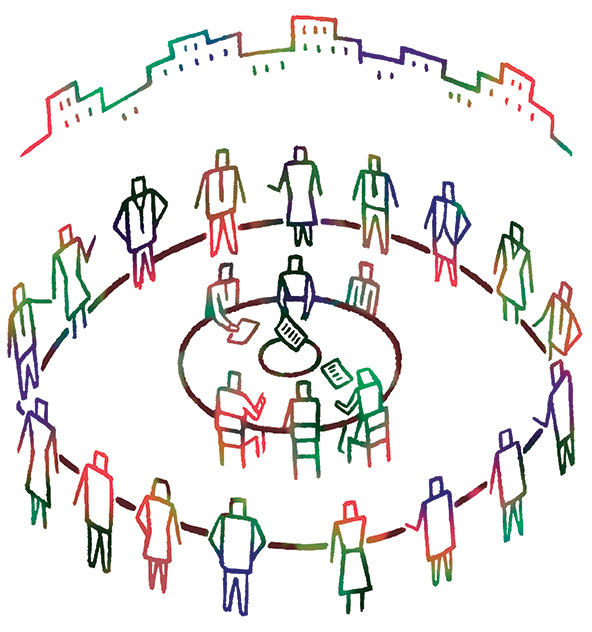
 (Illustration by Lewis Scott)
Public contracting is much closer to your daily life than you imagine. The roadway you drive, the airport you frequent, the school textbook your child studies, and the medicine that patients at public hospitals use are just a few examples of how public contracting affects you and billions of others across the globe. Public contracting has many costs, a significant amount of which is hidden. Every year, government authorities across the European Union spend 14 percent of the EU’s gross domestic product (GDP) on public contracting—more than €2 trillion ($2.24 trillion). Public contracting is the biggest corruption risk for foreign bribery, according to the Organisation for Economic Cooperation and Development. By 2030, close to $6 trillion could be lost annually to corruption, mismanagement, and inefficiency in the construction industry.
Civil society has been working for years to make public contracting transparent and accountable. In late 2017, Transparency International, along with its partners—Open Contracting Partnership (OCP); CoST—the Infrastructure Transparency Initiative; Hivos; and Article 19—launched the Clean Contracting Manifesto. The effort issues a call for action and articulates a common agenda for all actors interested in public contracting, including civil society, governments, and international organizations.
The manifesto calls for effective and meaningful participation by affected communities. Since the 1990s, experts have led civil society organizations’ efforts on public contracting, and they have prioritized legal and technical review of documents and included little community engagement. This has been a mistake. In the short term, the participation of citizens boosts the democratic legitimacy of civil society and thereby puts more pressure on government authorities. In the long term, the participation of citizens in monitoring public contracting increases their civic awareness and interest in public affairs, which can counteract today’s political apathy, especially among young citizens.
The work of ActionAid Italy to secure public participation in the Integrity Pacts (IP) project is one of many projects that Transparency International and its partners have been implementing across the European Union. Funded by the European Commission, IP brings together government officials, businesses, NGOs, and private citizens to try to establish a “civil control mechanism for safeguarding EU funds.” Specifically, it is working on 17 large public contracts totaling almost €1 billion ($1.1 billion) in 11 EU countries to ensure that they are transparent and in the public interest.
The IP initiative demonstrates how civic engagement can further the cause of clean public contracting. By helping to monitor public contracting, citizens can reclaim their ability to hold their government accountable. Through understanding the impact of public contracting on their daily lives, citizens become more aware of the need for transparency and accountability beyond this particular project and public contracting in general.
Citizens Discover Themselves
The experience of ActionAid Italy shows that civic engagement is possible even in the least favorable conditions. Italy is way below the EU average when it comes to perceptions of corruption—its citizens see the country as more venal than the citizens of other European countries see their own governments. Italy has suffered from the infiltration of organized criminal networks in public contracting, and Italians have fallen into political apathy as a result.
Between 2016 and 2021, as part of the IP effort, ActionAid Italy is monitoring the public contracting and implementation of two major tourism projects worth €2 million ($2.22 million) in Sibari, Italy. The organization is pursuing this with two partners: Gruppo Abele, which has more than five decades of experience with citizen engagement; and Monithon, an award-winning initiative to monitor the implementation of public policies in Italy. Together they have educated citizens on public contracting, taken them on field visits to see the locations of both projects, guided them on how to judge whether a public contract is clean and what red flags to look for, and arranged for direct meetings between citizens and government officials to discuss the process.
To prepare for citizen participation in the project, ActionAid Italy staffers did a lot of background work. They identified 300 local contacts who were interested in monitoring the public contracting process; spent a full week in the field meeting with people to explain the project and what citizen participants needed to do, and spent several hours on the phone conversing with interested people.
To overcome distrust and apathy, ActionAid Italy focused on building relationships and gaining trust. The process began by inviting citizens to discuss their struggles and share their stories. “The process of building relationships is long and requires patience,” says Cinzia Roma, community engagement manager at Gruppo Abele.
Citizens’ participation in the project took many forms. They attended webinars to build their knowledge base on public contracting and to know the project developments. They participated in “integrity schools,” which train the participants to put the knowledge gained in webinars into practice. The capacity-building program sought to provide citizens with a basic skill set that included knowledge of legal transparency requirements and how to work with open data, how to read and understand procurement documents, and how to use spreadsheets and employ social networks and crowd-mapping tools. Participants in integrity schools also met with government officials and voiced their concerns and asked questions about the public contracting process. They also took part in civic monitoring labs to pass on the information they gained about public contracting to fellow citizens. Finally, they participated in field visits to witness the real-life impact of their work.
To ensure the commitment of citizen participants in monitoring the implementation of the two tourism projects, ActionAid Italy developed civic monitoring regulations that define the relationship between them and participating citizens and outline their mutual obligations and responsibilities. The regulations included, for example, a confidentiality clause, since some of the public contracting documents accessed are restricted by an agreement between the government and ActionAid Italy and are not accessible for the wider public under Italy’s access-to-information law.
After their participation, citizens were interviewed on video to share their experiences. “Before participating in the project,” one member says, “I did not know how to be a real citizen.” Another participant says, “For years, citizens have perceived public works as useless and a mere waste of money, but by having access to the documents and with the Integrity Pacts methodology, one has a say in what is happening and what the government is doing.” These accounts suggest that the short-term value of their participation in the particular public contracting process may be outweighed by the long-term value of behavioral changes that get citizens involved in public affairs.
Democracy at Its Best
So far, the experience shows that engaging citizens in public contracting is worth it. In fact, participants have become more civically active generally. Some of them have started attending political rallies. Others participated in an ActionAid Italy campaign on gender-based violence and in a workshop on migrants and social inclusion. They are networking across Italy with other associations and groups committed to civic activism.
Participants have also moved on to monitor other public contracting projects. For example, two members are currently working on signing an agreement with the Calabrian municipality of Paola to monitor all public contracting projects. Other participants have drafted an agreement to be shared with the prefecture office of Cosenza, another city in Calabria, to adopt measures aimed at improving the quality of public services for citizens by, among other steps, applying Integrity Pact methods in public contracting. Citizen participants have shown increased willingness and capacity to monitor public contracting projects in the future. They have developed a growing confidence that uncovered wrongdoing will be investigated.
Creating avenues for direct interaction between citizens and public authorities is paramount. Such interactions and meetings add a human face to all the work that citizens do and offer an opportunity for both parties to build trust and collaborate. Through these meetings, citizens listen firsthand to public authorities about their plans and the challenges they face. Authorities also listen to citizens, who represent the wider constituency that will benefit from the project, about their concerns.
Managing the expectations and emotions of citizen participants is also important. Participants are volunteering their time and effort, and they expect the public contracting process to move forward as expected in a transparent and accountable way. When the public contracting authority did not give ActionAid Italy the opportunity to comment on the tendered documents in good time, in accordance with the Integrity Pact and monitoring agreement, citizens accused ActionAid Italy of protecting the authorities. The organization responded immediately to their concerns by hosting a webinar that clarified the terms of the agreement with the public authorities about their monitoring role and what ActionAid would do to alert authorities about any problems they found.
ActionAid Italy also organized social events. The legal and technical trainings on public contracting and the analysis of documents can be very boring. Informal gatherings can boost the overall experience and help participants to get to know each other and become comrades. It is essential to organize citizens into working groups so that they can collaborate well together and keep each other motivated.
By doing all this work, ActionAid Italy contributes to rebuilding the relationship between citizens and public authorities. This is about getting all those actors to speak and listen to each other, to trust each other, and to work collaboratively toward the public good. It represents democratic government at its best.
This article appeared in the Winter 2020 issue of the magazine with the headline: "Opening Public Contracting to Citizen Participation"
Read more stories by Mahmoud Farag.